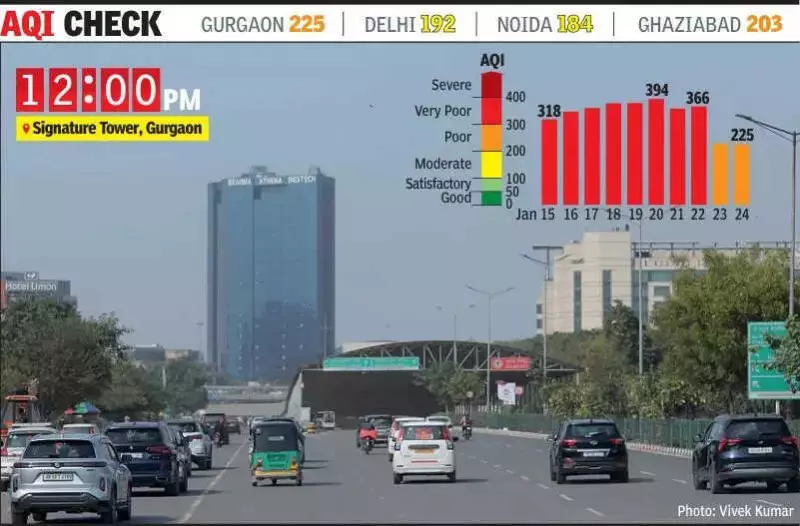
Gurgaon's Air Quality Stagnates in Poor Category Despite Brief Rainfall
Gurgaon's air pollution situation showed little improvement on Saturday, with the city's air quality index (AQI) registering at 228, maintaining its position in the 'poor' category. This reading represented a marginal change from Friday's AQI of 227, despite light rainfall occurring the previous day that offered only temporary respite.
Monitoring Stations Continue to Record Concerning Readings
Data from the city's air quality monitoring network revealed that three out of four stations persistently recorded air quality in the 'poor' range. Vikas Sadan reported the highest AQI at 240, closely followed by Sector 51 at 239, while Gwal Pahari logged a slightly lower but still concerning AQI of 204.
Forecasts from environmental agencies suggest that sustained improvement remains unlikely in the immediate future. Air quality is expected to fluctuate between the 'poor' and 'very poor' categories over the coming days, raising health concerns for residents.

Unfavorable Meteorological Conditions Hinder Pollutant Dispersion
According to the System of Air Quality and Weather Forecasting and Research (Safar), current meteorological conditions are not conducive to pollutant dispersion. Predominant surface winds are projected to blow from the northwest at speeds below 15 kilometers per hour during morning hours, weakening further to approximately 10 kilometers per hour in the afternoon.
The situation worsens during evening and nighttime hours, with wind speeds likely to drop to about 8 kilometers per hour, significantly limiting the dispersal of accumulated pollutants.
Technical Parameters Indicate Poor Ventilation Conditions
Safar's technical projections for Sunday include a maximum mixing depth of around 800 meters and a ventilation index of approximately 3,000 square meters per second. The agency noted that "a ventilation index below 6,000 square meters per second, combined with average wind speeds of less than 10 kilometers per hour, creates unfavorable conditions for pollutant dispersion."
Independent air quality expert Sachin Panwar explained that Friday's brief rainfall and slightly stronger winds provided only limited relief. "Rain and improved wind speeds helped flush pollutants to some extent, which became evident through better visibility. However, decreasing temperatures are now causing local pollutants to remain trapped near the surface due to inadequate vertical mixing," he observed.
Panwar added that "if rainfall continues for two to three consecutive days, we might witness more noticeable improvement. Otherwise, air quality will likely hover in the poor category as temperatures drop further and ventilation conditions deteriorate."
Particulate Pollution Levels Reach Alarming Heights
Particulate pollution measurements revealed particularly concerning data across monitoring stations. PM2.5 concentrations exceeded safe limits at all locations, with Gwal Pahari recording 337 micrograms per cubic meter, followed by Vikas Sadan at 324 micrograms per cubic meter and Sector 51 at 311 micrograms per cubic meter.
These readings dramatically surpass the World Health Organization's recommended 24-hour guideline of 15 micrograms per cubic meter for PM2.5 particles, which pose significant health risks due to their ability to penetrate deep into lungs and bloodstream.
PM10 levels presented equally worrying statistics. Both Gwal Pahari and Sector 51 recorded concentrations of 214 micrograms per cubic meter, while Vikas Sadan reported 196 micrograms per cubic meter. These values are several times higher than the WHO's safe limit of 45 micrograms per cubic meter for PM10 particles.
Regulatory Standards Consistently Breached
The severity of Gurgaon's air pollution crisis becomes even more apparent when comparing monitoring data against regulatory standards. The Central Pollution Control Board's annual permissible limits of 60 micrograms per cubic meter for PM2.5 and 100 micrograms per cubic meter for PM10 were breached at nearly all monitoring stations, highlighting the persistent nature of the city's air quality challenges.

This consistent violation of both international health guidelines and national regulatory standards underscores the urgent need for comprehensive air quality management strategies in Gurgaon, particularly as meteorological conditions continue to hinder natural pollutant dispersion mechanisms.