

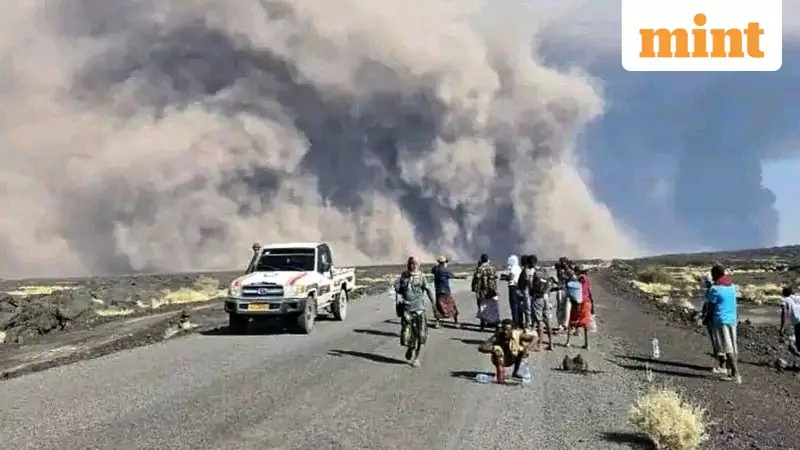
An unprecedented volcanic event in Ethiopia sent plumes of ash travelling thousands of kilometres, reaching the skies over northern India and sparking concerns about air travel and public health. The Hayli Gubbi volcano, located in Ethiopia's remote Afar region, erupted on Sunday for the first time in nearly 12,000 years.
Ash Cloud's Journey to Indian Skies
According to the Toulouse Volcanic Ash Advisory Centre (VAAC), the eruption did not produce lava but spewed thick smoke that rose to an astonishing 14 kilometres (nine miles) into the sky. This massive ash cloud began its transcontinental drift, reaching Indian airspace around 11 pm on Monday.
By Tuesday, satellite imagery confirmed its presence over several Indian states, including Gujarat, Delhi-NCR, Rajasthan, Punjab, and Haryana. The immediate concern was the potential impact on weather patterns and the already critical air quality in regions like Delhi.

IMD's Reassuring Update: The Threat Has Passed
For over 24 hours, the question on everyone's mind was whether Delhi and North India remained at risk. The India Meteorological Department (IMD) provided a conclusive answer in its latest update.
As of 10:30 pm on Tuesday, the volcanic ash plume had completely exited India. Mrutyunjay Mohapatra, the Director General of Meteorology at IMD, explained to ANI that the impact was confined to high altitudes. "The impact of this volcanic ash is being seen only in the upper troposphere, and it is affecting the flight operations. It has no impact on air quality and weather," he stated. He added that the ash was expected to move completely towards China.
Widespread Flight Disruptions and Local Impact in Ethiopia
The primary consequence for India was in the aviation sector. The IMD's earlier update noted the ash plume had risen to around 45,000 feet, directly disrupting high-altitude flight corridors. This led to widespread cancellations.
Air India cancelled 11 flights, mostly international, on Monday and Tuesday to inspect aircraft that may have flown through the affected zone. Another carrier, Akasa Air, cancelled flights to Middle Eastern destinations like Jeddah, Kuwait, and Abu Dhabi. At least seven international flights at Delhi's Indira Gandhi International Airport were cancelled on Tuesday, with a dozen more facing delays.
While India was spared from ground-level effects, the local population near the volcano in Ethiopia faced significant challenges. An official in the Afdera district, Abedella Mussa, reported that residents were coughing and mobile medical teams had been dispatched to provide services. Furthermore, Nuur Mussa, an official in charge of livestock, stated that animals were struggling as their water and grass were covered in ash.
The event served as a stark reminder of the interconnectedness of our global systems, where an eruption in a remote part of Africa can directly impact air travel in India within a matter of days.






