A Year After Baisaran Massacre, Pahalgam Tourism Still Feels the Pain of Closure
A motorable road winds its way from the picturesque town of Pahalgam through the majestic mountains, leading to a location known locally as CM’s Hut. From this point, a challenging trek of approximately six kilometers would normally take visitors to the breathtaking Baisaran valley. However, that journey now ends abruptly at the junction near CM’s Hut. This is the site where, one year ago, a horrific terrorist attack claimed the lives of 26 tourists and left 17 others wounded in what has become known as the Baisaran massacre.
The Invisible Barrier
At the junction, any attempt to proceed further along the muddy track is met with immediate intervention. Police and CRPF personnel appear swiftly, politely but firmly informing visitors that the valley remains strictly off-limits. Notably, there are no visible barricades or coils of concertina wire blocking the path. Authorities have deliberately avoided such overt security measures to prevent alarming tourists. Instead, the closure manifests in subtler, more pervasive ways.
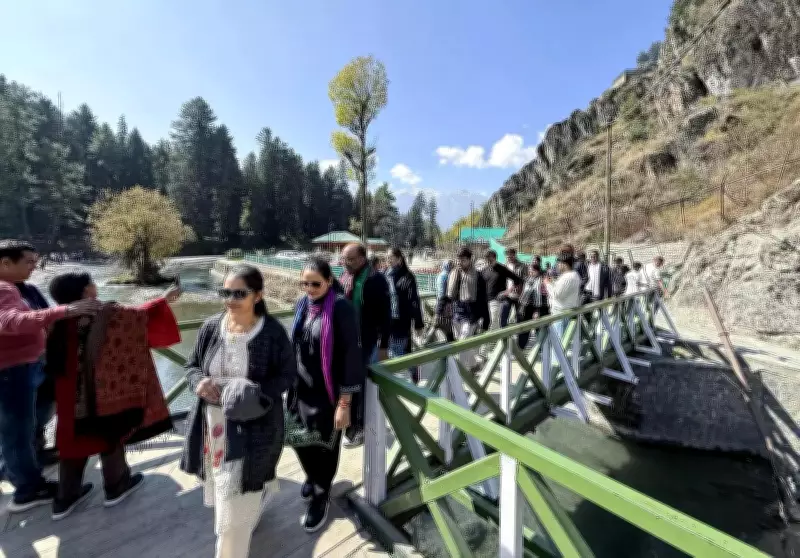
Local horse guides, known as ponywallahs, no longer venture beyond this checkpoint. They pause here, allowing tourists to capture photographs of the stunning Pahalgam bowl from this vantage point before turning back toward the town. The absence of the iconic trek to Baisaran has fundamentally altered the rhythm of tourism in the region.

Economic Despair in the Valley
Down in the bustling Pahalgam market, the economic impact is palpable. Pony owners are desperately trying to motivate visitors to at least make the trip up to the junction viewpoint. Abdul Waheed Wani, a 39-year-old union leader for the ponywallahs locally known as “Moulvi Sahab,” stands on the banks of the Lidder River, which bisects Pahalgam. He describes how the closure of Baisaran has disrupted the town’s entire ecosystem.
“People come here specifically to see Baisaran and the four surrounding valleys. When these areas are closed, they spend just a few hours in Pahalgam town before leaving,” Wani explains. He estimates that around 5,500 ponywallahs depend entirely on tourism for their livelihood. Following last year’s attack, work came to a complete standstill for nearly seven months. “There was nothing to do. Tourists have now started returning, but it is nothing like before,” he laments.
Wani adds that visitors frequently inquire about accessing Baisaran, making it “awkward to tell them it is closed.” He observes a visible change in the town’s atmosphere since the tragedy on April 22. “Earlier, we could move freely and go anywhere. Now there are red lines and accountability. You are held accountable if even your horse crosses a red line,” he states, highlighting the new security realities.
Voices from the Taxi Stand
Outside Pahalgam’s main taxi stand, a signboard optimistically declares: “Difficult roads often lead to beautiful destinations.” Yet, the scene tells a different story. While taxis fill the stand and drivers gather in groups chatting, only a handful of tourists are visible.
Inside the office, Ghulam Nabi Lone, who has led the taxi stand for decades, reflects on the profound changes. Dressed in a traditional pheran and sipping tea, he recounts his four-decade career, from driving a military jeep to owning three vehicles. However, he asserts he has never witnessed a situation as dire as the current one in Pahalgam.
“For seven months after the attack, everything came to a complete halt. Grass had grown on the roads,” Lone describes vividly. “Everything was shut. Only Chandanwari was open for some time. Now that too is closed due to road construction.”
Lone has actively raised the issue with officials, including in recent high-level meetings involving senior Army, civil, and police officers. “We told them these places, particularly Baisaran, need to open. Without them, tourists will not stay in Pahalgam,” he warns, repeating this crucial point multiple times. “If Baisaran opens, tourists will come.”

He also addresses a critical security narrative, clarifying that Baisaran had never been closed prior to the attack. “I had a ticketing contract there. Many urged me to tell the media it would remain closed, but I refused. I stated it was never shut before the attack, even in a security meeting,” Lone explains, dispelling rumors that the valley was opened by Jammu & Kashmir’s elected government shortly before the tragedy.
Uncertain Future
At the Pahalgam police station, officers confirm there is no clear timeline for reopening Baisaran valley. They note that Chandanwari has been closed for road construction, adding to the accessibility issues. Some roads in the region now literally lead nowhere, symbolizing the stalled recovery of this once-thriving tourist destination.
The closure continues to cast a long shadow over Pahalgam, with the local economy and community still grappling with the aftermath of the massacre. The hope for revival hinges on the elusive reopening of Baisaran, a valley whose beauty is now matched only by the sorrow of its recent history.