

In the vast tapestry of nature, parental sacrifice takes many forms. While human parents dedicate years to nurturing their children, the animal kingdom presents a far more startling and visceral version of this devotion. In a rare but fascinating phenomenon known as matriphagy, mothers provide the ultimate nourishment for their young: their own bodies. This extreme form of parenting, though unsettling from a human perspective, is a critical survival strategy for several species.
Spider Mothers: The Ultimate Sacrifice
The world of arachnids provides the most striking examples of matriphagy. Different spider species have evolved unique methods to ensure their offspring thrive, with the mother's body serving as the primary food source.
The Black Lace Weaver's Two-Course Meal
For the black lace weaver spider (Amaurobius ferox), the journey begins with a special provision. The mother produces a batch of unfertilized eggs specifically as the spiderlings' first meal. Once this initial nourishment is consumed, the hungry young turn to the mother herself, consuming her body to gain the essential nutrients needed in their early life stages.

The Australian Crab Spider's Single Chance
The Australian crab spider (Australomisidia ergandros) faces a biological constraint. She can lay only one egg sac in her lifetime and cannot produce supplemental feeding eggs. Consequently, her offspring have no alternative but to feed directly on her. This one-time, total sacrifice provides the entire energy reserve required for the next generation to survive and disperse.
The Desert Spider's Gradual Liquefaction
The process is more prolonged for the desert spider Stegodyphus lineatus. Initially, the mother regurgitates digested food for her babies. As her resources deplete, her body begins an internal breakdown. Her organs gradually liquefy, creating a nutritious fluid that the spiderlings consume. Over approximately two weeks, they ingest this liquid and then the remainder of her body, leaving behind nothing but an empty exoskeleton.
The African Social Spider's Communal System
In the African social spider (Stegodyphus dumicola), matriphagy is a collective effort. While the biological mother does produce a nutritious fluid for her young, leading to her death, she is not the only one who contributes. Other adult females in the colony, such as sisters and cousins, can also be consumed by the hungry spiderlings. This creates a shared, communal system of nourishment that supports the entire group's offspring.
Beyond Spiders: The Case of the Hump Earwig
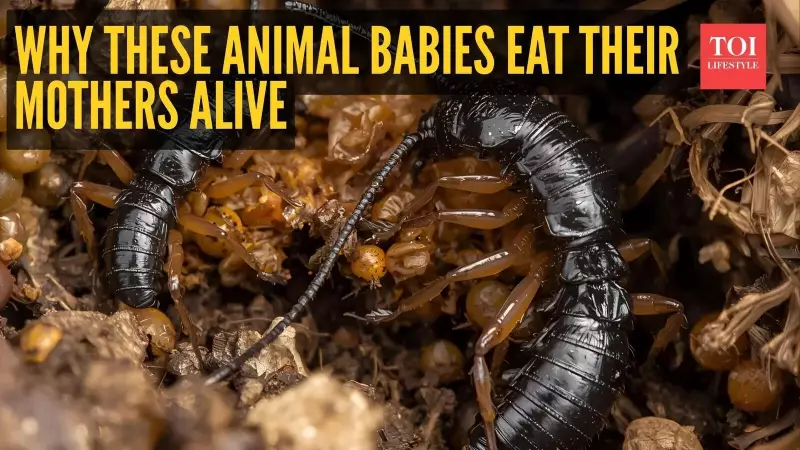
While spiders dominate this niche behaviour, matriphagy is also observed in at least one insect species. The hump earwig (Anechura harmandi) follows a direct and uncomplicated approach. The young earwigs simply consume their mother as their main source of sustenance, a straightforward part of their natural life cycle without intermediate steps like egg-laying or regurgitation.
Why Does This Harsh Reality Exist?
To human sensibilities, matriphagy seems brutal and emotionally charged. However, in the context of evolution, it is a highly effective survival strategy. For these species, the mother's body represents a guaranteed, rich source of nutrition during the offspring's most vulnerable period. This sacrifice dramatically increases the chances that her genes will be passed on, as the well-fed young are more likely to reach maturity. Without this ultimate provision, many would perish in the critical early days of life.
Nature does not adhere to a single rulebook for parenting. Survival strategies vary wildly—from decades of protection in some mammals to complete independence at birth in others. Matriphagy represents one of the most extreme ends of this spectrum. These examples serve as a powerful reminder that nature operates on instincts and evolutionary imperatives, not human emotions. What appears as a shocking act of violence is, in its own context, a profound act of ensuring continuity, demonstrating that the drive for species survival can manifest in ways that challenge our deepest understandings of care and sacrifice.






