Norway's 300-Year-Old Lime Barrels Unearth Urban Survival Secrets
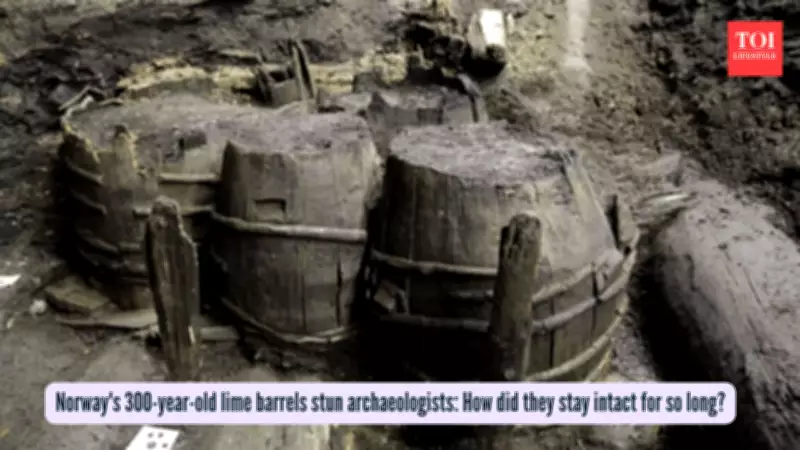
In the heart of Skien, Norway, archaeologists have uncovered a remarkable piece of history that tells a story of resilience and ingenuity. During routine water system upgrades on Torggata street, researchers from the Norwegian Institute for Cultural Heritage Research (NIKU) discovered three intact oak barrels dating back to the 17th century. These barrels, buried deep underground for over 300 years, contained slaked lime—a crucial building material for mortar used in masonry and construction finishes.
A Deliberate Preservation Strategy
The discovery is far from accidental. Builders in early modern Scandinavia intentionally buried these lime barrels to protect the material from Norway's freezing winter temperatures. By storing lime underground, they maintained its chemical properties, ensuring it remained workable when mixed with sand and water for construction. This practical adaptation was essential for urban survival in a challenging climate.
The preservation conditions were extraordinary. The lime created an oxygen-free, alkaline environment that prevented wood decay, allowing the oak barrels to remain nearly perfect after centuries underground. This natural preservation process is rare in archaeology and has provided researchers with an unprecedented look at historical building techniques.

Layers of History Beneath Skien
Beyond the barrels themselves, the excavation site reveals multiple historical layers that trace Skien's evolution as a trade hub. Stratigraphic reports from NIKU indicate that while the barrels date to the 1600s, lower layers at the site could be as old as the 9th century, potentially linked to Viking-era trade centers for Eidsborg whetstones.
The archaeological context tells a story of repeated destruction and rebuilding. Compacted lime at the base of the barrels and debris at the top suggest they were reused multiple times following devastating fires that frequently ravaged Skien. These barrels likely played a vital role in the town's recovery efforts after such disasters.
From Practical Tool to Museum Treasure
What began as a simple storage solution has now become a significant archaeological find. NIKU researchers describe the discovery as a standout example for understanding early urban building practices. The barrels were found alongside a large wooden rammer in dense lime deposits, providing a complete picture of historical construction methods.
Experts are now exploring conservation options to prepare these artifacts for museum display, where they can educate the public about Norway's architectural heritage. The find highlights how ordinary people in Scandinavia engineered urban life long before modern tools, using practical wisdom to overcome environmental challenges.
Connecting Centuries of Urban Development
This discovery bridges multiple historical eras, from Viking trade networks to 17th-century urban expansion. It demonstrates how cities like Skien functioned as living puzzles, constantly adapting to fires, climate, and economic changes. The lime barrels serve as tangible evidence of the clever strategies early modern Scandinavians employed to build and maintain their communities.
Through careful archaeological detective work blending science with historical analysis, researchers continue to uncover how practical innovations shaped Norway's urban landscape. These quiet artifacts—sturdy oak barrels holding centuries-old lime—speak volumes about human resilience and the enduring legacy of smart building practices in the face of adversity.