

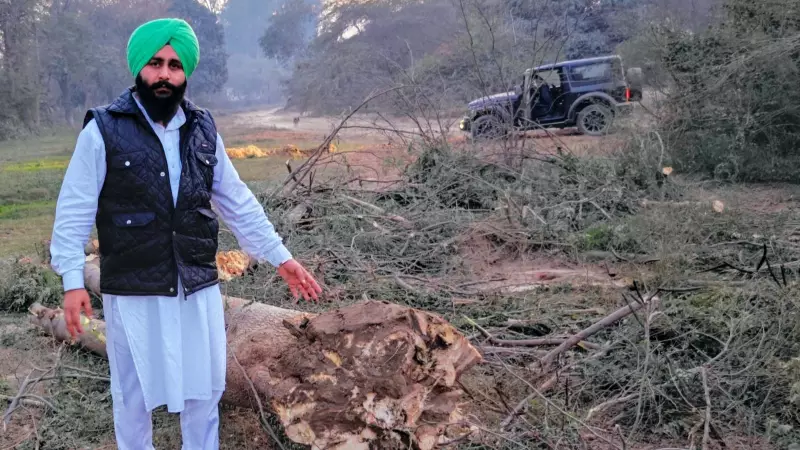
Amritsar Canal Tree Felling Probe: 80 Trees Axed Illegally, Second Incident in a Month
Authorities in Punjab have launched a formal investigation after approximately 80 trees were discovered to have been illegally felled along the Upper Bari Doab Canal near Bohru village in Amritsar. This alarming incident marks the second occurrence of unauthorized tree cutting in the district within just one month, raising serious environmental and legal concerns.
Violation of High Court Directives
Activists and environmental groups have expressed grave dismay, highlighting that the tree felling directly contravenes explicit orders from the Punjab and Haryana High Court. In December 2025, the court imposed a comprehensive ban on tree cutting across Punjab, mandating that no trees be removed without prior judicial approval.
Sarabjit Singh Sonu Jandiala, a prominent social activist who visited the site on Wednesday, stated, "It is deeply regrettable that those meant to protect nature have become the killers of trees. These trees not only sustain the environment but also serve as homes for countless birds and wildlife." He further pointed out that a similar incident near Tarawala Pul in Amritsar city last month had already triggered investigations.

Preliminary Findings and Official Response
Preliminary findings from the Canals wing of the Water Resources Department indicate that the trees were cut down beyond the permissible scope for road construction. Parveen Kumar, Sub-Divisional Officer of the Canal department, revealed, "The contractor claimed to have the Forest Department’s permission to cut the trees for road construction. However, our initial probe has found that the trees were felled away from the road and were not required to be cut."
The department has now initiated a detailed probe and is seeking clarifications from the Forest Department regarding the permissions granted. This development underscores potential lapses in oversight and coordination between governmental bodies.
Activist Demands and Administrative Action
In response to the incident, the Akal Seva Foundation, along with activist Jandiala, has submitted a formal written complaint to Amritsar’s Deputy Commissioner Dalwinderjit Singh. The complaint demands:
- Strict legal action against those responsible for the illegal tree felling.
- The formation of a new high-level probe committee to ensure an impartial and thorough investigation.
- Immediate administrative measures to uphold the High Court's orders and prevent future violations.
Copies of the complaint have also been forwarded to the Punjab Chief Minister, the Governor, the National Environment Commission, and Amritsar MP Gurjeet Singh Aujla, urging swift intervention.
Recurring Environmental Lapses
This incident follows a similar pattern observed last month near Tarawala Pul, where large-scale tree felling along the same canal was reported. An inspection by Preetinder Singh Bains, Sub-Divisional Magistrate of Amritsar-I, on December 24, 2025, confirmed the unauthorized cutting, leading to an official letter (No. 1392) on December 31 notifying senior authorities to take appropriate action.
Jandiala remarked, "Previously, a case of tree felling near Tarawala Pul in collusion with a private company had surfaced, leading to an investigation which Amritsar’s Deputy Commissioner handed over to a high-level committee. The recurrence of such an incident along the Bahoru canal stretch has now raised questions about the administration’s functioning."
Broader Implications and Community Concern
The repeated incidents of illegal tree cutting in Amritsar have sparked widespread concern among residents and environmental advocates. The indiscriminate felling of old and dense trees along the Upper Bari Doab Canal, which leads towards Guru Pind Bahoru, not only violates legal directives but also poses a significant threat to local biodiversity and ecological balance.

As the probe progresses, all eyes are on the administration to demonstrate accountability and enforce environmental protections rigorously. The outcome of this investigation will be crucial in determining whether such violations can be curtailed and the High Court's mandates effectively upheld in the region.





