

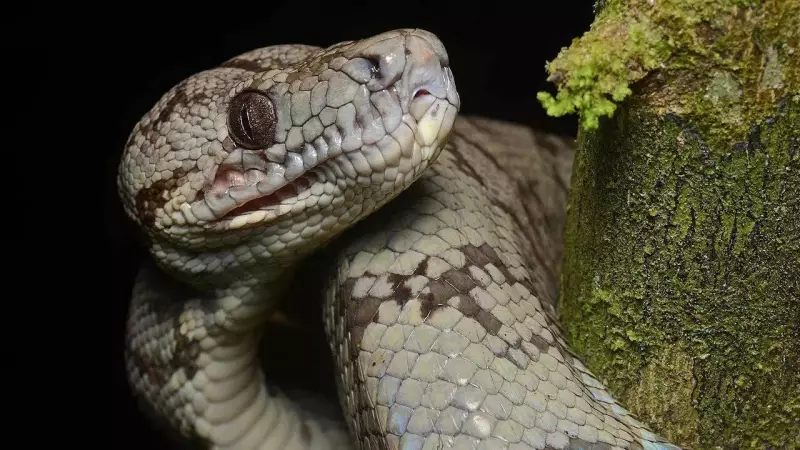
Deep within the Amazon rainforest, a remarkable serpent has evolved perfect adaptations for life in the treetops. The Amazon tree boa, known scientifically as Corallus hortulanus, represents nature's engineering at its finest, with recent research revealing how its skin microstructure enables extraordinary climbing abilities and hunting prowess.
The Arboreal Specialist's Physical Marvels
The Amazon tree boa displays a slender, muscular build typically measuring between 1.2 to 1.8 metres in adulthood. Its broad head features large, forward-facing eyes perfectly suited for nocturnal hunting, while dramatic color variations ranging from bright yellow and orange to deep brown and gray provide excellent camouflage in the rainforest's complex layers.
Among its most impressive features are heat-sensing pits located on upper labial scales, allowing the snake to detect warm-blooded prey even in complete darkness. The boa's prehensile tail acts as a secure anchor on branches, freeing the body for movement and striking. This slender physique proves ideal for navigating through vines and narrow tree limbs rather than ground-based combat.

Skin Microstructure: Nature's Friction Control System
A groundbreaking study published in the Journal of Comparative Physiology has uncovered how the snake's skin microstructure varies significantly across different body regions. Dorsal and lateral scales feature net-like micro-ornamentation, while ventral scales display ridges running parallel to the body's length.
This design creates what scientists call frictional anisotropy. The ventral scales demonstrate remarkably low friction when sliding forward along branches with a coefficient of approximately 0.191, while dorsal and lateral scales show higher friction coefficients between 0.323 and 0.331. This sophisticated system allows efficient forward movement while preventing sideways slipping on smooth or inclined surfaces.
Mastering the Canopy Hunt
As an ambush predator, the Amazon tree boa selects strategic perches where potential prey regularly pass. It combines its camouflage, elevated position, and heat-sensing capabilities to detect birds, small mammals, and reptiles. When prey approaches within striking distance, the snake launches a lightning-fast attack, grasps the animal, and delivers light constriction before swallowing it whole.
Diet varies with age: juveniles typically consume smaller prey like lizards and frogs, while adults graduate to birds, bats, and rodents. Operating exclusively in the canopy allows this boa to access prey unavailable to ground-based predators, making it a specialist hunter in three-dimensional space.
Ecological Significance and Conservation Implications
The research demonstrates how skin surface structure directly influences locomotion and ecological behavior. By analyzing skin regions using scanning electron microscopy and measuring friction across different surface roughness levels, scientists confirmed that ventral scales optimize forward motion and grip, while dorsal and lateral scales provide higher friction in other directions.
These adaptations prove crucial for survival in rainforest vegetation where slipping or inefficient movement could mean failed hunts or increased predation risk. Ecologically, these specialized climbing abilities enable the snake to exploit canopy niches, influencing bird and small mammal populations and contributing to broader ecosystem dynamics including seed dispersal and insect population regulation.
Although currently classified as Least Concern for conservation, the Amazon tree boa faces threats from habitat loss, fragmentation, and climate change. Understanding its mechanical adaptations helps conservationists assess resilience to changing habitats, particularly if canopy structure or branch availability alters significantly.
Beyond conservation, studying the snake's scale microstructure offers valuable insights for biomimetic design in engineering and robotics, connecting rainforest biology with technological innovation and highlighting the importance of preserving these complex ecosystems.






