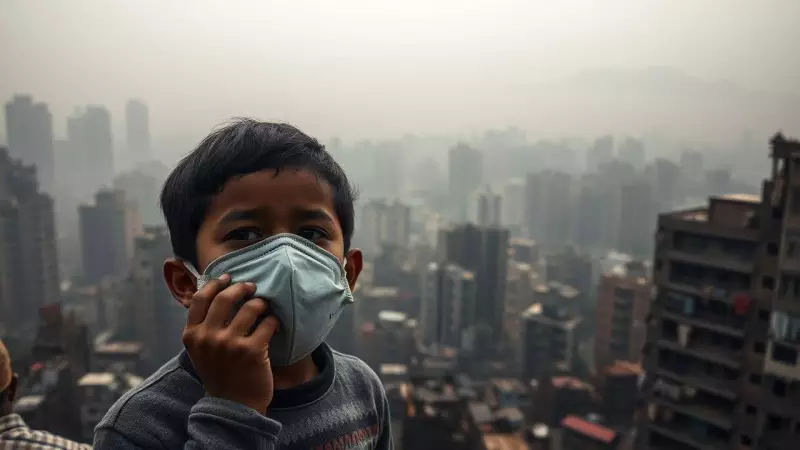
A recent comprehensive analysis has delivered a stark warning about India's air quality crisis, revealing that chronic pollution is a deep-seated, structural issue plaguing a vast number of urban centres. The study indicates that nearly 44 percent of Indian cities are suffering from persistently poor air, driven by constant emission sources rather than temporary spikes.
Widespread Pollution and Inadequate Coverage
The findings, released by the Centre for Research on Energy and Clean Air (CREA), are based on satellite data assessing dangerous PM2.5 particles across 4,041 cities over five recent years from 2019 to 2024, excluding the pandemic year of 2020. The data shows that at least 1,787 cities consistently breached the national annual PM2.5 standard during this period.
This widespread problem highlights a critical gap in policy response. Currently, the government's flagship National Clean Air Programme (NCAP) covers only 130 cities. Alarmingly, just 67 of these NCAP cities overlap with the identified chronically polluted areas. Consequently, the analysis notes that NCAP addresses a mere 4 percent of India's chronically polluted cities, leaving hundreds of urban areas without targeted action plans.

Most Polluted Cities and State-Wise Breakdown
The report also listed the most polluted cities for 2025 based on projected data. Byrnihat in Assam emerged as the worst-affected, with an annual PM2.5 concentration of 100 µg/m³. It was followed closely by the national capital Delhi (96 µg/m³) and its neighbour Ghaziabad (93 µg/m³).
Other cities in the top ten most polluted list include Noida, Gurugram, Greater Noida, Bhiwadi, Hajipur, Muzaffarnagar, and Hapur. On a larger scale, Uttar Pradesh has the highest number of non-attainment cities at 416. It is followed by Rajasthan, Gujarat, Madhya Pradesh, Punjab, Bihar, and West Bengal.
Furthermore, Delhi also tops the list for PM10 pollution, with an annual average three times higher than the national standard. The ground situation remained concerning, with cold weather and smog pushing air quality in parts of Delhi into the 'poor' and 'very poor' categories recently.
Gaps in Monitoring and the Path Forward
The CREA report pointed out significant infrastructural shortcomings in the fight against pollution. It revealed that 28 cities under NCAP still do not have continuous air quality monitoring stations, hampering accurate, real-time assessment and action.
Commenting on the findings, CREA India analyst Manoj Kumar emphasised that strengthening air quality governance through targeted, science-based reforms is the only viable way forward. He stressed several urgent measures needed to tackle the crisis effectively:
- Prioritising the reduction of PM2.5 particles.
- Revising the NCAP list of non-attainment cities to reflect the true scale of the problem.
- Adopting an airshed-based management approach, as pollution does not respect city boundaries.
The analysis underscores that India's air pollution challenge is not limited to a few metropolitan areas but is a pervasive national issue requiring a dramatically scaled-up and more inclusive response from policymakers.