The Notorious Corpse Flower: Nature's Botanical Marvel
In the shadowy depths of Southeast Asia's tropical rainforests, a botanical wonder captures attention for both its immense size and repulsive fragrance. Commonly dubbed the 'corpse flower', Rafflesia arnoldii emits a potent odor reminiscent of decaying flesh when it blooms. This stench is not merely a quirk of nature but a clever evolutionary tactic for survival. Thriving on the dim forest floor where pollinators are scarce, the plant relies on flies attracted to the scent of rot to transfer pollen, ensuring its reproduction.
Unmatched in Scale: The World's Largest Single Bloom
While other plants like the titan arum or talipot palm may appear larger, their structures consist of clusters of smaller flowers. In stark contrast, Rafflesia arnoldii produces the largest individual flower on Earth, a singular bloom that can reach up to 1 metre in diameter and weigh nearly 11 kilograms. This distinction secures its unique botanical title, setting it apart from any other floral species.
A Striking Yet Unsettling Appearance
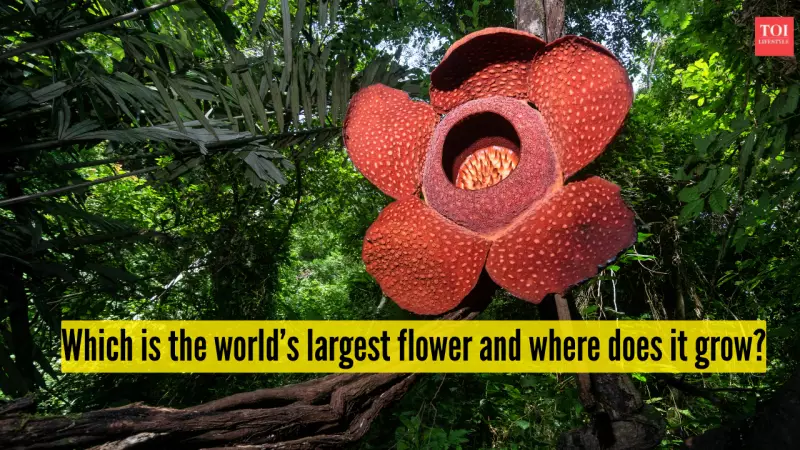
The visual impact of Rafflesia arnoldii is as memorable as its smell. The flower displays a reddish-brown hue, often maroon or dark brick in color, adorned with pale, wart-like spots. Its thick, fleshy petals possess a wrinkled texture frequently compared to raw or decaying meat, enhancing its eerie presence. When fully open, the bloom rests low on the forest floor, creating a dramatic and almost surreal spectacle amidst the dense rainforest foliage.

Habitat and Growth: A Parasitic Existence
Native to the rainforests of Sumatra and Borneo, Rafflesia arnoldii thrives in specific environmental conditions. It favors dark, moist forests with minimal sunlight and stable temperatures, but its survival hinges on a parasitic relationship. Unlike typical flowering plants, it does not grow independently in soil. Instead, it spends its entire lifecycle embedded within a host vine of the Tetrastigma genus. This dependency ties its range closely to these vines and the forest canopy, where it prefers the darkest areas. Due to its reliance on precise rainforest parameters, the plant's occurrence is localized and unpredictable, with blooming specimens being rare and scattered.
A Plant Unlike Any Other: Holoparasitic Nature
What makes Rafflesia arnoldii extraordinary is its lack of conventional plant structures. It possesses no visible leaves, stems, or roots, classifying it as a holoparasite that depends entirely on its host vine for water and nutrients. For most of its existence, the plant remains hidden, growing as a network of thread-like strands within the vine's tissues. It only becomes visible when ready to reproduce, forming a large, round bud on the host vine near ground level. These buds, sometimes called "knops" by researchers, can be massive, with the largest recorded specimen measuring 43 centimetres across in Sumatra.
The Smell of Decay and Reproductive Challenges
When the bud finally opens, it does so spectacularly, occasionally emitting a mild hissing sound. However, the fully opened bloom lasts only a few days, during which it releases its infamous rotting flesh odor. This smell plays a crucial role in pollination, attracting flies and insects that feed on carrion to facilitate pollen transfer. Reproduction is further complicated by the plant's dioecious nature, meaning individual flowers are either male or female. Successful pollination requires both types to bloom simultaneously and in proximity, a rare event given the plant's infrequent flowering and scattered distribution.

Rarity and Conservation Concerns
Despite being the world's largest single flower, Rafflesia arnoldii is paradoxically rare. Its small populations, narrow host vine dependency, and specific environmental needs make it highly vulnerable to disturbances. Habitat loss from deforestation and agricultural expansion poses significant threats, as these activities destroy both the plant and its ecological relationships. Additionally, human activities like harvesting and unregulated tourism have contributed to declines in some areas. Although not formally assessed on the IUCN Red List, its conservation status is a growing concern. In Indonesia, it holds national significance as one of the country's three national flowers, alongside white jasmine and the moon orchid, and is protected under presidential decree for its cultural and ecological importance.