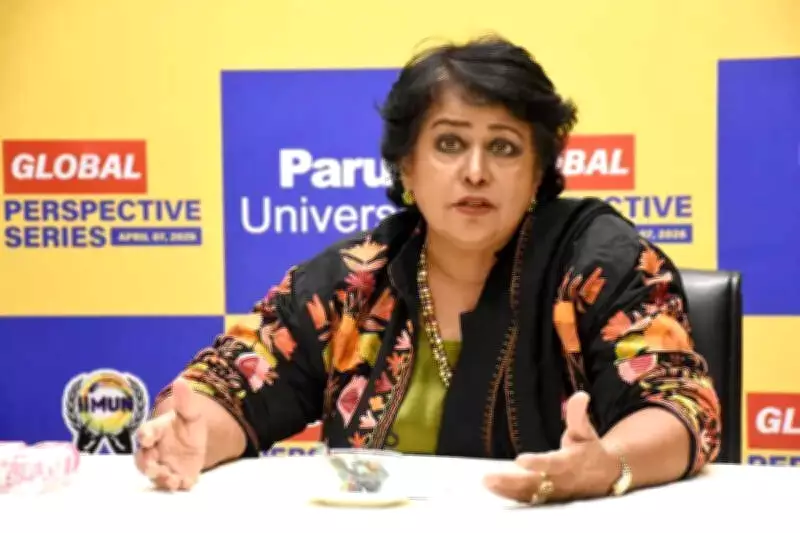
Vadodara: The world is entering a prolonged phase of geopolitical instability marked by shifting power equations, supply chain disruptions, and escalating conflicts, with the poorest nations likely to suffer the most, former Mauritius President and scientist Ameenah Gurib-Fakim said in Vadodara on Wednesday.
Address at Parul University
She was speaking at the Global Perspective Series organised by Parul University. Placing current developments in a historical context, Gurib-Fakim said the last major global power-sharing arrangement emerged after World War II in 1945. "What we are witnessing now is a significant shift with the rise of Asia, effectively ending a 500-year-old global order. Such transitions are rarely peaceful," she said.
Control Over Natural Resources
She underlined that control over natural resources lies at the heart of many ongoing conflicts. "There is a concerted push to control resources, while countries that possess them are resisting. These are not isolated incidents but part of a broader geopolitical realignment," she said, adding that the effects are visible even in countries like India and Mauritius.

Supply Chain Disruptions
Highlighting the deep interdependence of global systems, she pointed to disruptions in supply chains spanning fuel, fertilisers such as urea, and food. "Even if conflicts were to end today, their impact would persist for at least a decade. The scale of the crisis is far greater than we currently comprehend," she said.
She warned that food security could emerge as a major global concern, noting that disruptions in critical trade routes like the Strait of Hormuz could drive up freight costs, ultimately impacting consumers—especially the poor.
Call for Restraint
Calling for restraint, Gurib-Fakim urged global leaders to act responsibly. "We need sanity on all sides, but I do not see it prevailing," she said, expressing concern over the weakening of multilateral institutions such as the United Nations and questioning whether the world is drifting towards a 'might is right' order.
BRICS and India-Mauritius Ties
On BRICS, she noted that while the grouping's combined GDP now surpasses that of the G7, internal differences could limit its effectiveness. Describing India-Mauritius relations as deeply rooted, she said Mauritius looks to India for diversification and capacity building, while also positioning itself as a gateway to Africa's 2.8-billion-strong market.
Climate Change Threat
She also flagged climate change as an existential threat to island nations, warning that damage to coral reefs could have severe consequences for marine biodiversity and livelihoods.