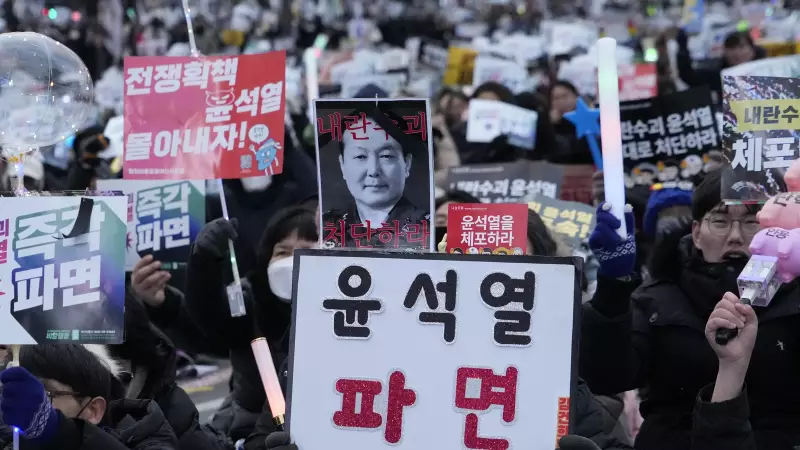
In a powerful and symbolic statement marking a significant anniversary, South Korea's main opposition leader has declared that the nation's journey to fully reckon with its authoritarian past is far from over. Lee Jae-myung, head of the Democratic Party of Korea, asserted that the "cleanup" from the era of martial law remains incomplete, casting a spotlight on the country's ongoing struggle for historical justice and democratic consolidation.
A Solemn Declaration on a Historic Anniversary
The remarks were delivered by Lee Seok-gu, the party's secretary general, who was representing Lee Jae-myung at a commemorative event in the city of Gwangju. The occasion was the first anniversary of President Yoon Suk Yeol's administration. The location was deeply significant: Gwangju is the hallowed ground of the 1980 pro-democracy uprising, a brutal crackdown that stands as a dark chapter from the nation's period of military rule.
Lee Seok-gu conveyed Lee Jae-myung's firm stance, emphasizing that the tasks of restoring honor to the victims of past authoritarian regimes and achieving a complete societal reckoning are urgent national priorities. "The cleanup of the remnants of martial law has not been completed," the message stated, framing this unfinished work as a cornerstone for South Korea's future as a mature democracy.

The Unhealed Wounds of the Gwangju Uprising
Central to this call for action is the May 18 Gwangju Democratic Uprising of 1980. During this event, citizens rose against the new military junta led by Chun Doo-hwan, only to be met with deadly force. The official death toll remains a point of contention, but it is widely accepted that hundreds were killed. For decades, the uprising was falsely labeled as a communist-inspired riot by successive authoritarian governments.
The legacy of Gwangju has been a litmus test for South Korea's democratic progress. While later democratic governments have officially recognized the uprising as a pro-democracy movement and offered apologies, many victims and their families feel that full justice and societal understanding have not been achieved. Lee Jae-myung's statement directly taps into this sentiment, suggesting that the current administration under Yoon Suk Yeol needs to do more to address these historical grievances.
Political Divisions and the Path Forward
The opposition leader's comments are not made in a political vacuum. They arrive at a time of intense partisan division in South Korea. The conservative administration of President Yoon and the liberal opposition led by Lee are frequently at odds over issues ranging from foreign policy to historical interpretation. By highlighting the "unfinished cleanup," Lee is drawing a clear ideological line, positioning his party as the true guardian of democratic values born from struggles like Gwangju.
This political narrative serves multiple purposes. It mobilizes the Democratic Party's base, which holds the memory of the democratic movement dear. It also applies pressure on President Yoon's government to take a more proactive and clear stance on historical issues, potentially creating a rift with more conservative factions that may view the past differently. The call implies that true national unity and advancement cannot be realized without first confronting and resolving the shadows of history.
The message from Lee Jae-myung, delivered in the heart of Gwangju, is a potent reminder that South Korea's remarkable economic and democratic transformation is built upon a foundation of sacrifice. It argues that the work of building a just society is continuous. As the nation moves forward, the demand to fully reconcile with the trauma of martial law and the Gwangju Uprising remains a powerful and unresolved force in its political and social landscape.