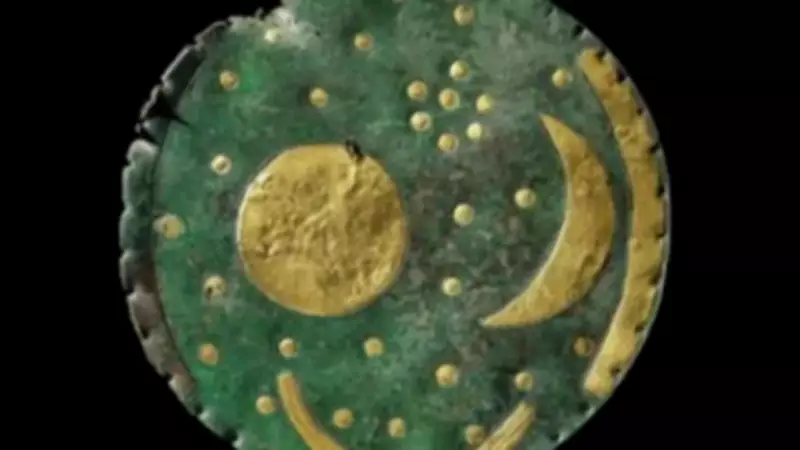
Some archaeological discoveries possess the power to halt you in your tracks, compelling a moment of profound reflection. The Nebra Sky Disc undoubtedly belongs to this rare category. Unearthed in Germany, this remarkable 3,800-year-old bronze disc presents a deceptively simple appearance at first glance—a circular bronze plate adorned with intricate gold inlays depicting stars and celestial bodies. Yet, experts now propose it might represent humanity's earliest known "astronomy application," a sophisticated tool that Bronze Age societies potentially employed to interpret the heavens, monitor seasonal changes, and possibly coordinate religious ceremonies.
The Astonishing Discovery on Mittelberg Hill
The disc was discovered under dramatic circumstances on Mittelberg Hill, near Nebra in Saxony-Anhalt, Germany, back in 1999. According to reports, treasure hunters initially excavated it illegally alongside other artifacts including swords, axes, and bracelets. Following a police recovery operation, archaeologists took charge of this extraordinary find. Radiocarbon dating techniques suggest the disc was crafted between 1800 and 1600 B.C., placing it firmly within the European Bronze Age.
Its specific placement near a hilltop with expansive sky views appears significant. Experts speculate it might have been used outdoors, possibly functioning as both a practical astronomical instrument and a spiritual object. The disc's construction—bronze with gold inlays—displays a crescent moon, what might be a full moon or sun, and thirty-two distinct stars. Seven of these stars seem to deliberately represent the Pleiades star cluster, while other markings potentially indicate solstices.

A Sophisticated Celestial Calendar and Agricultural Guide
Researchers increasingly believe the Nebra Sky Disc served as an advanced celestial calendar. By tracking astronomical events like solstices, it could have guided agricultural communities on optimal times for sowing and harvesting crops. The craftsmanship reveals remarkable precision—tiny gold pieces were meticulously placed according to a deliberate design, not randomly arranged. This challenges modern assumptions about ancient cognitive capabilities, demonstrating that Bronze Age Europeans possessed sophisticated observational, calculative, and recording skills regarding celestial phenomena.
Evolution of the Disc Through Multiple Phases
Detailed studies reveal the disc underwent several modifications over generations. Initially featuring just the moon and stars as primary elements, later phases saw the addition of gold arcs that experts interpret as marking horizon points for summer and winter solstices. A third golden arc appeared subsequently, possibly representing a "solar boat" mythological concept. Finally, holes were added around the disc's perimeter, perhaps for ceremonial mounting during rituals.
This evolutionary pattern suggests a living tool that accumulated knowledge across generations. One can envision ancient people holding it aloft, aligning it with solar and stellar positions, experiencing the empowerment that comes with celestial understanding. Beyond practical utility, the disc likely symbolized authority—possibly owned by chieftains or priests whose comprehension of heavenly patterns conferred social power. The use of precious metals further emphasized its significance, transforming it from mere decoration into what was probably considered a sacred object.
Alignment With Natural Landscapes and Enduring Legacy
Adding to its intrigue, the disc's arcs align with nearby mountain ranges when positioned correctly, corresponding to sunset positions during solstices. Imagine Bronze Age communities witnessing these annual alignments, tracking solar and stellar movements that governed their agricultural cycles and cultural rhythms.

The Nebra Sky Disc represents a fascinating convergence of science, mythology, and human curiosity. Nearly four millennia after its creation, it continues to inspire awe and wonder. More than just a metal artifact, it serves as a window into ancient minds that gazed upward at the night sky with the same fundamental curiosity that drives modern technological innovation. In many respects, this might be considered humanity's first "application"—ancient technology in its most elemental, starlit manifestation, connecting us across centuries to our ancestors' cosmic contemplations.