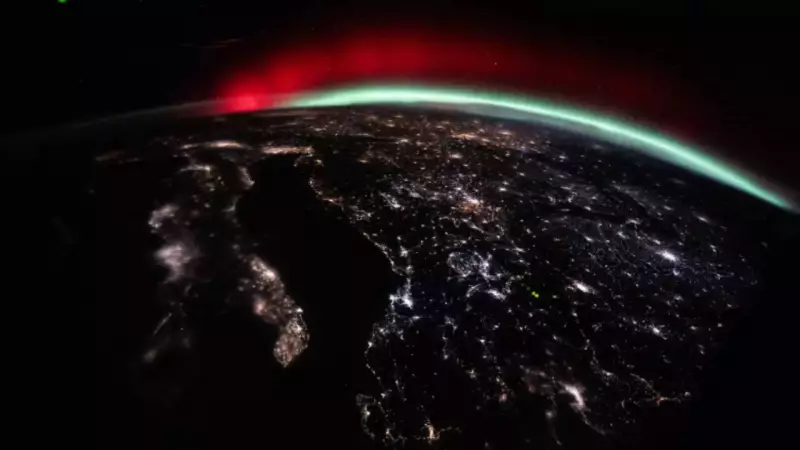
On the chilly winter night of January 19, 2026, Europe was treated to a breathtaking aurora spectacle of remarkable rarity. Vast regions across the continent were bathed in vibrant shades of red and green, creating a natural light show that captivated observers far beyond the typical polar zones.
International Space Station Captures Rare Aurora Over Europe
While auroras typically grace skies near the poles, this particular display was so vivid that locations distant from the North Pole could witness its sheer magnificence. The entire scene was meticulously recorded by NASA from the International Space Station, orbiting 262 miles above Earth.
The photograph reveals luminous curtains of light tracing the planet's horizon, with the dark mass of the European continent below and clusters of city lights visible through the atmospheric veil. This image serves as a powerful reminder that Earth's skies are influenced by forces extending well beyond our planet.

The photo was taken at approximately 10:02 PM local time during the ISS's flyover of the Mediterranean Sea at night. From this unique vantage point, astronauts could gaze northward across Italy into central and northern Europe. The station's altitude provided a perspective where the aurora appeared spread along Earth's curvature, emphasizing its immense scale.
NASA astronaut Chris Williams, aboard the shuttle at the time, was responsible for capturing this extraordinary image. The photograph has since been added to NASA's official photo gallery. Such images are uncommon due to the precise timing required—orbital positioning must align with both darkness on Earth and heightened aurora activity in space.
What Causes Auroras in Earth’s Atmosphere
Auroras occur when charged particles emitted from the Sun interact with Earth's atmosphere. These particles travel through space via solar wind, guided toward our planet by its magnetic field. Upon reaching the upper atmosphere near the poles, they collide with gases like oxygen and nitrogen.
These collisions release energy that emits light. Oxygen at lower altitudes produces the familiar green glow, while oxygen at higher altitudes emits red light. Nitrogen can generate purple or blue hues, though these are often less visible to the human eye. The prominent red and green colors in this January display indicate intense solar activity penetrating deep into Earth's magnetic environment.
Why the Colors Appear Red and Green
The striking contrast between red and green in NASA's image can be explained by the altitudes at which these phenomena occur. Green light typically appears at lower altitudes where oxygen concentrations are higher. Red light emerges at higher altitudes where oxygen levels are lower.
The simultaneous visibility of both colors suggests that solar energy particles were traversing multiple atmospheric layers at once. This often signals geomagnetic storms of significant magnitude. Indeed, such conditions can cause auroras to expand well beyond their usual latitudinal boundaries.
Role of Space Weather in Shaping the Display
Auroras represent one of the most visible effects of space weather, which involves the interaction between solar activity and Earth's magnetic field. Most auroras occur when energy is released from the Sun, sending charged particles toward our planet.
The disturbance of Earth's magnetosphere by these particles triggers auroral displays, linking them directly to space weather phenomena. Even minute particles can profoundly influence atmospheric conditions, including auroral activity. Space weather primarily examines how solar activity affects satellite operations, terrestrial weather patterns, and auroral events.
Why This Aurora Matters to Scientists
Beyond its aesthetic appeal, the aurora captured over Europe provides invaluable data for researchers studying Earth's upper atmosphere and magnetic field. Observations from space enable scientists to track solar particle movement, atmospheric entry points, and energy distribution across various altitudes.
Images like this enhance space weather models, which are increasingly crucial as modern societies depend more on satellite technology. Each aurora observed from orbit deepens our understanding of the profound connection between Earth and solar activity.

About the Author
TOI Science Desk
The TOI Science Desk comprises a team of curious journalists who continuously explore scientific discoveries to deliver engaging news, features, and articles from the ever-evolving world of science to Times of India readers. Consider us your scientific companion, offering daily insights and wonder.
Whether covering genetic engineering intricacies, space exploration marvels, or artificial intelligence advancements, the TOI Science Desk keeps you connected to science's pulse. We are not merely reporters but storytellers of scientific narratives, committed to demystifying complex concepts and making science accessible and engaging for all readers.
Join us as we craft knowledge with precision and passion, guiding you on a journey where the universe's mysteries unfold with every word.