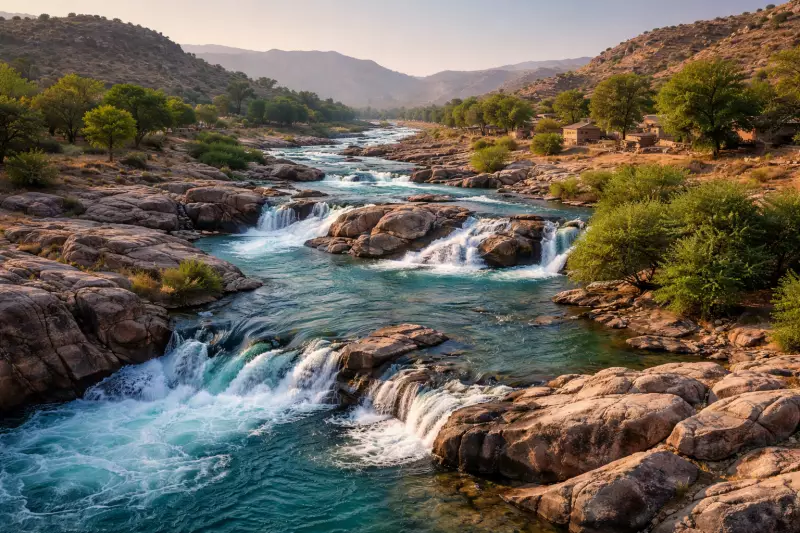
The Arid Challenge of the Thar Desert
The Thar Desert stands as one of the most challenging natural environments within the Indian subcontinent. Characterized by scorching high temperatures, minimal rainfall, and vast expanses of arid land, this region presents extreme difficulties for sustaining life. In such a harsh setting, water emerges as the critical determinant for where life can thrive or perish.
The Luni River: A Seasonal Savior
Over centuries, human settlements in the Thar Desert have clustered around a single reliable river system that provides seasonal relief to this drought-prone area. This river has profoundly influenced agriculture and settlement patterns across western Rajasthan. Despite flowing only for a few months annually and turning saltier in certain stretches, its importance cannot be overstated. This vital waterway is the Luni River, widely recognized as the "lifeline of the Thar Desert."
Origin and Course of the Luni River
The Luni River represents the largest river system in the Thar Desert and the only one of significant length in this arid zone. Unlike other parts of India blessed with perennial rivers, the Thar Desert relies almost entirely on seasonal water sources. The Luni meets this crucial need by delivering surface water during the monsoon season and helping replenish underground aquifers that support life year-round.

Its journey begins in the Aravalli Range near Pushkar, close to Ajmer in Rajasthan. At its source, it is known as the Sagarmati River. After merging with a small tributary near Govindgarh, it adopts the name Luni River. The Aravalli Range acts as a natural catchment area, channeling monsoon rains into the river system. This elevated origin enables the river to traverse the desert landscape effectively.
Agricultural and Settlement Impact
Flowing southwest for approximately 495 kilometers, the Luni passes through Rajasthan districts including Pali, Jodhpur, Jalore, and Barmer. These regions depend heavily on the river for irrigation, livestock grazing, and drinking water. Eventually, the river enters Gujarat, where it weakens and disperses into desert wetlands.
One fascinating aspect of the Luni River is that it does not empty into the sea. Instead, it terminates in the salt marshes of the Rann of Kutch, classifying it as an endorheic river. This characteristic leads to salt deposition in its lower course, increasing salinity as it moves downstream.
Seasonal Dynamics and Salinity
The Luni primarily flows during the monsoon months from July to September. During this period, heavy rainfall fills the riverbed and spreads water across adjacent plains. Once the monsoon concludes, extensive stretches dry up. However, this temporary flow plays a vital long-term role by recharging groundwater aquifers essential for wells and hand pumps used throughout the year.
Historically known as Lavanavari in Sanskrit literature, meaning "salt river," the Luni features fresh, potable water near its source. As it traverses desert regions with high salt content, salts dissolve into the water. After about 100 kilometers, particularly around Balotra, the water becomes saline and undrinkable, though still usable for certain agricultural and industrial purposes.
Agricultural Significance and Human Habitation
The Thar Desert's aridity makes crop cultivation challenging, but the Luni River brings floodwaters that enrich soil fertility, enabling cultivation of millet, barley, and legumes. Even minimal irrigation from the Luni boosts crop production in surrounding villages, shaping traditional agricultural practices adapted to the river's seasonal patterns.
Human settlement in western Rajasthan has been intrinsically linked to the Luni River. Towns and villages along its banks utilize its water for drinking, bathing, and livestock irrigation. Cattle, goats, and camels—essential to desert ecosystems—depend on water collected during the monsoon season. The Jaswant Sagar Dam, constructed in 1892 on the Luni River, stands as one of Rajasthan's oldest and largest reservoirs, storing monsoon water for irrigation and drinking needs while mitigating drought impacts in neighboring districts.

The Luni River remains indispensable for the habitability of the Thar Desert, demonstrating how even a seasonal, saline river can sustain life in one of India's most demanding environments.