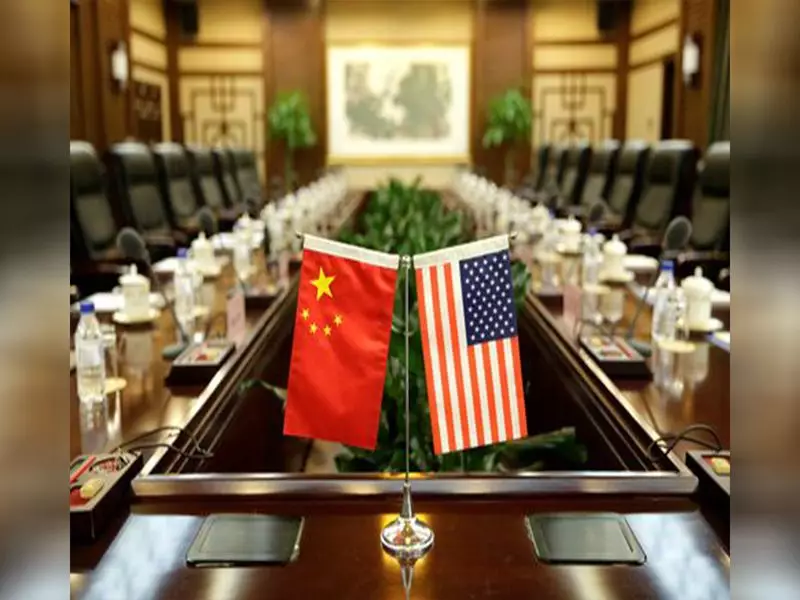
China has taken a significant step toward challenging American naval supremacy with the commissioning of its third aircraft carrier, the Fujian. This advanced warship represents Beijing's most formidable naval asset to date and signals a major shift in the balance of power in the Indo-Pacific region.
Technological Leap Forward
The Fujian aircraft carrier, designated as Type 003, represents a substantial technological advancement over China's previous carriers. Unlike the Liaoning and Shandong which used ski-jump ramps for aircraft launches, the Fujian features state-of-the-art electromagnetic catapults similar to those on the latest American carriers.
This electromagnetic aircraft launch system (EMALS) allows the carrier to launch a wider variety of aircraft, including heavier planes carrying more weapons and fuel. The system also enables faster launch rates and reduces stress on aircraft compared to older steam catapults. The Fujian's advanced capabilities mark China's entry into an elite group of nations operating modern carrier technology.
Strategic Implications for Indo-Pacific
The commissioning of China's third carrier comes at a time of heightened tensions in the Indo-Pacific region. The Fujian significantly enhances China's power projection capabilities beyond its immediate coastal waters, potentially extending its operational reach deep into the South China Sea and Western Pacific.
This development poses a direct challenge to United States naval dominance, which has been the cornerstone of regional security architecture for decades. With three operational carriers, China can maintain near-continuous carrier presence in strategic waterways, complicating American military planning and response capabilities in potential conflict scenarios.
Military analysts note that while the US Navy still maintains numerical superiority with 11 nuclear-powered carriers, China's rapid carrier development program indicates Beijing's determination to close this gap. The Chinese Navy (PLAN) has been expanding at an unprecedented rate, becoming the world's largest navy by number of ships.
Regional Reactions and Future Projections
Neighboring countries including India, Japan, Australia, and Southeast Asian nations are closely monitoring China's naval expansion. Many regional governments have responded by increasing their own naval budgets and strengthening security partnerships with the United States and each other.
India, which operates two aircraft carriers with a third under construction, faces increased Chinese naval presence in the Indian Ocean. Chinese warships and submarines have become frequent visitors to regional waters, raising concerns in New Delhi about its traditional dominance in the Indian Ocean.
Experts predict that China is unlikely to stop at three carriers. Evidence suggests that work has already begun on a fourth, potentially nuclear-powered carrier that would represent another technological leap. This continued expansion aligns with President Xi Jinping's vision of making China a comprehensive maritime power.
The United States has responded to China's naval growth by increasing its own naval deployments in the Indo-Pacific and strengthening alliances through initiatives like the Quad partnership with India, Japan, and Australia. However, the strategic balance in the region continues to shift as China's capabilities grow more sophisticated.
As the Fujian begins sea trials and operational integration, the global community watches closely how this new asset will affect regional dynamics. The carrier's deployment patterns and operational areas will provide important indicators of China's future naval strategy and its ambitions for global power projection.