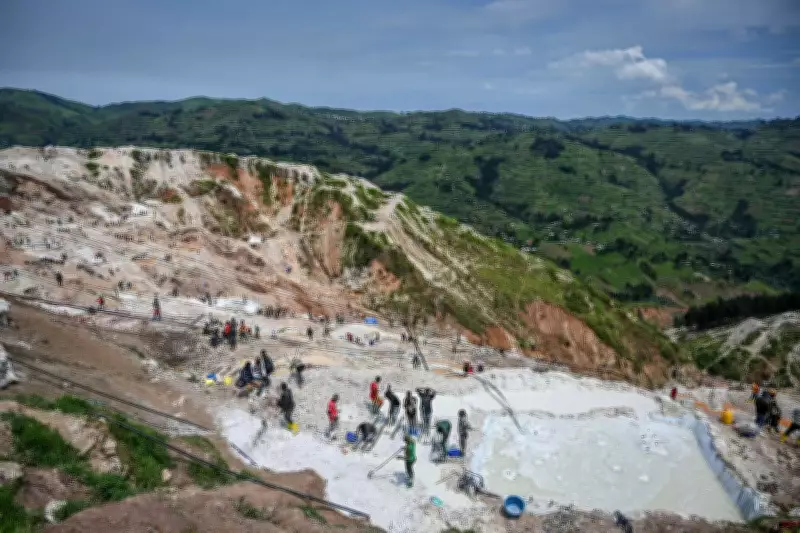
DRC Landslide Tragedy: Over 200 Feared Dead in Rebel-Controlled Mine Collapse
The Democratic Republic of Congo is grappling with a devastating humanitarian tragedy after a massive landslide struck a militia-controlled mining site in the country's volatile eastern region. Government authorities announced on Sunday that they fear at least 200 people have been killed in the catastrophic event that occurred earlier this week.
Rebel Authorities Confirm Catastrophic Death Toll
The announcement came following confirmation from rebel authorities who also placed the death toll at a minimum of 200 victims. The collapse occurred on Wednesday at the Rubaya mines, which are controlled by the M23 rebel group according to Lumumba Kambere Muyisa, spokesperson for the rebel-appointed governor of North Kivu province.
Muyisa attributed the landslide to heavy rainfall that destabilized the mining area. "So far, more than 200 people are feared dead, some of whose bodies remain trapped in the mud and have yet to be recovered," he stated. "Several others were injured and taken to three health facilities in Rubaya, while ambulances were expected to transfer the wounded to Goma," he added, referring to the nearest city approximately 50 kilometers away.

Immediate Response and Mining Suspension
In response to the tragedy, the rebel-appointed governor of North Kivu has taken immediate action by:
- Temporarily suspending all artisanal mining activities at the site
- Ordering the relocation of residents who had built shelters near the mine
- Coordinating emergency medical response for the injured
The Congolese government expressed solidarity with the victims' families in a statement posted on social media platform X, while simultaneously accusing the rebels of illegally and dangerously exploiting the region's natural resources without proper safety measures.
Geopolitical Context of the Tragedy
Rubaya lies in eastern Congo, a mineral-rich region that has endured decades of violence involving government forces and multiple armed groups, including the Rwanda-backed M23. The group's recent resurgence has significantly escalated the conflict, deepening what was already a severe humanitarian crisis in the area.
The Democratic Republic of Congo serves as a major global supplier of coltan, a black metallic ore containing tantalum that is essential for manufacturing smartphones, computers, and aircraft engines. According to the US Geological Survey, the country accounted for approximately 40% of global coltan production in 2023, with Australia, Canada, and Brazil among other leading producers. Remarkably, more than 15% of the world's tantalum supply originates specifically from Rubaya's mines.
Economic and Humanitarian Dimensions
M23 rebels seized control of Rubaya town and its valuable mines in May 2024. A United Nations report revealed that the group has since imposed taxes on the trade and transport of coltan, generating at least $800,000 monthly from these operations.
Eastern Congo has faced recurring crises for decades, resulting in one of the world's largest humanitarian emergencies. The region has witnessed:
- More than seven million people displaced from their homes
- Over 300,000 additional displacements since December last year alone
- Continuous violence despite diplomatic efforts
Despite a US-brokered agreement between the Congolese and Rwandan governments and ongoing talks involving the rebels, fighting continues on multiple fronts, causing further civilian and military casualties. The agreement also grants the US government and American companies greater access to critical minerals from the region.
This tragic landslide underscores the dangerous intersection of armed conflict, illegal mining operations, and the global demand for critical minerals that continues to fuel instability in one of Africa's most resource-rich yet conflict-ridden regions.