

The Violent Truth Behind Our Childhood Stargazing
As children, many of us recall lying on terraces or open fields, attempting to count the stars. One, two, three—and then losing track. Parents would often say, "You can't count them all." Yet we persisted, tracing imaginary shapes between those tiny, silver dots that seemed eternal, watching over the world while everyone slept.
Back then, we had no inkling that each star was actually a giant, burning fireball. Inside those distant specks, atoms collided at millions of degrees, and some of the stars we counted had already died, their light merely still traveling toward Earth. The romance of stargazing conceals a violent truth: a star's life is far from calm.
Not Just Twinkling Lights: The Real Nature of Stars
For centuries, humans have gazed at stars, weaving stories around them. Sailors used them for navigation, ancient civilizations crafted constellations and myths, and to the naked eye, they appear as small, flickering lights pinned to a dark sky. However, a star is not a tiny, fragile dot. In reality, it is a massive, glowing sphere of hot gas, shining due to an extraordinary process deep within its core: nuclear fusion.

Scientists explain that stars produce energy by fusing hydrogen atoms into helium, releasing immense light and heat. This light travels across space to reach our eyes. Inside a star, gravity constantly pulls gas inward, trying to crush it, while fusion energy pushes outward. A star survives through this delicate balance, shining steadily for millions or even billions of years. This equilibrium makes a star stable but also temporary.
Not everything that shines in space qualifies as a star. True stars must be massive enough to sustain hydrogen fusion. Objects too small, like brown dwarfs, never fully ignite. Conversely, massive stars burn brighter and hotter than our Sun. A star's size and mass dictate its brightness, lifespan, and eventual death.
More Than One Kind of Light: Types, Traits, and Cosmic Importance
When we look up, stars may seem identical, but no two are alike. They vary in size, color, temperature, and lifespan. Types are grouped by color and temperature: blue stars are hottest and short-lived, yellow stars like our Sun are medium-sized and steady, and red stars are cooler and often older. Stars undergo stages—born in gas and dust clouds, they spend most of their lives in the "main sequence" phase, producing energy until it runs out.
Characteristics reveal much: color indicates temperature, brightness hints at distance, and size determines longevity. Bigger stars burn fuel quickly, while smaller ones last longer. Stars are not mere distant lights; they create elements like carbon, oxygen, and iron—the building blocks of our bodies and world. Without stars, there would be no planets, sunlight, or life. They guide travelers, shape calendars, and inspire scientists and poets alike.
From Cosmic Dust to Shining Light: The Birth of a Star
Long before a star shines, it begins as a quiet cloud of gas and dust called a nebula. Gravity pulls particles together, forming a dense core that heats up until hydrogen fusion ignites, and the star starts to shine. Newborn stars enter the main sequence phase, like our Sun. Over time, stars evolve: red giants emerge when hydrogen fuel depletes, white dwarfs form from shrinking stars, and massive stars end in supernovae explosions.
Supernovae scatter elements across the universe, seeding new stars, planets, and life. Some leave behind neutron stars, tiny yet incredibly dense. Every star, from red dwarfs to supergiants, tells a story of birth, life, and transformation—a cosmic rhythm shaping the galaxy.
How Stars Say Goodbye: Endings in Light and Fire
Stars, like all cosmic entities, have an end. Smaller stars cool and shrink into white dwarfs, fading gently over billions of years. Massive stars, however, experience a dramatic farewell: when fuel vanishes, gravity causes core collapse, leading to a supernova explosion—a brilliant, spectacular burst of light. Whether a quiet fade or fiery explosion, a star's death closes a chapter, leaving traces of its luminous life.

Life After Death: How Stars Live On
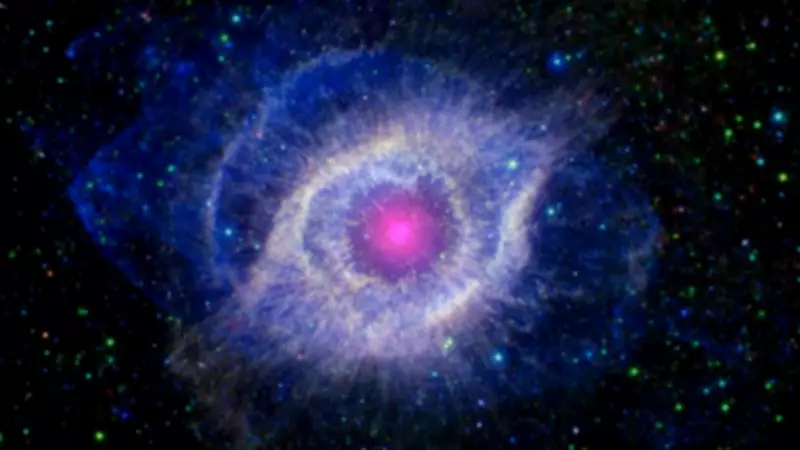
Stars are storytellers of the universe; their deaths shape creation, transformation, and continuity. When medium-sized stars shed outer layers, gas and dust form intricate shapes like planetary nebulae. Astronomers discovered that companion stars, through gravitational pulls and magnetic fields, sculpt these remnants into forms such as the Cat's Eye or Butterfly Nebula.
Ejected material becomes cosmic stardust, spreading carbon, oxygen, and other heavy elements into space. This stardust seeds new stars, planets, and life. Planetary nebulae serve as glowing memorials, illuminated by white dwarfs for centuries. Observations of stars like V Hydrae reveal how companion stars influence ejections, offering insights into transformations spanning thousands of years. Even our Sun, influenced by planets like Jupiter, may leave subtle spirals in its eventual nebula.
Life Lessons from Dying Stars
Stars teach that endings are not absolute—they transform, influence, and seed new beginnings. The matter from a blazing sun can become part of planets, oceans, or life. As Carl Sagan famously said, "We are made of star stuff." Every atom in our bodies was forged in a star's heart, recycled across the cosmos.
The death of a star reminds us of life's continuity: endings become beginnings, fading light leads to new illumination, and past stories shape the future. Next time you gaze at the night sky, look beyond the twinkling points. See the stories they carry, the transformations they've undergone, and the endless echoes of existence they leave behind.





