Six Planets and Moon to Grace Night Sky on February 28: A Celestial Spectacle
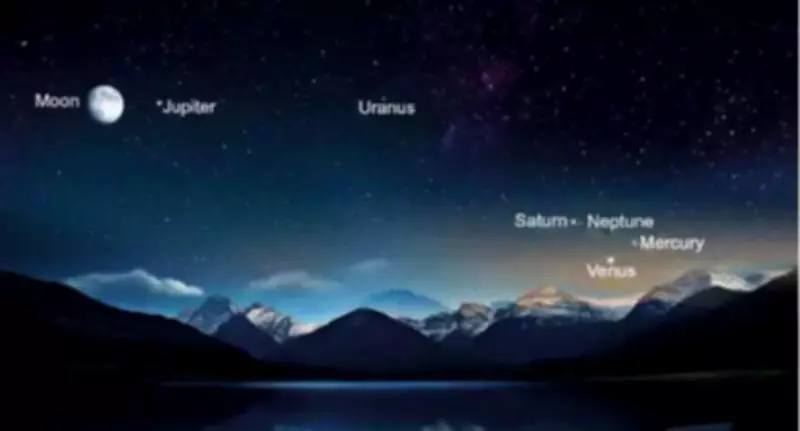
Chennai: Stargazers and astronomy enthusiasts are in for a treat as a rare celestial event is set to unfold on February 28. If you have a telescope and a bit of luck, you might be able to catch a glimpse of six planets—Mercury, Venus, Saturn, Neptune, Uranus, and Jupiter—parading in the night sky alongside the Moon shortly after sunset.
Planetary Parade Details and Visibility
Experts have noted that while this planetary alignment is a remarkable occurrence, the planets may not form a perfectly straight line. Mercury, Venus, Saturn, Uranus, and Neptune are expected to be positioned low on the western horizon, whereas Jupiter will be accompanied by the Moon high on the eastern side. This configuration means that the planets will be visible for only about 30 minutes after sunset, provided the sky remains clear and free of clouds.
According to NASA, these planets have been visible throughout the month of February, but they will be lined up most optimally towards the end of the month. Weather permitting, four of these planets—Mercury, Venus, Saturn, and Jupiter—will be visible to the unaided eye. However, to view Uranus and Neptune, optical assistance such as binoculars or a telescope is necessary due to their faintness in the sky.

Challenges and Recommendations for Viewing
S Soundararaja Perumal, former executive director of the Birla Planetarium, highlighted some challenges for observers. He mentioned that stargazers may have a very limited window to spot planets like Mercury, as they could dip below the horizon by around 7 pm. Light pollution in urban areas like Chennai could further complicate viewing, making it difficult to see these celestial bodies clearly.
Perumal advised, "If the sky is clear, we may be able to see the partial phase for a few minutes after moonrise. Jupiter may be the brightest of them all, standing out prominently in the night sky." For those aiming to view Neptune and Uranus, a powerful telescope is essential. He explained, "The planets' visual magnitude would be 8, which is not visible to the naked eye, as it will be fainter than the typical human limit of 6."
Historical Context and Significance
This event follows a similar rare planetary parade that occurred in January 2025, featuring Venus, Saturn, Jupiter, Mars, Uranus, and Neptune. Mercury, which takes approximately 88 days to orbit the Sun, has now joined the lineup in February 2025, adding to the uniqueness of this celestial display.
For those interested in astronomy, this alignment offers a fleeting opportunity to witness multiple planets in the sky simultaneously. It serves as a reminder of the dynamic nature of our solar system and the beauty of celestial phenomena that can be observed from Earth.