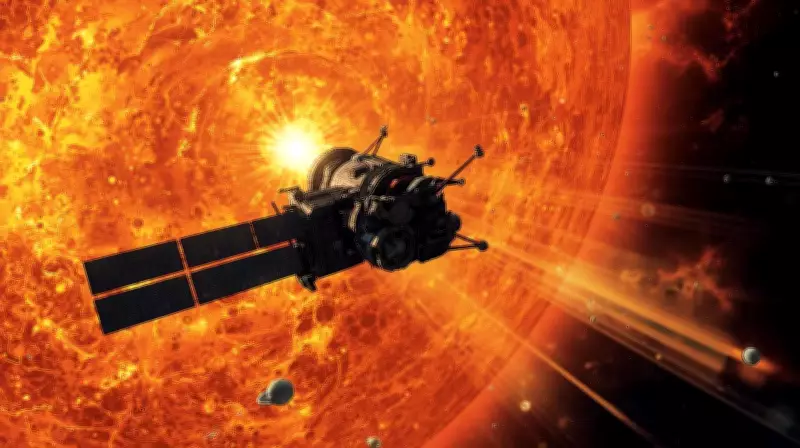
Parker Solar Probe Breaks Barriers in Sun's Outer Atmosphere
In a groundbreaking achievement, a spacecraft is now navigating a region once deemed inaccessible, sampling the Sun's thin outer atmosphere at distances never before reached by any mission. The Parker Solar Probe, launched by NASA, is delivering data that offers an unprecedented close-up view of how the solar wind is heated and propelled outward into space. These findings, detailed in a study published in Geophysical Research Letters, focus on the energy flow from the Sun's corona into the broader heliosphere, marking a significant leap in solar physics research.
Direct Measurements Overcome Simplified Models
Researchers are leveraging direct particle measurements from the probe, moving beyond reliance on simplified theoretical models. This technical work has profound practical implications: enhanced knowledge of solar wind behavior directly feeds into improved space weather forecasting models. Such forecasts are crucial for protecting satellites, radio communication systems, and power grids on Earth from solar disturbances.
Since its 2018 launch, the Parker Solar Probe has progressively approached the Sun, using repeated Venus flybys to tighten its orbit. During recent encounters, it traveled within just a few million miles of the solar surface. At these extreme distances, instruments captured detailed motions of charged particles in the solar wind, revealing complexities previously unseen.

Irregular Particle Patterns Challenge Old Assumptions
The solar wind, a steady stream of plasma flowing from the Sun, was long assumed to follow orderly mathematical patterns known as Maxwellian distributions. However, the new measurements show a less uniform reality. Velocity patterns are uneven, shaped by waves and magnetic forces that shift as the plasma expands, challenging decades-old assumptions in plasma physics.
New Tool Revolutionizes Wave Heating Calculations
To analyze these irregular particle distributions, scientists developed a novel numerical system called the Arbitrary Linear Plasma Solver. This tool calculates how real particle distributions respond to electromagnetic waves, rather than forcing observations into neat theoretical shapes. The results indicate that some ion-scale waves behave differently than earlier models predicted, with damping rates varying by up to a factor of three in certain cases.
This variation affects energy transfer between waves and particles in the corona and alters estimates of how quickly the solar wind cools as it travels outward. Observations suggest the plasma retains heat longer than simple expansion models would imply, a phenomenon still under investigation.
Implications for Space Weather and Beyond
Understanding how the solar wind gains and retains energy extends beyond solar physics. Disturbances like coronal mass ejections travel through this same medium, with their speed and intensity influenced by background plasma conditions. By measuring real particle behavior near the Sun, the mission is closing gaps that have persisted for decades, refining rather than overturning earlier theories. Heating processes in the inner heliosphere now appear more varied than previously thought.
Researchers caution that these conclusions are based on selected intervals and specific wave types, with further encounters likely to reveal additional patterns. The Parker Solar Probe continues its orbit, returning invaluable measurements from a region that had long remained theoretical, reshaping our understanding of space weather and advancing plasma physics.