

Universe Delivers Loudest Gravitational Wave Ever Recorded, Testing Einstein's Theory
The cosmos has produced the most powerful gravitational wave signal ever detected by humanity, presenting what appears to be one of the most rigorous challenges yet to Albert Einstein's century-old theory of general relativity. According to groundbreaking research published in the APS Journal, the signal designated GW250114 journeyed an astonishing 1.3 billion light-years across the universe before reaching our planet.
Violent Black Hole Merger Creates Unprecedented Signal
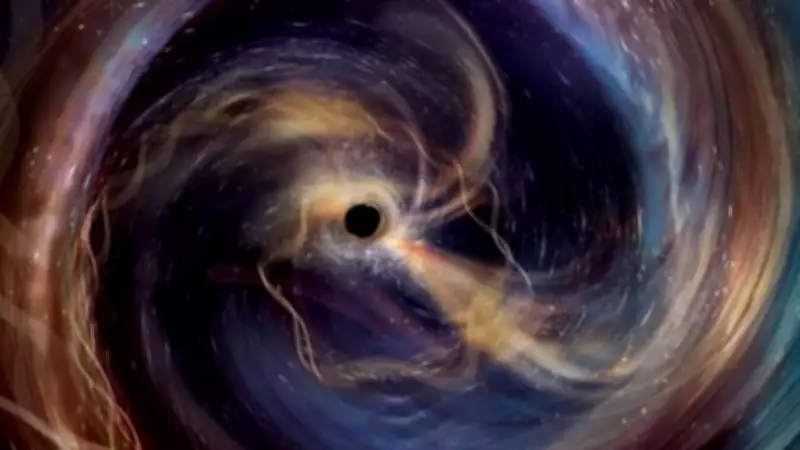
This extraordinary gravitational wave originated from the cataclysmic merger of two black holes, an event of such immense violence that it sent powerful ripples cascading through the very fabric of space-time. Researchers emphasize that the clarity and strength of this detection surpass anything previously observed in the brief history of gravitational wave astronomy. The signal reportedly demonstrated approximately three times greater clarity than earlier gravitational wave detections, marking a significant advancement in observational capabilities.
How Scientists Detected the Cosmic Phenomenon
As detailed in the study titled "Black Hole Spectroscopy and Tests of General Relativity with GW250114," scientists working with the Laser Interferometer Gravitational-Wave Observatory (LIGO) in the United States made this historic detection. Since first confirming the existence of gravitational waves in 2015, LIGO has continuously refined its instruments through successive upgrades, with each enhancement yielding improved sensitivity to these cosmic vibrations.

Gravitational waves represent ripples in space-time generated by massive accelerating objects, particularly when celestial bodies like black holes spiral toward one another in a cosmic dance of destruction. When these waves traverse Earth, they produce minuscule stretching and compression of space itself—distortions so subtle they require incredibly sensitive equipment to detect.
Einstein's Theory Faces Extreme Cosmic Environment
The existence of gravitational waves was initially predicted in 1915 by Albert Einstein as a fundamental consequence of his general theory of relativity. This revolutionary theory reconceptualized gravity not as a conventional force but as the curvature of space and time caused by mass and energy. With GW250114, scientists have gained an exceptional opportunity to subject general relativity to another demanding examination under extreme conditions.
Black hole mergers represent some of the most intense gravitational environments in the entire universe. Following the collision of two black holes and their subsequent formation into a single, more massive black hole, the newly created object undergoes brief vibrations. This phenomenon, often described as "ringing" similar to a struck bell, generates distinct tonal patterns within the gravitational wave signal that carry vital information about the resulting black hole.
What the Ringdown Phase Reveals About Black Holes
The ringdown phase following a black hole merger provides crucial data about the fundamental properties of the newly formed celestial object, including its mass and rotational characteristics. By meticulously analyzing the specific tones embedded within the gravitational wave signal, scientists can deduce detailed attributes of the resultant black hole. GW250114 offered an unusually pristine view of these characteristics, enabling more precise measurements than previously possible.
Gravitational wave astronomy remains in its formative stages, with the field being less than a decade old. Despite its youth, this discipline has already fundamentally transformed humanity's approach to observing and understanding the cosmos. For the present moment, GW250114 stands as a landmark event in scientific history—the loudest gravitational wave ever recorded has once again validated Einstein's revolutionary theory while simultaneously heralding the true commencement of precision gravitational wave science.






