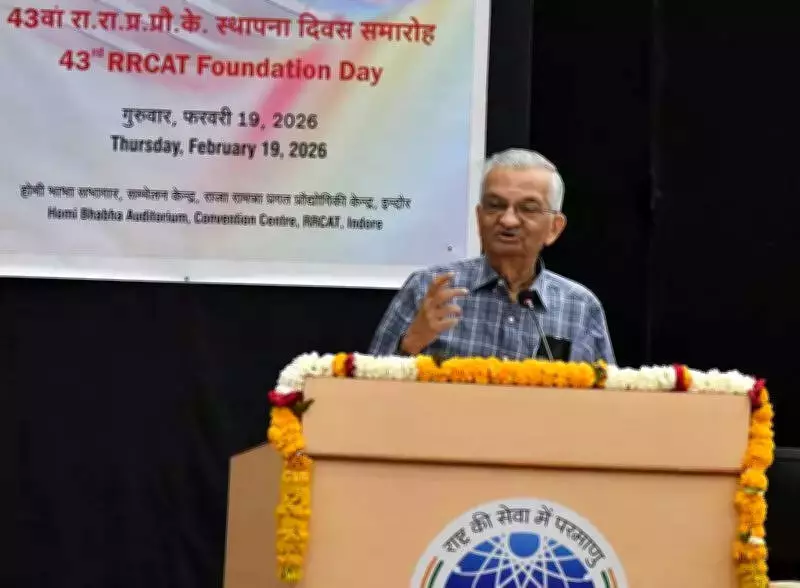
Former Atomic Energy Commission Chairman Stresses Need for Industry-Academia Partnership
During the 43rd Foundation Day celebrations of the Raja Ramanna Centre for Advanced Technology (RRCAT) in Indore on Thursday, Dr Anil Kakodkar, former chairman of the Atomic Energy Commission and ex-secretary of the Department of Atomic Energy, delivered a powerful message about the future of scientific research in India.
Bridging the Gap Between Laboratories and Industry
Dr Kakodkar asserted that advanced research must not remain confined within laboratory walls but should actively reach industrial sectors to contribute meaningfully to national development. He highlighted India's established strengths in specialized technological domains, particularly in lasers and particle accelerators, which have positioned the country as a credible player in advanced scientific fields.
The former atomic energy chief emphasized that the next crucial phase of India's scientific journey must prioritize closer collaboration between academic institutions and industrial enterprises. This partnership is essential for transforming sophisticated scientific capabilities into practical technological solutions and enhancing manufacturing strength across various sectors.

Technology Transfer and Collaborative Innovation
Dr Kakodkar specifically urged for increased technology transfer from advanced research and development institutes like RRCAT to industrial partners. He called upon both Indian academics and industry leaders to join forces in addressing complex technological challenges facing the nation.
The event attracted numerous scientists, engineers, and institutional heads from across the city, creating a platform for meaningful dialogue about India's scientific future. In his annual address, RRCAT director Viraj P Bhanage detailed the center's significant accomplishments over the past year, providing context for Dr Kakodkar's forward-looking vision.
RRCAT's Ongoing Contributions and Infrastructure Development
Director Bhanage reported that the national synchrotron radiation facilities, Indus-1 and Indus-2, continue to see extensive utilization by researchers from universities and industrial units throughout the country. These facilities represent critical infrastructure supporting advanced scientific investigation across multiple disciplines.
Bhanage also provided comprehensive updates on several major projects currently underway at RRCAT, including:
- The LIGO-India gravitational wave observatory project
- IR-FEL (Infrared Free Electron Laser) development
- Advanced laser development programs
- Functional materials research initiatives
- Innovations in cryogenic systems technology
The director highlighted substantial enhancements to computational capabilities and infrastructure across the RRCAT campus, ensuring the center remains at the forefront of technological research and development.
Practical Applications and Industrial Partnerships
A particularly significant moment during the celebrations occurred when Dr Kakodkar officially flagged off a batch of sterilized medical devices. This event marked the processing of two crore devices at RRCAT's electron beam radiation facility located near the Devi Ahilya Bai Holkar Fruit and Vegetable Market.
This sterilization facility stands as a prime example of practical applications emerging from accelerator technology developed at RRCAT, demonstrating how advanced scientific research can directly benefit public health and medical sectors.
In a move underscoring the center's commitment to extending laboratory research beyond campus boundaries, RRCAT signed five separate agreements for technology transfer and collaborative incubation with industrial partners through the AIC RRCAT PI-HUB Foundation. These agreements represent concrete steps toward implementing Dr Kakodkar's vision of closer industry-academia collaboration.
The foundation day celebrations collectively highlighted RRCAT's increasing focus on transforming laboratory research into manufacturing applications, startup innovations, and real-world industrial solutions, marking a significant shift toward more applied and commercially relevant scientific development in India.