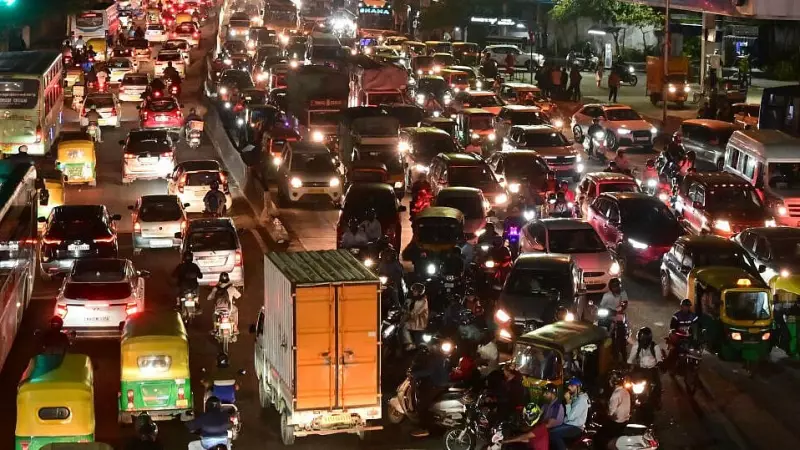
Bengaluru, India's tech capital, has long been synonymous with crippling traffic jams. However, a silent technological revolution on its streets is now turning the tide against chronic gridlock. The city has successfully rewired its traffic management system, achieving a remarkable level of automation that is smoothing commutes and setting a new benchmark for urban mobility.
The Blueprint for Automated Traffic Flow
The transformation is led by the Bengaluru City Traffic Police under the guidance of Commissioner Seemant Kumar Singh. The core of this initiative is a sophisticated adaptive traffic control system that has moved beyond fixed-timer signals. Instead of operating on pre-set cycles, these smart signals now dynamically respond to real-time vehicle flow detected by sensors and cameras at junctions.
The results are impressive. The system currently operates with over 95% automation across all operational junctions. This high level of self-regulation means that human intervention is rarely needed. Even during the chaotic morning and evening rush hours, manual overrides account for less than 5% of signal operations, a figure confirmed by the police commissioner in a recent opinion piece dated December 16, 2025.

Technology at the Heart of the Change
This wasn't a simple upgrade but a complete rewiring of the city's traffic nerve centre. The system uses a combination of hardware and intelligent software to make decisions. It continuously collects data on vehicle density, queue lengths, and waiting times. Using complex algorithms, it then calculates the optimal green signal duration for each approach at a junction, reducing idle time at empty lanes and clearing longer queues more efficiently.
The move to automation addresses a key bottleneck: the limitations of manual traffic policing. With a finite number of personnel, it was impossible to optimally manage hundreds of junctions simultaneously. The automated system acts as a force multiplier, ensuring consistent, data-driven management 24/7, which has led to a measurable reduction in average travel time and intersection delay.
Impact and the Road Ahead
The benefits of this smart traffic management overhaul extend beyond just shorter commute times. Reduced stop-and-go traffic leads to lower fuel consumption and vehicle emissions, contributing to better air quality. There is also a significant decrease in driver frustration and road rage incidents stemming from unpredictable waits.
For the Bengaluru City Police, the success of this project, achieving over 95% automation, is a major milestone. It frees up valuable personnel resources for other critical enforcement and public safety duties. The system's ability to function autonomously, even during peak hours, proves its robustness and marks a paradigm shift in how Indian cities can tackle traffic congestion.
The journey, however, continues. Authorities are likely focusing on integrating this system with other smart city platforms, such as public transit data and emergency vehicle pre-emption, to create a fully integrated urban mobility ecosystem. Bengaluru's experience now serves as a crucial case study for other metropolitan areas across India and the world grappling with similar challenges of urban gridlock.