UP Government Issues Stern Warning to Noida Labor Contractors After Violent Industrial Protests
The Uttar Pradesh government has issued a strict warning to labor contractors and outsourcing agencies operating in Noida and Greater Noida. Authorities have stated that these entities will face blacklisting and license cancellation if workers deployed by them are found involved in any violent activities or disruptive behavior.
Government Response to Recent Industrial Unrest
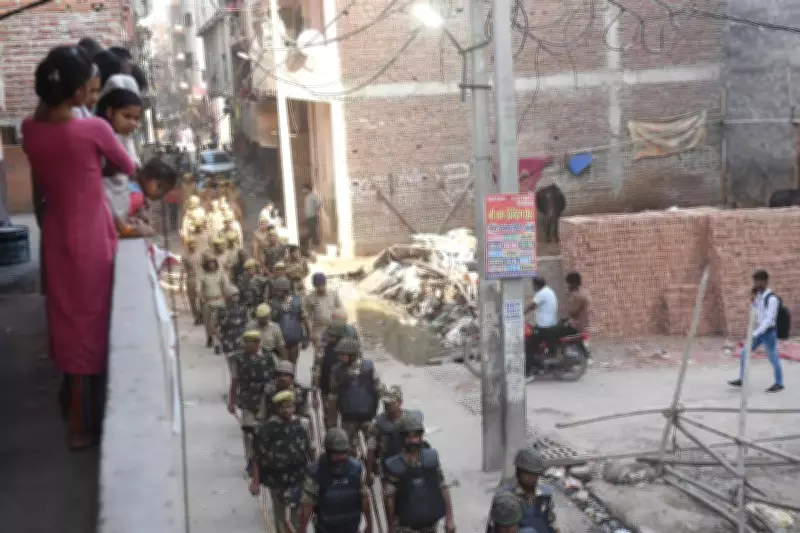
This decisive move comes just two days after industrial protests in Noida escalated into violence, with multiple vehicles including police SUVs set ablaze and law enforcement officers pelted with stones across several sectors. The situation prompted immediate government intervention to prevent further disturbances.
A high-level committee chaired by Infrastructure and Industrial Development Commissioner Deepak Kumar convened with representatives of outsourcing agencies in Greater Noida to address the growing concerns. During this meeting, Kumar emphasized the dual role of these agencies in both generating employment and maintaining discipline among workers.

"Outsourcing agencies play an important role in running industries and generating employment," Kumar stated. "It is also their responsibility to keep workers disciplined and properly trained so that no disorder or unrest arises. If any agency or its employees engage in disruptive behaviour, the agency concerned will be held responsible. In such cases, action will be taken to blacklist the agency and cancel its licence."
Contractors Express Concerns About Shared Responsibility
While the government has taken a firm stance, some contractors have raised questions about the distribution of responsibility for maintaining industrial peace. Dharmendra Nagar, who operates outsourcing agency Prachi Enterprises, pointed out that contractual workers typically represent about 40% of the workforce in industrial units, though this ratio varies across different companies.
"Monday's unrest was an unfortunate incident," Nagar commented. "It is not clear whether those involved were contractual workers or directly engaged by the companies. Ensuring peaceful functioning of industrial units is a collective responsibility, and holding only contractors responsible may not be just." Nagar's firm employs approximately 9,000 workers across factories in Noida.
Lalit Kumar, operations manager at Lions Workforce, echoed similar concerns about accountability. "Such incidents depend on multiple workplace factors, including work culture, salary payments, medical coverage and other issues. If an agency places a candidate in a factory and they commit a crime months or years later, how can the agency alone be held responsible?" Kumar's company manages nearly 1,200 contractual workers in local factories.
Government Announces Significant Wage Increases
Alongside the warning to contractors, the government has implemented substantial wage increases for workers in Noida and Ghaziabad. Effective from April 1, minimum monthly wages have been raised by 21% across all categories:
- Unskilled workers: Increased from Rs 11,313 to Rs 13,690
- Semi-skilled workers: Increased from Rs 12,445 to Rs 15,059
- Skilled workers: Increased from Rs 13,940 to Rs 16,668
Officials have mandated that these wages must be transferred directly into workers' bank accounts to ensure transparency and prevent any discrepancies in payment.
Commissioner Deepak Kumar explained that the committee carefully balanced rising living costs with industrial pressures when determining the revised wages, particularly considering export challenges linked to the West Asia conflict. He also addressed misconceptions among workers, noting that many had been misled into believing higher wages had already been officially fixed by central and state governments, when in reality the national minimum floor wage remains under consideration.

Additional Measures and Worker Verification Requirements
Labor Commissioner Markandeya Shahi announced additional requirements for worker verification and statutory compliance. "Workers must undergo police verification at the time of joining," Shahi stated. "PF and ESI deductions should be ensured in keeping with the rules to prevent dissatisfaction among workers."
Shahi clarified that the revised wage rates are interim measures, with final wages to be determined next month following recommendations from the wage board. April 23 has been set as the deadline for submitting objections and suggestions regarding the wage adjustments.
District Magistrate Medha Roopam visited industrial units in Greater Noida to personally communicate the wage changes to workers. "The chief minister has also given directions, including double payment for overtime and weekly offs," she informed workers. "Dialogue is the solution to any problem, not violence."
Helplines Established and Gradual Return to Normalcy
The labor department has established multiple channels for workers to voice concerns and register complaints:
- Toll-free number: 9411900251
- Helpline numbers: 0120-2336004 and 0120-2336005
Officials report that factories have begun displaying the revised wage lists on notice boards, and workers are gradually returning to their jobs following Monday's unrest. The government's combined approach of strict accountability for contractors alongside improved worker benefits aims to restore stability to Noida's industrial landscape while addressing the root causes of recent disturbances.