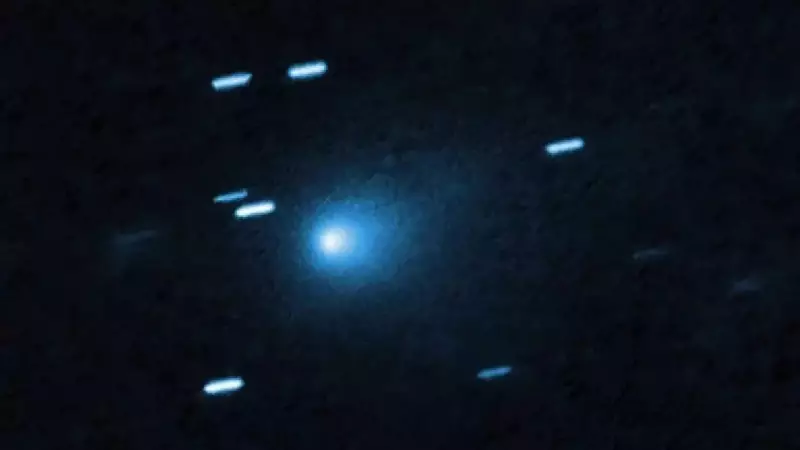
In an unprecedented celestial event, NASA is preparing to broadcast the most detailed views ever captured of 3I/ATLAS, the third confirmed interstellar object to visit our solar system. This rare visitor from another star system is currently making its journey through the inner solar system, offering scientists an extraordinary opportunity to study material that formed around a distant star.
When and How to Watch the Historic Live Stream
Mark your calendars for a groundbreaking space viewing experience. NASA has scheduled a special multi-mission live broadcast for 19 November 2025 at 3:00 p.m. EST (UTC-5). The event will be hosted from NASA's Goddard Space Flight Center in Maryland and will be accessible through multiple platforms including the NASA+ app, NASA mobile app, NASA.gov, NASA's official YouTube channel, and select NASA events on Amazon Prime.
This represents the first time NASA has organized a comprehensive, multi-observatory public broadcast dedicated entirely to an interstellar object. Viewers will have the unique opportunity to submit their questions during the event using the hashtag #AskNASA, making this an interactive educational experience for space enthusiasts across India and worldwide.

Unprecedented Scientific Opportunity
Comet 3I/ATLAS holds tremendous significance for the scientific community. Discovered on 1 July 2025 by the ATLAS survey telescope in Chile, this interstellar wanderer provides a rare chance to study material that originated around another star. Unlike comets native to our solar system, 3I/ATLAS carries chemical signatures from its birth environment, offering clues about planetary formation in distant star systems.
Early observations from the James Webb Space Telescope (JWST) have already revealed surprising characteristics. The comet displays an unusually high CO₂ to water ratio, suggesting it formed in a much colder environment or under different stellar radiation conditions than comets in our solar system. This chemical diversity helps astronomers test theories about how planetary systems evolve throughout our galaxy.
What to Expect from NASA's Broadcast
The live stream will combine observations from multiple space and ground-based observatories, creating the most comprehensive view of an interstellar object ever assembled. Viewers can expect to see:
- JWST near-infrared spectroscopy results revealing the comet's chemical composition
- Hubble Space Telescope optical observations showing detailed surface features
- Visualizations from NASA's Goddard heliophysics division
- Imagery from both space-based and ground-based solar observatories
- Expert discussions about comet chemistry and interstellar origins
This integrated approach will demonstrate how different scientific instruments track and analyze a fast-moving interstellar object, providing the public with unprecedented insight into cutting-edge astronomical research methods.
Safety and Visibility from Earth
For those wondering if they can spot 3I/ATLAS in the night sky, the comet is unfortunately too faint for naked-eye observation and requires powerful telescopes for meaningful study. However, there's absolutely no cause for concern about Earth's safety. NASA has confirmed that the comet's trajectory brings it no closer than approximately 1.8 astronomical units (AU) from our planet, ensuring a completely safe passage.
The comet reached its closest approach to the Sun (perihelion) around 29-30 October 2025 at a distance of about 1.4 AU. Traveling at an incredible inbound speed of roughly 61 kilometers per second, 3I/ATLAS follows a hyperbolic trajectory that will ultimately carry it out of our solar system permanently after this brief encounter.
This historic broadcast marks a significant moment for space science, bringing the mysteries of interstellar visitors directly to screens across India and the world. Don't miss this opportunity to witness scientific history in the making as we explore a traveler from beyond our solar neighborhood.