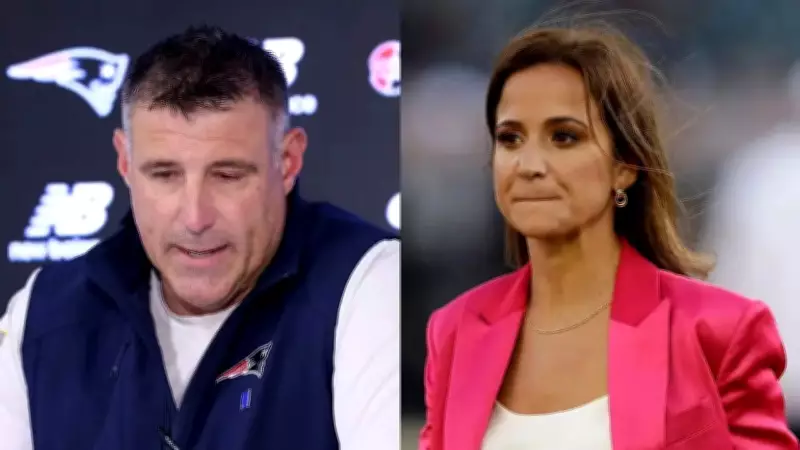
The ongoing saga involving Mike Vrabel and Dianna Russini has escalated from a private moment caught in public into a national talking point, drawing voices from across the sports world. What initially seemed like gossip has now sparked a broader discussion about media narratives, consistency in coverage, and the role of race in shaping public perception.
The Evolution of the Story
As new reactions surface, the focus has shifted beyond the individuals involved. The conversation now encompasses how media stories are constructed, who receives attention, and why certain stories dominate headlines while others remain in the background. Robert Griffin III's recent observations have added a new layer to the controversy.
Robert Griffin III Raises Questions
Griffin did not hold back when addressing the growing controversy. He pointed to what he sees as a gap in media intensity, arguing that this case is evolving rapidly without receiving the same level of scrutiny seen in other scandals. Sharing his thoughts publicly, he wrote, “This Dianna Russini and Mike Vrabel story is getting crazier and crazier. Every day it's something new. Why isn't it being covered with the same vigor as Ime Udoka or Sherrone Moore by the media? Heck, even Klay Thompson and Meg the Stallion are getting no-holds-barred coverage.” His remarks struck a nerve. By referencing figures like Ime Udoka and Sherrone Moore, Griffin framed the issue as one of consistency. The comparison raised eyebrows and pushed the conversation into more complex territory, including how race and context may influence coverage.

Racial Element Debate Intensifies
The discussion took another turn when Dan Dakich responded on his podcast. Dakich challenged Griffin’s perspective, suggesting that the situations being compared were fundamentally different. He argued that bringing race into the conversation may not be appropriate given the circumstances. As he put it, “There is a racial element to it with the examples he brought up. For this situation, talking about Udoka or Sherrone Moore, both of those situations involved actual employees of the same institution. This is something completely different when you look at Vrabel, and you look at Russini. Because we've not seen ESPN or a lot of these other big journalists cover this story.” Even so, Dakich acknowledged a gap between public curiosity and formal coverage. Online communities continue to dissect every detail, often moving faster than traditional outlets. That contrast has only added fuel to an already intense narrative.
A Broader Argument About Media Priorities
One thing is certain with the story’s progression. It’s not just about two people anymore. It has turned into a bigger argument about media priorities, the public interest, and the dividing line between private life and professional scrutiny. The debate now encompasses questions about how the media chooses which stories to amplify and whether consistency exists in covering controversies involving different individuals.
As the story continues to unfold, it remains to be seen how traditional outlets will respond. The public's appetite for details shows no signs of waning, and the conversation shows no signs of slowing down.