India's IT Minister Delivers Data-Driven Rebuttal to IMF's AI Assessment
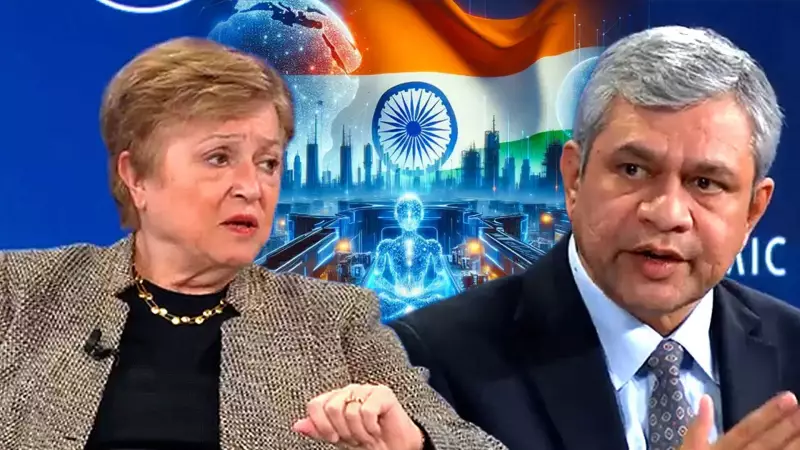
At the prestigious World Economic Forum in Davos, India's Union Minister for Electronics and Information Technology, Ashwini Vaishnaw, issued a pointed and evidence-based response to the International Monetary Fund's recent characterization of India as a "second-tier AI power." Dismissing this classification as fundamentally incorrect, Vaishnaw presented compelling data to underscore India's formidable position in the global artificial intelligence landscape.
Stanford Rankings Counter IMF Narrative
Central to Minister Vaishnaw's argument were the authoritative rankings from Stanford University. He highlighted that according to Stanford's rigorous assessment, India stands third globally in overall AI preparedness. Furthermore, in the critical domain of AI talent, the nation secures an even more impressive second place worldwide. This factual counterpoint directly challenged the IMF's methodology and conclusions, suggesting a potential disconnect between the fund's criteria and on-ground technological realities.
Blueprint of a Comprehensive and Cost-Effective AI Strategy
Moving beyond mere rebuttal, Vaishnaw elaborated on India's holistic and pragmatic approach to artificial intelligence. He detailed a strategic framework encompassing all five foundational layers of the AI ecosystem:

- Applications: Developing practical, sector-specific solutions.
- Models: Building efficient AI models tailored to real-world needs.
- Chips: Fostering semiconductor capabilities.
- Infrastructure: Creating robust computational support systems.
- Energy: Ensuring sustainable power for AI operations.
The minister emphasized that India's strategy is deliberately cost-efficient and ROI-driven, moving away from the global trend of developing prohibitively expensive mega-models. Instead, the focus is on creating deployable, people-first solutions that address specific national and societal challenges.
Revealing India's Powerful Compute Grid
In a significant revelation, Vaishnaw disclosed the scale of India's public-private computational infrastructure. The nation has established a compute grid powered by 38,000 GPUs (Graphics Processing Units), which is operating at approximately one-third of the global average cost. This massive and economical computing power is the engine enabling the development of the targeted, sector-specific AI models Vaishnaw described, fostering innovation without creating external dependencies.
Positioning India as an Independent, Ethical AI Leader
The minister's address framed India's AI journey within broader contexts, from geopolitics to ethics. He positioned the country not as a follower seeking validation from international bodies, but as an independent AI power engineering its own path to leadership. The core message from Davos was unequivocal: India is building a self-reliant, practical, and inclusive AI ecosystem designed for tangible impact and global relevance.