Peter Thiel's $2 Billion Bet on AI That Herds Cows Without Fences
Imagine a dairy farmer in New Zealand who, at 4:30 AM, simply taps a button on his smartphone instead of pulling on boots and whistling for his dog. Outside, 600 cows begin moving autonomously toward the milking shed, guided not by human hands or physical barriers, but by small collars around their necks emitting precise sound cues. This is the reality created by Halter, an agricultural technology startup recently valued at a staggering $2 billion by investor Peter Thiel.
The End of Traditional Farming Inefficiencies
For decades, dairy farming relied on three fundamental elements: physical fences costing $15,000 to $40,000 per mile, herding dogs, and constant human observation. These traditional methods came with significant limitations—permanent infrastructure requiring maintenance, daily labor-intensive herding, and missed health or fertility issues among livestock. Halter's technology represents the first serious innovation to address these age-old inefficiencies systematically.
How Virtual Fencing Transforms Herd Management
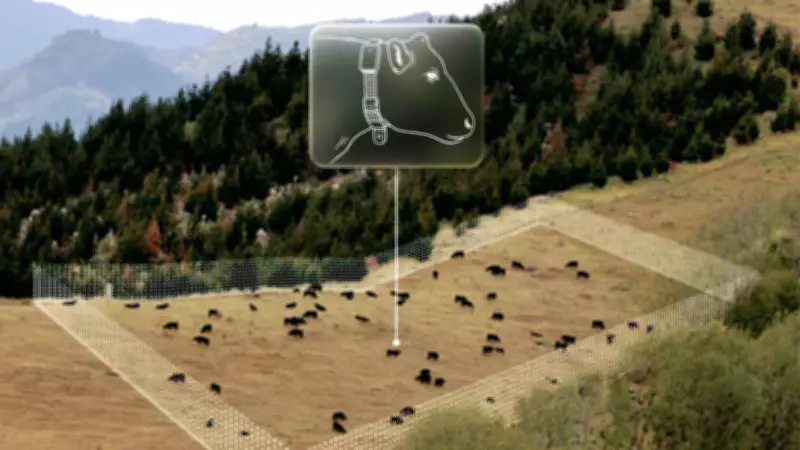
Through the Halter mobile application, farmers draw virtual boundaries on satellite maps of their land, similar to circling areas on Google Maps. These digital perimeters are transmitted as GPS coordinates to every collar in the herd within seconds. Each collar tracks individual cow locations four times per minute continuously.

When an animal approaches a virtual boundary, the collar emits a sound cue on one side of its neck. Through behavioral conditioning, cows learn to associate this sound with turning away—when they respond correctly, the sound stops immediately. This automated process occurs dozens of times daily without human intervention.
The Coordinated Herding Revolution
When it's time for milking, a single tap activates Halter's sophisticated system. Artificial intelligence calculates each animal's position, determines optimal paths for every cow, and sends coordinated directional cues through the collars. The system intelligently sequences movement, starting with cows at the back while providing stronger prompts to slower animals. Entire herds reach milking sheds within minutes through this precisely coordinated guidance.
Behavioral Science: The Core Innovation
The true breakthrough isn't merely technological but psychological. During the initial week-long onboarding process, farmers physically walk with their herds while collars emit sound cues, reinforcing correct responses. Cows, being naturally social animals, learn collectively—once a few respond appropriately, others follow. Within days, the association becomes automatic, eliminating the need for human presence in paddocks.
Continuous Monitoring Through the "Cowgorithm"
Halter's collars provide far more than herding capabilities. They continuously monitor each animal's chewing behavior, body temperature, walking speed, rest patterns, and fertility signals. This data creates comprehensive behavioral profiles for individual cows.
The company's AI system, affectionately termed the "Cowgorithm," has been trained on data from hundreds of thousands of cows over several years. It establishes normal baselines for each animal and flags deviations—detecting potential health issues 24 to 48 hours before visible symptoms appear. Early detection significantly reduces treatment costs and improves outcomes.
Fertility tracking represents another major advantage. Since cows have breeding windows lasting only 12 to 18 hours, missing these opportunities delays cycles by weeks. The system detects subtle behavioral changes associated with fertility phases and alerts farmers at precisely the right moments.
Impressive Growth Metrics and Business Model
Across the United States, Halter users have created over 11,000 miles of virtual fencing—comparable to the perimeter of the continental United States—resulting in estimated savings of $220 million in physical fencing costs. The system currently manages more than 700,000 cattle across New Zealand, Australia, and 22 U.S. states.

Halter operates on a subscription model, charging between $5 and $8 per cow monthly while leasing rather than selling collars. A farm with 500 cows might pay approximately $3,000 monthly, with larger operations paying proportionally more. Once farms restructure operations around this digital infrastructure, switching becomes increasingly difficult due to system dependence.
Peter Thiel's Long-Term Vision
Peter Thiel's Founders Fund has supported Halter since its early stages, participating in the 2018 Series A round when the company was still developing its technology. This isn't a recent discovery but a calculated long-term investment. After observing growth to hundreds of thousands of managed animals, Founders Fund is now leading a funding round that values Halter at approximately $2 billion, reflecting confidence in both the technology and its expansive potential.
Broader Implications Beyond Agriculture
At its core, Halter has developed a system coordinating thousands of living organisms in real time using data, sensors, and behavioral cues. While currently applied to agriculture, the underlying principles have far-reaching implications for wildlife management, logistics, robotics, and physical environment management.
This technology represents a fundamental shift—tasks once requiring constant human effort can now be managed by software systems operating continuously in the background. In an industry facing labor shortages and physically demanding work, systems like Halter reduce manual intervention while dramatically improving efficiency.
The story of a former rocket engineer returning to farming and applying engineering principles to traditional agriculture has culminated in a billion-dollar valuation. It demonstrates that even the oldest systems can undergo radical transformation when viewed through innovative lenses.