The Penance of Tarakasura and the Clever Boon
The origin of Maa Skandamata is intricately tied to a powerful demon named Tarakasura, whose story begins with intense penance that would reshape cosmic destiny. As with many mythological turning points, this narrative unfolds through severe tapasya performed to please Lord Brahma. Tarakasura's demand was unequivocal: he sought invincibility, a shield against all threats to his reign.
Lord Brahma, bound by cosmic laws, refused to grant complete immortality. Undeterred, Tarakasura devised a clever alternative—a boon with a loophole that appeared impregnable. He requested that he could only be killed by the son of Lord Shiva. This condition seemed brilliantly secure to the demon because Shiva, at that time, was a detached ascetic mourning his immolated consort Sati. Tarakasura believed Shiva would never remarry and consequently never father children, making the named killer an impossibility.
For a significant period, this strategic boon functioned exactly as intended, creating what seemed like an unassailable position for the demon.

Atrocities Across the Universe and the Call to Save Creation
Empowered by this seemingly foolproof boon, Tarakasura unleashed terrible atrocities across the universe. The mythological texts describe these acts as shaking the very foundations of life and cosmic order. When such malevolent force rises, its impact is never contained; it spills into every corner of existence, threatening the balance of creation itself.
To counter this existential threat and preserve cosmic harmony, Mother Parvati was reborn in the Himalayas. This rebirth represented more than mere reincarnation—it was a deliberate cosmic response to the demon's tyranny. Her subsequent marriage to Shiva established a divine household, fundamentally altering the conditions Tarakasura had relied upon. The demon's confidence had rested entirely on Shiva remaining forever detached, but Parvati's rebirth and marriage transformed the entire situation, making the divine household the turning point where destiny began to move against evil.
Skandamata, Birth of Kartikeya, and the Defeat of Tarakasura
In her manifestation as Skandamata, Parvati gave birth to Kartikeya, described in some traditions as an incarnation of Mars. The narrative notably does not depict Skandamata entering the battlefield directly. Instead, it reveals her strength through a different, equally powerful mechanism: she generated immense divine force and dispatched her illustrious son to lead the gods in battle against Tarakasura.
This represents the heart of the Skandamata legend. The divine mother does not engage in combat personally but brings forth the very power that destroys evil. This portrayal highlights a mother's role as both tender nurturer and world-changing force. When the decisive moment arrived, the condition of Tarakasura's boon was fulfilled not by random chance but through the deliberate unfolding of Parvati's rebirth, marriage, and motherhood. The demon's defeat emerged as the natural culmination of this divine progression.
The Symbolism of Her Form: Power Held in Loving Hands
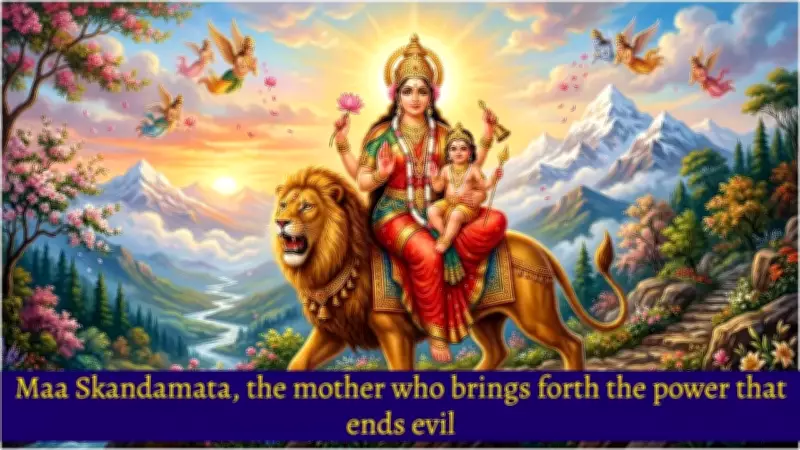
Skandamata's beautiful form is rich with profound symbolism that conveys her dual nature. She possesses four hands, each holding significant meaning:
- Two hands hold lotus flowers, symbolizing purity and spiritual enlightenment
- The third hand displays the Var Mudra, the gesture of granting boons and blessings
- The fourth hand lovingly cradles her child, Kartikeya, representing maternal devotion
Her mount adds another layer of symbolism—she rides a fiercely angry and powerful lion. Despite sitting atop this ferocious beast, her demeanor remains completely loving and motherly. This imagery presents a philosophical ideal: the perfect balance between immense power and nurturing grace. The lion's anger and her calm love coexist not as contradictions but as complementary aspects of one complete divine picture.
For spiritual practitioners, contemplating Skandamata's form—the two lotuses, the Var Mudra, the child in her arm, and the fierce lion beneath—can serve as guidance for balancing strength with compassion in daily life.