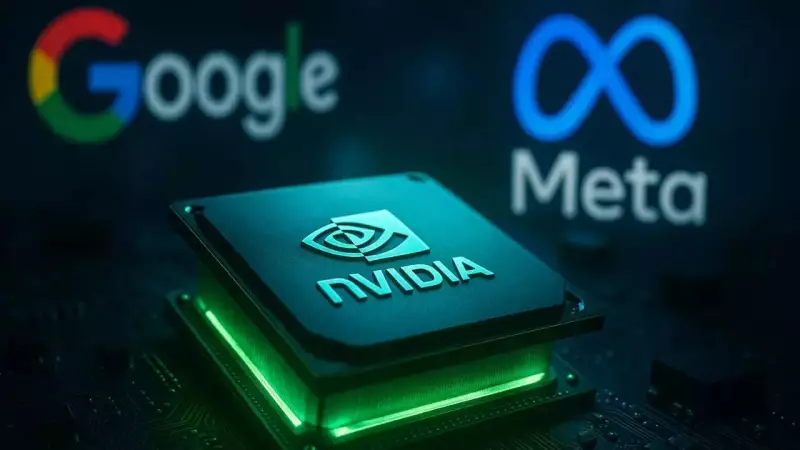
Technology giant Nvidia is facing increased scrutiny about its long-standing dominance in the artificial intelligence hardware market, as major tech companies explore alternative chip solutions for their AI workloads.
Market Pressure Mounts on Nvidia
The situation intensified when reports emerged that Meta is evaluating whether to adopt Google's in-house AI chips in its data centers. This development triggered immediate market reaction, with Nvidia's shares dropping by three percent as investors grew concerned about potential shifts in AI hardware supply chains.
The stock movement reflects growing worries that two of the world's largest AI platforms might begin moving portions of their computing workloads away from Nvidia's graphics processing units (GPUs). This speculation has put Nvidia's strategic positioning under the microscope, particularly as hyperscale companies consider mixed chip infrastructures to reduce dependency on single suppliers.

Nvidia's Strong Defense
In response to these challenges, Nvidia is pushing back firmly against questions about its market leadership. The company insists that its GPUs remain "a generation ahead of the industry" and emphasized that it is the only platform capable of running all major AI models across every computing environment.
The chipmaker highlighted the broader adaptability of its GPUs compared to Google's application-specific integrated circuits, which are designed for narrower functionality. Nvidia specifically pointed to the capabilities of its latest Blackwell generation, claiming it delivers superior performance, flexibility, and interchangeability when measured against specialized chip designs.
CEO Jensen Huang reiterated that scaling laws, which connect AI progress to greater computing power, ensure long-term rising demand for Nvidia systems. This argument forms the cornerstone of Nvidia's confidence in maintaining its market position despite emerging competition.
Google's AI Chips Gain Momentum
Google's custom AI chips have attracted fresh attention following the successful launch of Gemini 3, a highly-rated AI model that was trained entirely on the company's internal processors rather than Nvidia GPUs. This achievement has demonstrated the viability of Google's tensor processing units (TPUs) for demanding AI workloads.
While Google doesn't sell its chips directly to consumers, it deploys them extensively across its ecosystem and provides access to businesses through Google Cloud. The company reported that demand is increasing for both its custom chips and Nvidia's GPUs, indicating a dual-track strategy that maintains flexibility in hardware sourcing.
Industry analysts note that Google's chips are optimized for targeted AI workloads, offering strong efficiency and cost advantages in specific use cases. In contrast, Nvidia's GPUs serve as general-purpose accelerators used across a wider range of machine-learning frameworks, deployment settings, and enterprise applications.
This fundamental distinction explains why Nvidia continues to hold over 90 percent of the AI chip market despite rising interest in specialized alternatives. The company's scale, comprehensive software ecosystem, and broad industry adoption still provide it with a commanding lead in the competitive landscape.
However, as Google advances its in-house chips and Meta experiments with alternatives, the balance of power in AI hardware appears less certain than before. The next phase of competition will likely depend not just on raw performance metrics, but also on factors like cost efficiency, availability, and strategic partnerships within the technology industry.