The Enduring Quest for Water on Mars
For decades, scientists have peered at the Red Planet, captivated by a fundamental question: did water once flow across its rust-colored surface, and could any remain locked beneath its dusty exterior? As robotic missions multiply, they are gathering unprecedented data, transforming hopeful speculation into evidence-backed science and sharpening our understanding of Mars' aquatic history.
The discovery of water—whether in the form of ice, ancient river systems, or temporary briny flows—carries profound implications. It shapes our knowledge of the Martian climate, its geological evolution, and, most tantalizingly, the potential for past life. Recent analyses from orbiters and landers are now painting a more detailed and complex picture of where water existed and where it might still be found.
What the Landscape Reveals: A Wetter Ancient Mars
The Martian surface is scarred with geological formations that strongly suggest a watery past. Dried-up riverbeds, vast deltas, and ancient shorelines point to a time when the planet was far less arid. Craters and valleys appear eroded by flowing liquid, building the case for a much wetter ancient Mars.

More recently, the study of salt deposits has provided compelling evidence. These deposits, rich in chloride salts, are believed to be the remnants of ancient flooding, formed when water evaporated and left behind mineral traces. This evidence indicates that liquid water persisted on Mars until about 2 to 2.5 billion years ago, a timeline significantly longer than earlier estimates suggested.
This extended period of water availability revives crucial questions about how long habitable conditions lasted and whether microbial life could have emerged. Beyond surface features, scientists are also finding clues underground. Sediments in dunes near mountains contain gypsum and other minerals that typically form in wet environments. A recent study suggests that fluids once moved through ancient sand layers, leaving behind mineral signatures that hint at a significant role for subsurface water in shaping the Martian terrain.
The South Pole Lake Illusion: A Radar Mystery
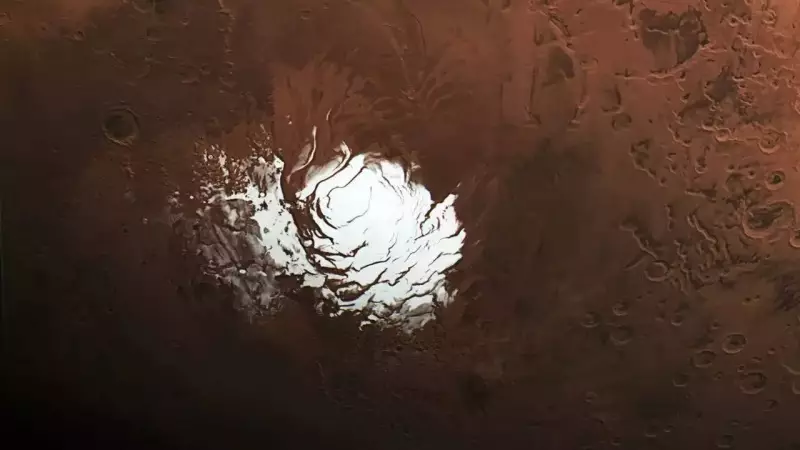
In 2018, a major announcement excited the scientific community: the potential discovery of a subsurface lake buried under the thick ice of Mars' south pole. The data, from the European Space Agency's orbiter, suggested radar reflections consistent with liquid water, raising the possibility of a stable habitat for life.
However, a new study published in Geophysical Research Letters casts serious doubt on this conclusion. Using a refined radar technique from the Mars Reconnaissance Orbiter (MRO), which involved a 'very large roll' manoeuvre to probe deeper, a research team detected only very faint radar echoes. These signals were far weaker than what would be expected from a body of liquid water.
The researchers now propose that the earlier bright signal likely came from a smooth layer of volcanic rock or sediment, not a subglacial lake. This finding raises significant doubts about the presence of a large, long-lived lake at the south pole. While it doesn't rule out water elsewhere, it weakens the case for this specific location, highlighting the need for more advanced radar surveys in the future.
Is Water Still Flowing on Mars Today?
While stable lakes may be a thing of the past, Mars appears to host transient water-related activity even today. Observations from MRO's spectrometers have identified hydrated salts on slopes where dark streaks, known as Recurring Slope Lineae (RSL), appear during warmer seasons and fade when it gets colder.
The behavior of these streaks is consistent with the presence of briny liquid flows. The salts involved, such as magnesium and sodium perchlorates, lower the freezing point of water, allowing it to remain liquid temporarily under Mars' low atmospheric pressure. Research shows these hydrated salts are present when the streaks are visible and disappear when temperatures drop.

This pattern offers the strongest evidence yet that Mars is not completely dry today. These flows are shallow, short-lived, and briny—not pure water—but they demonstrate that water activity on Mars is not confined to a distant epoch. Instead, ongoing interactions between salts, temperature, and geology create temporary moisture near the surface, a dynamic process that continues to shape the planet's modern habitability.
Rewriting the Martian Water Story
The evolving narrative of water on Mars is driven by technological advances. The re-examination of the south pole with refined radar techniques shows how new methods can overturn previous assumptions. By comparing data from different orbiters, scientists are getting better at distinguishing between ice, rock, and potential water reservoirs.
Furthermore, soil studies reveal that the Martian regolith is not a uniform sponge. Water distribution is highly uneven across the planet, with some areas being far more absorptive and capable of trapping moisture or ice near the surface than others. This challenges older models and suggests that much of Mars' water history may be hidden in unexpected, localized pockets.
These developments encourage a nuanced view where past floods, ice caps, subterranean water movement, and seasonal brine flows all play a part. As instruments improve and surveys expand, the goal remains to pinpoint where water, or its traces, still lies dormant, helping us understand how Mars transformed from a wetter world into the desert planet we see today.