

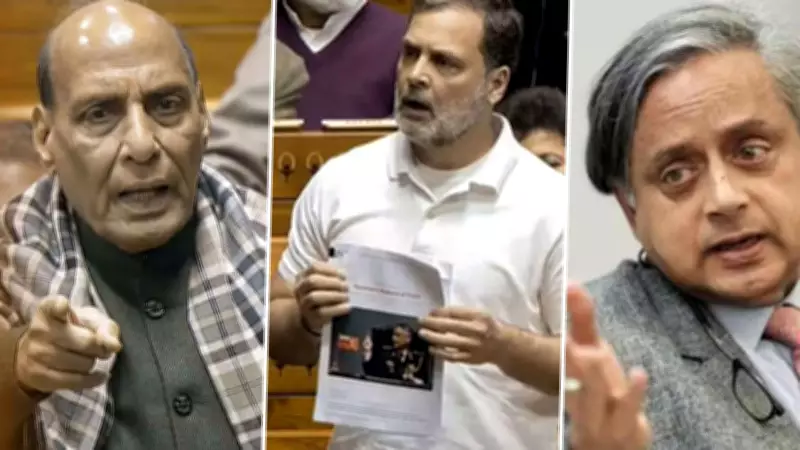
The Budget Session of Parliament witnessed intense political drama on Monday as a fiery exchange erupted between the ruling Bharatiya Janata Party and opposition leaders over Congress MP Rahul Gandhi's attempt to cite from the unpublished memoir of former Army Chief General MM Naravane.
Parliamentary Clash Over Unpublished Material
During the Lok Sabha proceedings, Rahul Gandhi referenced General Naravane's memoir while responding to BJP MP Tejasvi Surya's comments questioning the Congress party's patriotism. The move immediately sparked controversy, with Defence Minister Rajnath Singh rising to object, stating that unpublished material cannot be quoted in Parliament and accusing Gandhi of attempting to mislead the House.
Speaker's Ruling and BJP's Strong Reaction
Speaker Om Birla upheld the Defence Minister's objection, ruling that such unpublished content could not be read out in the parliamentary chamber. This decision triggered a strong reaction from BJP leaders who launched a scathing attack on the Congress leader.

Union Minister Kiren Rijiju, Giriraj Singh, and BJP MP Nishikant Dubey led the charge against Gandhi, with Rijiju calling the citation "nonsense and lies" that compromised national security. The BJP leaders also referenced what they described as the Congress party's poor track record on national security during their governance years.
Opposition's Vigorous Defence
In sharp contrast, opposition MPs rallied to defend Rahul Gandhi's parliamentary rights. Congress leader Shashi Tharoor clarified that Gandhi had actually referenced a publicly available magazine article discussing the memoir, not the unpublished book itself. Tharoor emphasized the importance of allowing parliamentarians to raise crucial national security matters without unnecessary restrictions.
TMC MP Kalyan Banerjee and RJD's Manoj Kumar Jha joined the defence, arguing that the essence of parliamentary democracy lies in open debate on matters of national importance. They stressed that discussions about border security and external threats should not be stifled by procedural technicalities.
Broader National Security Concerns Raised
Samajwadi Party chief Akhilesh Yadav entered the fray, highlighting the critical need to discuss China's growing threat along India's borders. Yadav emphasized that national security issues deserve serious attention in Parliament, regardless of political differences, and that the House should serve as a platform for transparent discussions about the country's defence preparedness.
The parliamentary confrontation underscores the deepening political divisions over how national security matters should be addressed in India's democratic institutions. While the BJP maintains that unpublished materials cannot form the basis of parliamentary discussions due to security concerns, opposition parties argue that such restrictions should not prevent legitimate debates about the country's defence challenges.
This incident has reignited discussions about parliamentary procedures, freedom of speech within legislative bodies, and the appropriate boundaries for discussing sensitive security matters in a democracy. As India faces complex security challenges along its borders, the debate over how Parliament should engage with these issues continues to evolve, reflecting broader tensions between governmental transparency and national security considerations.






