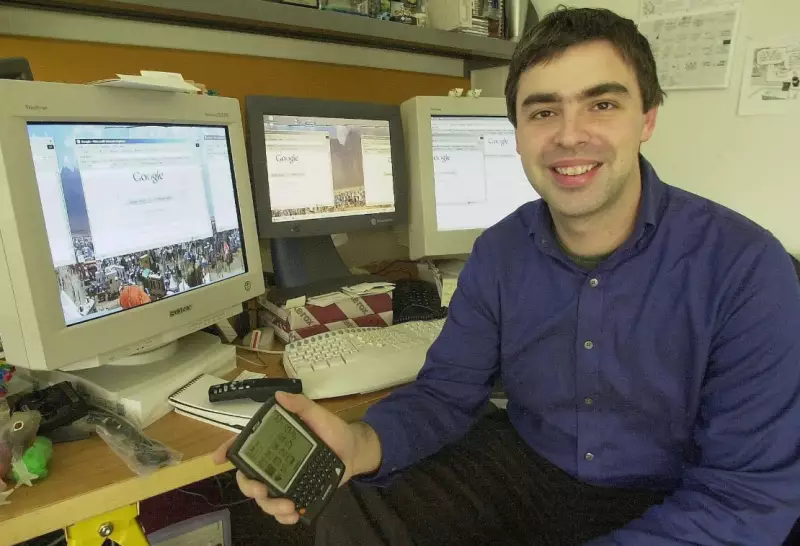
In a remarkable financial turnaround, Google co-founder Larry Page has rapidly climbed back into the elite circle of the world's wealthiest individuals. The tech visionary's re-entry into the global top five billionaires list comes with unprecedented speed, driven primarily by the successful launch of Google's latest artificial intelligence marvel.
The Wealth Surge: From AI Innovation to Financial Dominance
According to the Forbes Real-Time Billionaires List, Larry Page has now secured the third position among the world's richest people with a staggering net worth of $246.2 billion. This places him ahead of Amazon founder Jeff Bezos, who currently holds $233.5 billion. The dramatic wealth increase is directly linked to the market's enthusiastic response to Google's Gemini 3 artificial intelligence model, demonstrating how cutting-edge AI technology continues to reshape global wealth distribution.
The financial milestone represents more than just numbers on a balance sheet. It underscores the enduring impact of Page's early vision and the infrastructure he helped build decades ago, which now forms the foundation for Google's AI ambitions.

The Formative Years: Building Blocks of a Tech Visionary
Larry Page's journey to becoming one of the most influential figures in modern computing began in 1973 in Lansing, Michigan. Born into an environment where computers were everyday tools rather than luxury items, Page enjoyed early exposure to technology that would shape his future. His father, Carl Victor Page Senior, served as a computer science professor, while his mother, Gloria Page, taught programming.
The household environment proved instrumental in nurturing young Page's curiosity. He frequently dismantled devices to understand their inner workings and completed school assignments using word processors long before most children had access to such technology. Beyond computers, music played a significant role in developing his sense of timing and discipline—qualities that would later influence his approach to computing.
Academic Journey: From Engineering Experiments to Stanford Breakthrough
Page's formal education began at Okemos Montessori School, followed by East Lansing High School where he graduated in 1991. His undergraduate years at the University of Michigan saw him complete a Bachelor of Science in Engineering with a major in Computer Engineering. During this period, Page demonstrated remarkable ingenuity through various projects that hinted at his future trajectory.
He constructed an inkjet printer from Lego bricks, participated in the university's solar car team, and even proposed a driverless monorail system to replace campus buses. These weren't random experiments but reflected his growing interest in systems—how they moved, scaled, and could be optimized for speed.
The turning point arrived when Page moved to Stanford University for a Master of Science in Computer Science in 1998, later enrolling in its PhD program. While searching for a dissertation topic, he became fascinated by the mathematical structure of the World Wide Web and how link analysis could determine page importance.
This research direction, encouraged by his supervisor, led to the creation of PageRank algorithm developed alongside fellow student Sergey Brin. What began as academic curiosity evolved into the foundation of Google, launched in 1998, revolutionizing how people accessed information online.
Corporate Leadership and Lasting Legacy
Page served as Google's first CEO from 1997 to 2001, temporarily stepping aside when Eric Schmidt joined, then returning to leadership in 2011. When Google reorganized into Alphabet Incorporated in 2015, Page became its founding CEO. Though he stepped down from executive duties in 2019, he remains a board member, employee, and controlling shareholder.

Throughout his career, Page maintained consistent focus on improving speed, scaling systems, and reducing friction in information access. The current success of Google's AI models, including Gemini 3, builds directly upon infrastructure originating from those early experiments in link analysis and computation.
The recent wealth ranking reshuffle highlights how Page's childhood curiosity, engineering education, and Stanford research continue to influence today's technological landscape. As artificial intelligence dominates global economic discussions, Page's journey reminds us that today's most significant technological shifts often trace back to fundamental questions asked by students determined to make information more accessible and useful.