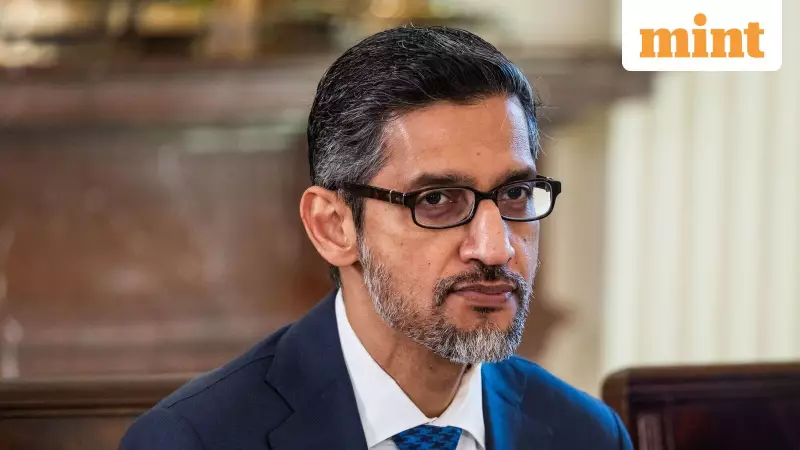
In a revealing interview that has sent ripples across the corporate world, Google CEO Sundar Pichai has suggested that artificial intelligence might eventually replace chief executive officers, describing the CEO role as potentially "one of the easier things" for AI to perform.
The CEO's Candid Admission
During an exclusive conversation with the BBC, the Alphabet Inc. chief executive was directly questioned about whether artificial intelligence could threaten all jobs, including his own high-profile position. Pichai responded with a subtle smile before delivering his surprising assessment of AI's potential reach into the C-suite.
"I think what a CEO does is maybe one of the easier things, maybe for an AI to do one day," Pichai stated, acknowledging the technology's growing capabilities. The interview took place against the backdrop of his recent participation in the White House Task Force on AI Education in Washington, DC, on September 4, 2025.

Reflecting on his long-standing position about artificial intelligence, Pichai recalled his earlier statement that "AI is the most profound technology humanity has ever worked on, and it has potential for extraordinary benefits." However, he also cautioned that society must prepare for significant disruptions as this technology evolves.
Broader Implications for the Workforce
The Google CEO elaborated on how artificial intelligence will transform the employment landscape, noting that while the technology will eliminate certain jobs, it will also "evolve and transition" others. This transformation will require people to adapt to new ways of working across various professions.
Pichai emphasized that AI will ultimately create new opportunities, using content creation as a prime example. "As an example, like YouTubers, anybody will be able to create the content...It will evolve and transition certain jobs, and people will need to adapt," he explained.
His advice to the next generation was clear: embrace artificial intelligence rather than resist it. "People who adopt and adapt to AI will do better," Pichai asserted, adding that this principle applies universally across professions from teaching to medicine. He assured that these professions would continue to exist, but success within them would increasingly depend on mastering AI tools.
Divided Opinions Among Tech Leaders
Pichai's comments align with similar sentiments expressed by other prominent figures in the technology sector who foresee a new era of "chief executive automations."
OpenAI CEO Sam Altman has previously stated that artificial intelligence will eventually perform his job better than he can, expressing enthusiasm for that development. Similarly, Sebastian Siemiatkowski, CEO of buy-now-pay-later company Klarna, declared in a social media post earlier this year that "AI is capable of doing all our jobs, my own included."
These perspectives find support in research data. According to a Fortune report citing a survey by online learning platform edX, 49 percent of 500 chief executives believed that "most" or "all" of their job functions should be automated by artificial intelligence.
However, not all tech leaders share this view. Nvidia CEO Jensen Huang offered a contrasting perspective when questioned last year about whether AI could replace him. "Absolutely not," Huang responded, arguing that AI remains far from replacing workers on a massive scale. While acknowledging that artificial intelligence might excel at specific tasks, sometimes performing them up to 1,000 times better than humans, he maintained that "As we speak, AI has no possibility of doing what we do."
The discussion around artificial intelligence's role in executive leadership continues to evolve as the technology advances, with Pichai's comments adding significant weight to the conversation about automation's potential reach into the highest levels of corporate management.