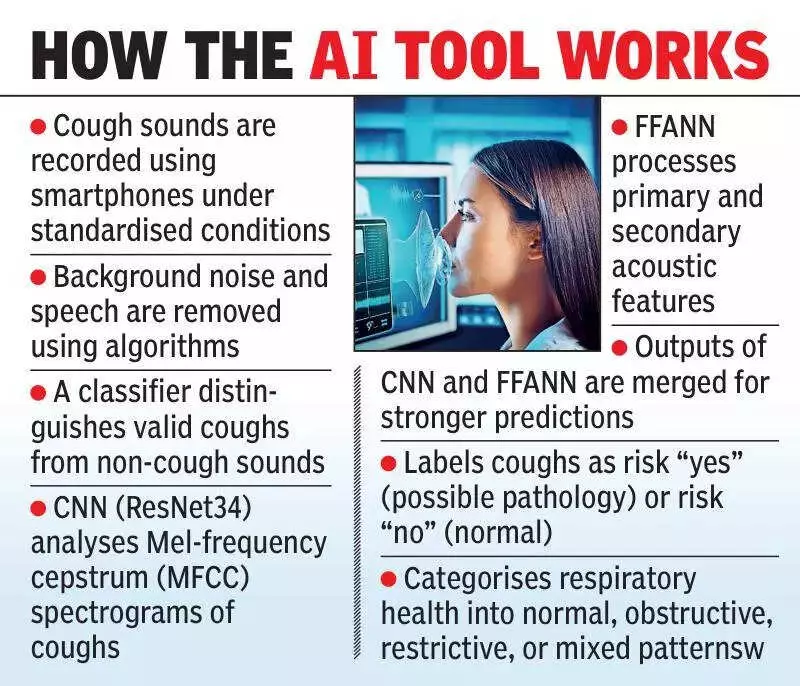
In a significant breakthrough for medical technology, an international research team has validated an artificial intelligence tool that can screen for respiratory diseases simply by analyzing cough sounds. The pioneering study conducted in Visakhapatnam demonstrates how AI could revolutionize healthcare access in remote areas.
Revolutionary AI Screening Platform
The research involved teams from Andhra Medical College in Visakhapatnam along with institutions from the United States and United Kingdom. They evaluated the Swaasa AI platform, developed by Salcit Technologies, which uses patented technology to decode the unique sound patterns in human cough.
Dr. PV Sudhakar, former principal of Andhra Medical College and lead investigator, explained the concept behind the technology. "The technology draws on the idea that cough sounds carry meaningful diagnostic clues," he told Times of India. "Diagnosing respiratory disease usually requires detailed medical history, physical exam, spirometry, and imaging like X-rays. Such tests are resource-heavy and often unavailable in remote areas."

Impressive Clinical Results
The study enrolled 400 participants from the Simhachalam rural healthcare centre, with conclusive data obtained from 355 participants after excluding 45 cases with inconclusive cough data. The results published in Scientific Reports, a Nature journal, revealed remarkable performance metrics.
The AI system achieved a sensitivity of 97.27%, meaning it correctly identified nearly all individuals with respiratory disorders while minimizing false negatives. The accuracy of the risk classifier stood at 87.32%, indicating reliable identification of healthy individuals and reduction of false positives.
Beyond Simple Detection: Disease Classification
The platform's capabilities extend beyond basic risk assessment. It can classify respiratory issues into specific categories:
- Normal - healthy respiratory function
- Obstructive - commonly seen in asthma and COPD
- Restrictive - often linked to conditions like pulmonary fibrosis
- Mixed - displaying characteristics of both obstructive and restrictive patterns
Dr. Sudhakar, currently serving as dean at NRI Institute of Medical Sciences, noted the strong agreement between pulmonologists' assessments and the AI findings. "When compared with physicians' assessments, the model achieved a sensitivity of 97.27%. There was also strong agreement between the patterns identified by pulmonologists and the findings generated by Swaasa," he stated.
Transforming Rural Healthcare
With respiratory illnesses increasing globally, researchers emphasize that AI-based screening tools could significantly reduce pressure on healthcare systems. The technology enables earlier detection and intervention, particularly valuable in remote regions where doctors and diagnostic equipment are scarce.
The research team included contributors from Andhra Medical College, Salcit Technologies, C-CAMP, Qure.Ai Technologies, University of Oxford, and Northeast Ohio Medical University. Their collaborative effort represents a major step toward making AI-powered medical screening accessible through portable devices or mobile applications for community healthcare settings.
This innovation in cough sound analysis marks a promising frontier in telemedicine and preventive healthcare, potentially bringing specialist-level diagnostic capabilities to the most underserved populations.