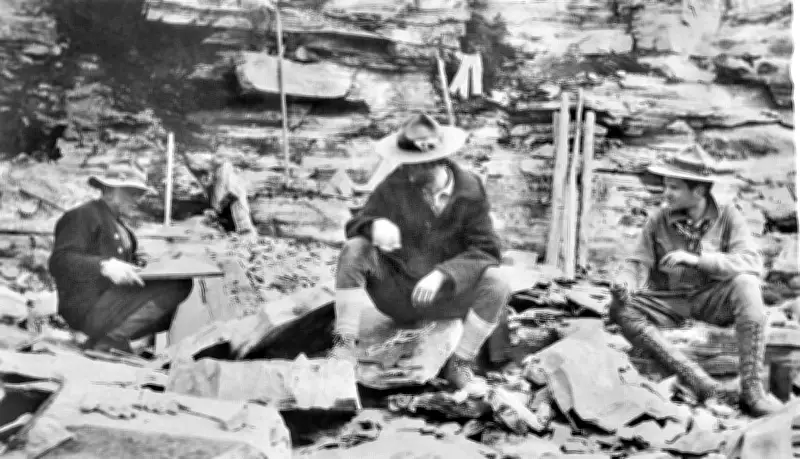
Imagine the final evening of a mountain expedition, with the sun dipping below the horizon, bags packed, and thoughts drifting toward the journey home. It was during such a moment in August 1909 that Charles Doolittle Walcott, then Secretary of the Smithsonian Institution, encountered an extraordinary stone while riding a horse through a rugged section of Yoho National Park in British Columbia, Canada.
A dark piece of rock blocked his path. When he moved it aside, he uncovered something remarkable: the delicate impressions of ancient soft-bodied life forms. While Walcott had spent his entire career hunting for fossils, this particular find was unique. Typically, fossils preserve only hard structures like shells, teeth, or bones, as soft tissues decompose too quickly to leave traces. However, the shale at this remote mountain pass acted like a prehistoric high-definition camera, capturing detailed silhouettes of species from the Cambrian Explosion. This brief encounter did not merely mark the end of an exploration season; it laid the foundation for scientific breakthroughs that continue more than a century after Walcott first discovered the Burgess Shale formation.
A Geologic Wonder of the Canadian Rockies
The scale of the discovery was immense. Walcott spent another 15 years exploring the area and amassed over 65,000 fossils at one point. This was no accident; the Burgess Shale formation is a unique phenomenon known as a lagerstätte, a geological term for a deposit with exceptional preservation. The rocks contain fossils of bizarre creatures that appear almost lifelike, some with five eyes and spiked bodies.

One of the most astonishing aspects is that the site preserved not just outlines but the actual chemical composition of the organisms. In a paper titled “Discovery of 505-million-year-old chitin in the basal demosponge Vauxia gracilenta,” researchers found biological materials such as chitin in the fossils. Consequently, this rock formation has not only saved the outlines of ancient sea fauna but also kept organic tissues intact for over 500 million years, an extremely rare occurrence in paleontology. Now, scientists can explore the anatomy of creatures that went extinct long before the first dinosaurs appeared. This geological wonder, a lagerstätte, has provided unprecedented insights into the Cambrian Explosion, showcasing diverse body plans and even retaining organic tissues. The site continues to yield discoveries, deepening our understanding of early complex life and its evolution.
The Significance of the “Strange” Fossils Today
This fossil bed represents the best available source of information on the development of complex life. Before Walcott’s expedition, science had an incomplete picture of early animal evolution. Thanks to the Burgess Shale, humanity learned about an incredibly diverse and colorful ecosystem where nature experimented with many different body plans. Some of these plans survived to become the foundation of all living organisms, while others became evolutionary dead ends.
The scientific importance of the site continues to grow as new outcrops are discovered. In a research paper published in Nature Communications, experts explain that Walcott’s original locality was just the beginning. Newer sites in the same region have revealed even more soft-bodied taxa, showing that this “exquisite preservation” was part of a larger ancient environment. These finds help us understand how the oldest animal communities on the seafloor interacted, what they ate, and how they survived in a world that was still very young.
Walcott’s discovery offers a subtle lesson: the greatest breakthroughs often happen when least expected. During a brief trip along a mountain path, Walcott opened doors to an ancient world nearly half a billion years old. Taking the time to examine a piece of “black rock” led to unlocking the gateways to understanding the emergence of life forms on Earth.