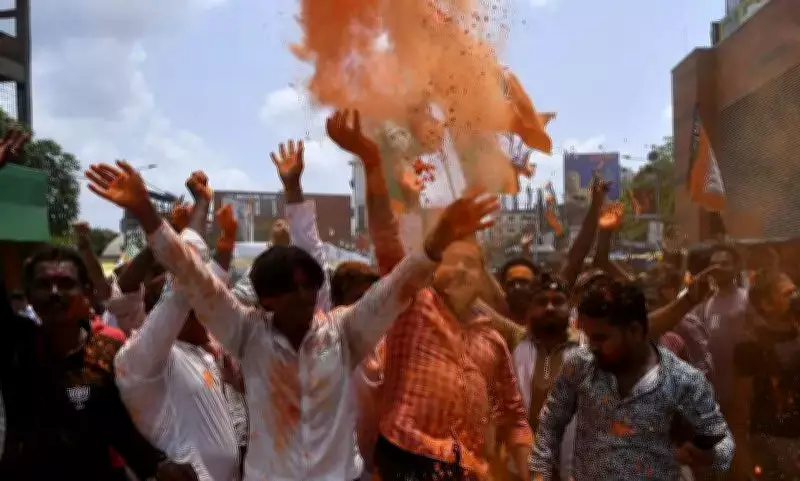
The Bharatiya Janata Party made significant gains in the Barrackpore and Howrah industrial belts of West Bengal, with election results shaped largely by economic grievances linked to industrial decline and factory closures. In Barrackpore, constituencies such as Bhatpara, Noapara, Jagaddal, Naihati, and Bijpur witnessed one of the sharpest reversals for the Trinamool Congress in a region it had dominated since 2011. Voters in these densely populated working-class areas, including many from Hindi-speaking migrant families connected to the jute and engineering economy, appeared to consolidate against the incumbent amid continuing industrial ruin, resentment, and drift.
Barrackpore's Political Shift
Barrackpore's politics had long centred on labour networks, union influence, local strongmen, and control over neighbourhood economies. As factories closed and industrial employment shrank, political influence shifted into other channels, including real estate on former industrial land. In several areas, residents complained that organised politics increasingly revolved around syndicates, ferry contracts, sand mining, gambling dens, and territorial control rather than jobs, wages, or investment. Krishnendu Ghosh, who runs a cable business, noted that the growing incidence of anti-social activities further fuelled resentment among locals, contributing to the erosion of the Left's traditional support base and then Trinamool's.
The BJP's rise in the Barrackpore belt was notable because the region was widely seen as politically charged, violence-prone, and tightly controlled by entrenched local networks. However, on polling day, several areas known for intimidation and clashes saw unusually peaceful voting and heavy turnout. In Bhatpara, Jagaddal, Kankinara, and Noapara, the absence of large-scale violence appeared to allow deeper anti-incumbent sentiment to surface. As counting trends became clear, BJP candidates moved ahead across much of the belt. Kaustav Bagchi in Barrackpore, Arjun Singh in Noapara, Pawan Singh in Bhatpara, Rajesh Kumar in Jagaddal, Sudipta Das in Bijpur, and Sumitro Chatterjee in Naihati established leads, with most of these seats having been held by Trinamool for three consecutive terms. The scale of the shift suggested broader dissatisfaction with Trinamool's ability to revive the industrial region, rather than only discontent with individual MLAs.

Industrial Stagnation as a Key Factor
Observers and local voices linked the outcome to a longer history of industrial stagnation. The decline in Barrackpore began from the 1980s, deepened through the later Left years, and continued under Trinamool rule. For many voters, the distinction between regimes appeared to have lost meaning, leaving a sense that successive governments managed unemployment better than they created employment, enabling the BJP to present itself as a vehicle for disruption. Arjun Singh, the BJP candidate from Noapara, said, "This victory was expected and should have come much earlier."
Howrah's Similar Pattern
A similar pattern played out in Howrah, where industrial decline became a central electoral issue in Bally, Howrah North, Howrah Central, Howrah South, and Shibpur. The BJP benefited from resentment among workers and families linked to closed factories, jute mills, cotton mills, and small industrial units. The Howrah outcome also drew attention because of a shift among a section of Muslim voters. In several industrial constituencies, Muslim worker communities affected by factory closures did not vote in the expected pattern. Local assessments suggested roughly one-fifth of Muslim voters in some areas backed the BJP, while smaller sections moved towards the Left and Congress. Masud Alam Khan, president of the non-political organisation Howrah Sramik Kalyan Samiti, said, "The extreme distress and frustration of the non-Bengali Hindu and Muslim worker communities in these closed industrial areas are evident."

Among Muslim families tied to closed industrial units, disappointment with Trinamool reportedly built since 2025. Many families saw relatives leave for work in other states, including BJP-ruled ones, as local opportunities declined. In these neighbourhoods, the BJP's campaign appeared to gain traction by focusing on economic abandonment, law-and-order concerns, and anger at local political intermediaries. Gouranga Bhattacharya, president of Howrah BJP, said, "We received support from nationalist Muslims during the campaign, and this influence was seen in the votes."
Industrialist Views and Trinamool Response
Industrialist Ram Ratan Chowdhary said the decline that began in the Left era worsened over the past 15 years because of harassment, non-cooperation, land-related complications, and a hostile climate for investment. The perception of industrial belts being sacrificed to patronage politics fed into the BJP's narrative. Howrah Trinamool functionaries acknowledged that harassment of industrialists by sections of the party occurred and said the reasons behind Muslim disenchantment needed review. Arup Roy, chairman of Howrah Trinamool and candidate for Howrah Central, said, "Our government has created many industries, but due to non-cooperation from the Centre, many problems could not be resolved."