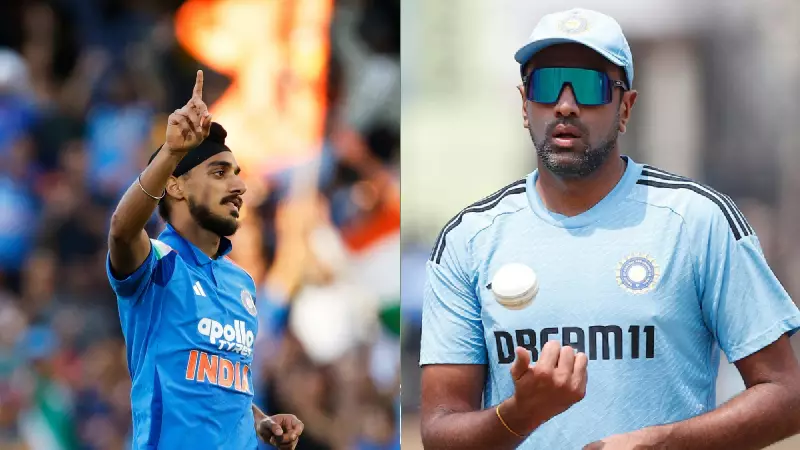
Veteran Indian spinner Ravichandran Ashwin has raised pointed questions about the team management's decision to leave fast bowler Arshdeep Singh out of the playing eleven for the first One Day International against New Zealand. Ashwin took to social media to express his concern, suggesting that such a move disrupts a player's rhythm and continuity.
Ashwin's Social Media Critique
While never explicitly naming Arshdeep Singh, Ashwin's posts on platform X were clear in their intent. He first posted a cryptic message asking, "Where-is-deep Singh? That's all #INDvsNZ." When a user responded by noting that Arshdeep is part of India's squad for the upcoming T20 World Cup, Ashwin elaborated on his viewpoint.
"Resting someone shouldn't be after he gets in the squad. Resting means he gets rested like Bumrah," Ashwin stated, drawing a comparison with premier pacer Jasprit Bumrah, who was not included in the ODI squad at all. He emphasized the potential negative impact, adding, "The lack of continuity can impact rhythm and hence performance." His comments highlight a perceived inconsistency in handling player workload and selection.

India's Pace Battery Steps Up
In the first ODI, the Indian team opted for a pace attack comprising Mohammed Siraj, debutant Harshit Rana, and Prasidh Krishna. The decision proved effective as the trio played a pivotal role in India's defense of a moderate total. On a pitch offering little assistance to spinners, the fast bowlers shouldered the responsibility.
Mohammed Siraj was the standout performer, delivering a controlled spell of 2 for 40. His use of slower balls, cutters, and varied lengths successfully stalled New Zealand's chase during the middle overs. Debutant Harshit Rana made a crucial breakthrough, dismissing both set openers—Henry Nicholls and Devon Conway—in quick succession to break a dangerous 117-run opening stand.
While Prasidh Krishna was expensive, he used his height effectively at the death, bowling short-of-length deliveries that made it difficult for the batters to accelerate. Collectively, the pacers finished with figures of 6 for 165 from 30 overs, generating an impressive dot-ball percentage of 46.9. This pressure ultimately compensated for the spinners' struggle to take wickets on an unresponsive surface.
Selection Dilemma and the Road Ahead
Ashwin's comments have sparked a debate on selection philosophy, especially concerning players who are regulars in the T20 setup but are in and out of the ODI side. The management's choice to pick Arshdeep in the squad but not play him, while categorizing Bumrah's absence as a clear 'rest', appears to be the core of Ashwin's argument for clearer communication and consistent player management.
The performance of Siraj, Rana, and Krishna in this match will likely make it challenging for Arshdeep Singh to break into the lineup for the subsequent games, barring any rotation or tactical changes. The incident underscores the delicate balance teams must strike between managing player workloads, building continuity, and rewarding current form.
As the series progresses, it remains to be seen how the team management addresses this rhythm and continuity concern raised by one of the squad's most senior thinkers, especially with major tournaments on the horizon.