From Celebrated Strategist to Political Outsider: The Prashant Kishor Lesson
When Prashant Kishor launched Jan Suraaj in Bihar, he aimed to disrupt the state's entrenched caste politics with a fresh narrative focused on governance failures, migration, and job creation. His message resonated with many voters who were disillusioned with traditional politics. However, when election results were declared, the anticipated electoral breakthrough failed to materialize.
Kishor's journey from celebrated political strategist to struggling politician underscores a harsh reality in Indian politics. Breaking through systems built on long-standing loyalties and intricate social networks remains an enormous challenge for outsiders, no matter how compelling their pitch might be.
Tamil Nadu's Cinematic Political Landscape
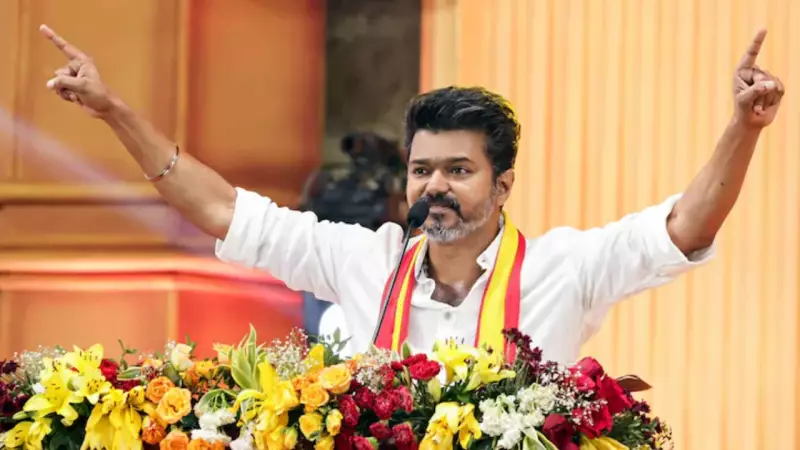
As Tamil Nadu prepares for another assembly election, a familiar narrative is unfolding once again. Actor Vijay Thalapathy has positioned himself as a political alternative in a state where power has traditionally oscillated between two dominant Dravidian parties: the Dravida Munnetra Kazhagam (DMK) and the All India Anna Dravida Munnetra Kazhagam (AIADMK).

But will Vijay face the same fate as Prashant Kishor? The crucial difference lies in Tamil Nadu's unique political culture where cinema doesn't merely entertain but often governs. Film stars are worshipped with religious fervor in this southern state, with fans performing rituals like milk baths on towering cut-outs before movie screenings. Many stars even have dedicated temples across Tamil Nadu.
The Star-Politician Legacy: Successes and Struggles
This extraordinary popularity has historically motivated Tamil film stars to transition into politics, attempting to convert their massive fan following into electoral support. The most successful examples remain M.G. Ramachandran and Jayalalithaa, who abandoned active film careers to become chief ministers. MGR governed Tamil Nadu for over a decade, while Jayalalithaa served as chief minister for more than 14 years across six terms.
Several other actors have followed this path with varying degrees of success. Rajinikanth, Kamal Haasan, Sivaji Ganesan, and Vijayakanth have all experimented with political careers, with some becoming full-time politicians. However, many discovered that cinematic stardom doesn't automatically translate into electoral victory.
Kamal Haasan launched his party, Makkal Needhi Maiam, in February 2018, positioning it as a centrist, non-Dravidian alternative. Despite initial enthusiasm, the party failed to win a single seat in the 2019 Lok Sabha elections. In the 2021 Tamil Nadu assembly elections, Haasan himself contested from Coimbatore South but lost to the BJP candidate. The party managed to secure only about 2.6 percent of the statewide vote.
By March 2024, MNM joined the DMK-led Secular Progressive Alliance ahead of general elections, opting for alliance-building over ideological isolation. This strategic shift earned Haasan a Rajya Sabha seat as part of the alliance's power-sharing arrangement.
Rajinikanth's political journey took a different turn. After making a euphoric announcement about launching a political party that would contest all 234 assembly seats, he unexpectedly reversed his decision, citing health concerns. In an emotional three-page statement, he expressed profound sadness about his inability to enter electoral politics while promising to serve people outside the political arena.
Vijay's Distinct Political Strategy
Unlike his contemporaries Rajinikanth and Kamal Haasan, Vijay has made a decisive break from his film career after 33 years in the industry. His upcoming film Jana Nayagan, if released, will mark his final cinematic appearance. This complete separation from cinema represents a strategic attempt to address what political analysts call the "credibility gap" that has historically plagued actor-politicians.
"Politics is not a time pass for me. It is a deep quest. I wish to immerse myself completely in politics," declared the 51-year-old actor. "I have decided to dedicate myself entirely to the service of the people after completing my responsibilities toward one more film I have signed up for."

This full-time commitment mirrors the approach of successful actor-politicians like MGR and Jayalalithaa, who demonstrated that sustained political engagement rather than episodic involvement between film projects builds voter trust in Tamil Nadu's political landscape.
Organized Fandom: TVK's Political Foundation
Ahead of the upcoming elections, Vijay's political party, Tamilaga Vettri Kazhagam (TVK), has demonstrated remarkable crowd-pulling capability. In October 2024, the party's first state conference in Vikravandi attracted over 8 lakh people. Thousands regularly attend Vijay's rallies across Tamil Nadu, drawn from every class, gender, and age group.
What distinguishes Vijay's political movement is its organized structure. Unlike many film stars whose support remains largely informal, Vijay's followers have demonstrated political effectiveness. During the 2021 local body polls, candidates from his fan clubs won 115 of the 169 seats they contested.
His fan organizations have evolved beyond mere admiration societies, taking on roles as:
- Social media activists promoting the party's message
- Organizers of blood donation camps and free medical check-ups
- Providers of educational support and disaster relief services
- Ground-level political workers during elections
TVK has cultivated a significant social media presence that Vijay claims is India's largest political digital force. "TVK's social media army is the biggest in India — not just our claim, but what others are saying after witnessing it," he announced. "You are no longer just fans on social media; you are TVK's virtual warriors."
Electoral Challenges and the Karur Stampede Shadow
Despite this impressive mobilization, Tamil Nadu's electoral history suggests that crowd enthusiasm doesn't automatically convert into seat victories. Booth-level organization, intricate caste arithmetic, and alliance mathematics continue to play decisive roles in determining electoral outcomes — factors that even popular actors have struggled to master during their initial political forays.
The tragic Karur stampede, which claimed 41 lives, presents another significant challenge for Vijay and TVK. Both the AIADMK and DMK have blamed TVK functionaries for the incident, accusing Vijay of mismanagement that allegedly led to chaos during the September event.
The Central Bureau of Investigation (CBI) has been questioning Vijay about the stampede, consuming time that could otherwise be devoted to pre-poll strategy and campaigning. On January 19, the agency questioned the TVK chief for over six hours at its New Delhi headquarters for the second time regarding the case.
Officials revealed that investigators posed numerous questions about:
- Decision-making processes regarding the rally
- Reasons for delays in program commencement
- Continuation of speeches despite emerging chaos
- Knowledge of crowd mismanagement issues
- Overall turnout and organizational preparedness
The political impact of this investigation remains uncertain. While rival parties frame the stampede as evidence of administrative inexperience, sections of Vijay's support base view the probe as pressure politics — a narrative that could either erode confidence or consolidate sympathy depending on how the case unfolds closer to polling.
TVK's Potential Impact on Tamil Nadu Politics
Since Independence, Tamil Nadu's chief ministerial position has largely alternated between the two Dravidian parties, with only a brief Congress interlude. Vijay's entry as a political challenger offers voters a genuine third option for the first time in decades.
His emergence has introduced new strategic calculations for both established parties. The DMK appears concerned about losing sections of its youth and urban vote share, while the AIADMK is closely monitoring whether TVK will dent its traditional base or cut deeper into the ruling party's support.
Amid reports that the BJP has been pressuring him to join the National Democratic Alliance — leveraging both the CBI inquiry and delays in certification for his film Jana Nayakan — Vijay has maintained his independence. "TVK would contest the assembly elections on its own and win if other parties chose not to align with it," he asserted.
He has positioned his party as an anti-corruption alternative, declaring: "Unlike the party that ruled and the one that is ruling, we will not allow corruption … I won't touch a paisa, you know that I don't need to touch that." He acknowledged that cleaning up the system represents a gradual process rather than an overnight transformation.
The Kingmaker Possibility
Even if TVK emerges only as the third-largest party, its presence could fundamentally alter Tamil Nadu's political arithmetic. In a potentially fractured mandate, a strong TVK performance could position Vijay as a potential kingmaker — reshaping alliance dynamics and bargaining power within the state.
In this emerging tripartite contest, several scenarios could unfold:
- Vijay could emerge as an unexpected winner, breaking the Dravidian duopoly
- TVK might split votes to the advantage of either DMK or AIADMK
- The party could secure enough seats to influence government formation
- Vijay's political experiment might follow the path of other actor-politicians who failed to convert popularity into electoral success
Just as box office collections determine a film's commercial fate, election results will ultimately reveal whether Vijay succeeds or fails in his ambitious political transition. His journey represents more than just another star entering politics — it tests whether organized fandom, anti-corruption messaging, and full-time commitment can overcome Tamil Nadu's deeply entrenched political structures and caste-based voting patterns.