The Enduring Political Shadow of M.G. Ramachandran in Tamil Nadu
Four decades after the passing of iconic AIADMK leader and former Chief Minister M.G. Ramachandran, Tamil Nadu's political landscape remains profoundly shaped by his legacy. Despite no concrete evidence that invoking his name translates directly into electoral victories, parties across the spectrum continue to fiercely compete in claiming his political and cultural mantle.
A Multifaceted Political Strategy
This phenomenon has become particularly pronounced as the AIADMK faces significant electoral setbacks and internal challenges. The party's vote share has declined substantially—from approximately 40% in the 2016 Assembly elections to 33.3% in 2021, with further drops in recent Lok Sabha polls. This weakening, compounded by factionalism and the absence of a unifying figure like the late J. Jayalalithaa, has created a political vacuum that multiple actors are attempting to fill through association with MGR.
Prime Minister Narendra Modi himself invoked MGR's legacy during his visit to Malaysia last month, noting on social media platform X that Malaysian Prime Minister Anwar Ibrahim, "like several of us in India, is a big fan of MGR!" Modi highlighted that the song 'Naalai namathe' from an MGR film was performed at a lunch hosted by Ibrahim.

Meanwhile, Tamil Nadu Chief Minister M.K. Stalin frequently references his personal connection to the late leader, calling him "periyappa" (respected uncle) in public addresses and expressing admiration for songs from classic MGR films.
The BJP's Foray into MGR Symbolism
The Bharatiya Janata Party has also strategically engaged with MGR's legacy. During L. Murugan's 2020 Vel Yatra, the party prominently featured MGR songs and punchlines, even drawing comparisons between Modi and the late leader. While this effort aimed to borrow MGR's considerable aura, political observers note it did not significantly translate into electoral gains.
Vijay's Calculated Parallels
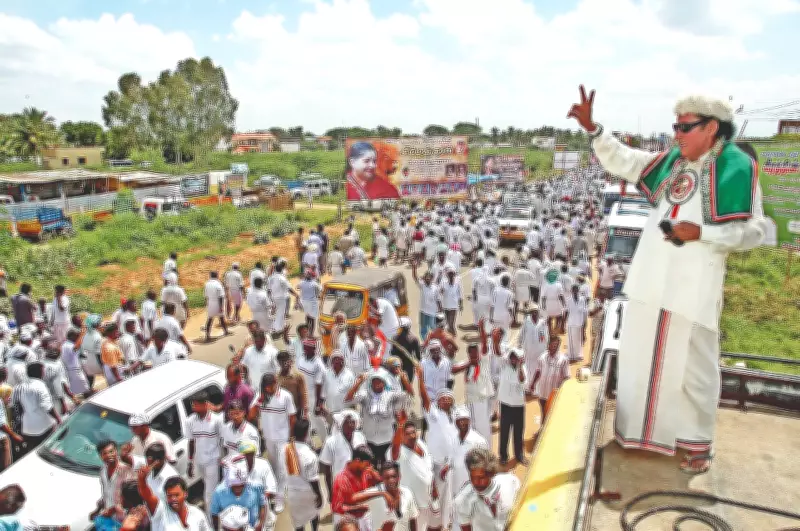
The latest and most visible claimant to MGR's legacy is TVK president and actor Vijay, who has made consistent references to the late leader in his speeches. Vijay draws explicit parallels between his own political journey and MGR's, noting that both faced initial dismissal as political novices. At his rallies, Vijay ensures MGR cut-outs are prominently displayed, reinforcing these connections visually.
Former AIADMK MLA J.C.D. Prabakar, who has joined Vijay's TVK, argues the timing is crucial: "People are desperately looking for an alternative to challenge the two Dravidian majors. After MGR, Vijay commands a strong fan following cutting across age and gender." Prabakar suggests Vijay's longstanding charitable work through his fan club, Vijay Makkal Iyakkam, mirrors MGR's pre-political philanthropy.
Critical Perspectives on the Strategy
However, political analysts and veterans question the effectiveness and authenticity of these comparisons. Political writer Rajan Kurai observes, "Vijay lacks the quality possessed by MGR. His movies don't have a social message or political approach like MGR's did."
Political commentator Suguna Diwakar adds, "The only similarity between Vijay and MGR is that both entered politics at the peak of their cinema careers. The similarity ends there. MGR was able to connect with people across caste, religion, and class, which helped him build a strong following, which Vijay has not managed."
K.C. Palanisamy, one of the youngest legislators under MGR's AIADMK, states bluntly that anyone comparing themselves to MGR will fail because "people will never accept a 'duplicate.'"
Historical Context and Broader Implications
Former minister S. Semmalai, a self-described MGR follower, explains the cultural dimension: "Every MGR fan turned his worshiper after his death. This tradition continues as they consider him like a 'kula theivam' (family deity), leading his legacy to continue to shine forever."
Yet, at a strategic level, what these political actors ultimately seek is to position themselves as the principal alternative to the DMK—the very role MGR originally carved for himself through the AIADMK. They aim to tap three key elements associated with MGR:

- Welfare politics and pro-poor policies
- Mass appeal across demographic divides
- The anti-DMK political space he successfully established
Former minister in MGR's cabinet, S. Thirunavukkarasar, notes, "Invoking MGR is natural for anyone coming from the cinema field. But MGR helped others with his hard-earned money and continued it through schemes when he became the chief minister." Thirunavukkarasar himself founded a party named after MGR in 1991 before merging it with the BJP in 2002.
Precedents and Limitations
Vijay is not the first actor-politician to invoke MGR's legacy. Filmmaker-actor Bhagyaraj made a brief attempt in 1989, while DMDK founder Vijayakant earned the nickname "Karuppu MGR" (Black MGR) through a combination of screen roles and personal charity. Actor Kamal Haasan has called MGR his "vaathiyaar" (teacher), claiming he "grew up on his lap," and named his 2018 election tour 'Naalai Namathe' after an MGR film.
Despite these numerous attempts, political observers emphasize that merely referencing MGR does not automatically generate goodwill or establish a stable vote base. AIADMK organizing secretary D. Jayakumar asserts, "By recalling MGR, new entrants only further his legacy, but the benefits remain intact with AIADMK and its two-leaves symbol."
The competition for MGR's legacy continues unabated, reflecting both the enduring power of his political memory and the current fragmentation of Tamil Nadu's opposition space. As parties navigate this complex terrain, they confront the fundamental challenge that symbolic association alone cannot replicate the deep, organic connection MGR cultivated with the Tamil electorate over decades.