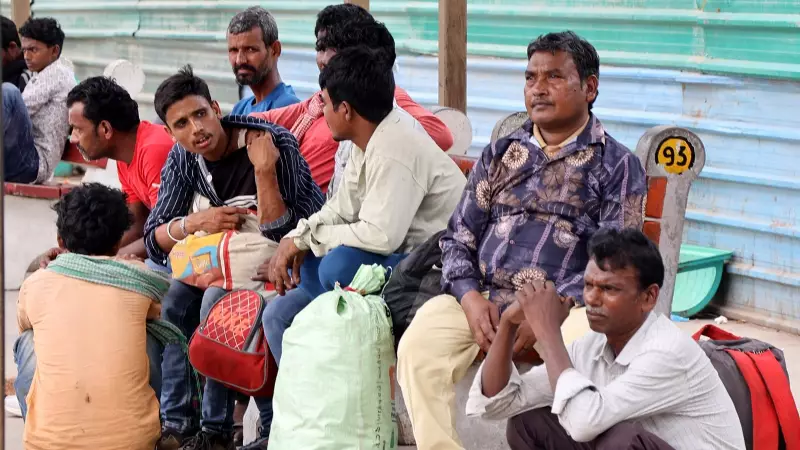
As Mumbai gears up for a highly polarised civic election, a stark contradiction lies at the heart of India's financial capital. While migrants now constitute a majority of the city's population and Hindi speakers have multiplied more than five times over four decades, their political representation in the Brihanmumbai Municipal Corporation (BMC) has consistently declined.
The Shrinking Voice of a Cosmopolitan City
A civic body that once mirrored the diverse, cosmopolitan fabric of Mumbai has steadily transformed. In the mid-1970s, nearly 45 percent of elected corporators were from non-Marathi communities, including Gujaratis, Parsis, Marwaris, South Indians, Muslims, and Christians. This reflected their significant presence in the city's life.
However, by the 2017 BMC elections, this proportion had shrunk to just 33 percent. This consolidation of political power within the Marathi-speaking bloc occurred even as the city's demographic profile diversified dramatically. Census data reveals that the share of individuals identifying Marathi as their mother tongue fell from 41.99 percent in 1971 to 35.40 percent in 2011.
From Non-Marathi Dominance to the Rise of Nativist Politics
In the decades surrounding Independence, the Bombay Municipal Corporation was a stage for the city's varied communities. From the first structured elections in 1968 until that period, 15 out of 21 mayors were non-Marathis. Influential trade guilds, philanthropic trusts, and business networks in areas like Fort, Kalbadevi, and Girgaon propelled Gujarati and Parsi leaders to power.
The political landscape began to shift in the late 1960s with the emergence of the Shiv Sena. The party's focus on Marathi pride and its hyper-local network of shakhas cultivated a loyal vote bank. This marked the start of a transformation where local Marathi leaders gradually replaced entrenched non-Marathi politicians. The subsequent formation of the Maharashtra Navnirman Sena (MNS) further amplified this nativist agenda.
The result was a steady decline in non-Marathi corporators, hitting a low of just 28 percent by 2012, despite a continuous influx of migrants into the city.
Changing Migration Patterns and a New Political Equation
Mumbai's history is a history of migration. In 1921, migrants made up a staggering 84 percent of the population. Initially, they came predominantly from the erstwhile Bombay Presidency—Konkan, western Maharashtra, Gujarat, and Goa—fuelling the city's industrial growth.
The last 40 years, however, saw a pivotal shift. De-industrialisation and the closure of textile mills turned Mumbai into a service industry hub, drawing cheap labour from Uttar Pradesh and Bihar. Research by Ram B Bhagat of the International Institute of Population Sciences shows the share of migrants from Maharashtra fell from 41.6% (1961) to 37.4% (2001), while those from Uttar Pradesh rose from 12% to 24%, and from Bihar from 0.2% to 3.5% in the same period.
The linguistic impact was profound. From 1971 to 2011, Mumbai's population grew 106%, from 0.60 crore to 1.24 crore. While Marathi speakers grew by 76%, Hindi speakers exploded by over 502 percent, from 5.96 lakh to 35.98 lakh.
The BJP's Rise and Migrant Political Assertion
The 2017 BMC elections, fought bitterly by former allies Shiv Sena and BJP, marked a subtle but significant change. The BJP's impressive tally of 82 seats was powered by a sharp consolidation among non-Marathi and migrant voters. This led to 76 non-Marathi candidates winning—the highest number ever—lifting their representation back to 33%.
The BJP's dominance at the national level has allowed it to adopt a more pro-migrant stance in Mumbai, in contrast to the Shiv Sena's traditional rhetoric. The party has actively promoted non-Marathi leaders, providing migrant communities with the political confidence and organisational backing to assert their identity and demand representation as a formidable electoral bloc.
This sets the stage for a complex political battle where demographic reality and political representation remain starkly misaligned, defining the core paradox of modern Mumbai's governance.