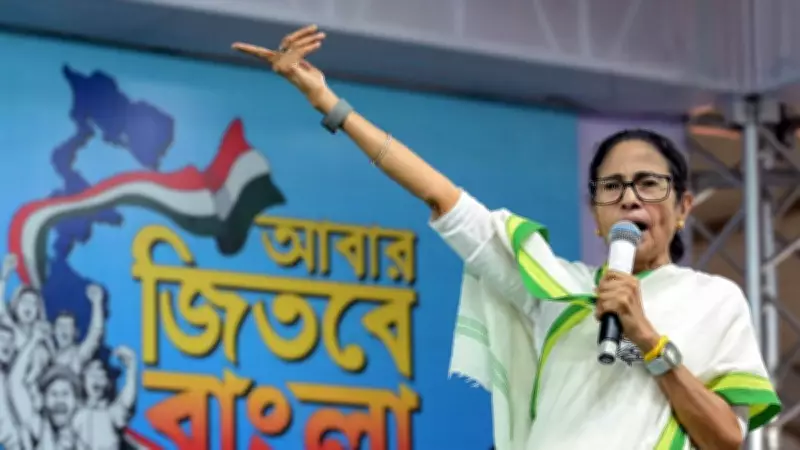
Mamata Banerjee Frames 2026 Bengal Polls as Epic Mahabharat-Style Battle
In a dramatic political statement, West Bengal Chief Minister Mamata Banerjee has drawn a vivid parallel between the upcoming 2026 state assembly elections and the legendary Mahabharat war. Speaking at a recent public rally, she characterized the contest between her Trinamool Congress (TMC) and the Bharatiya Janata Party (BJP) as a monumental clash akin to the ancient epic, with the TMC positioned as the virtuous Pandavas and the BJP cast in the role of the antagonistic Kauravas.
Epic Rhetoric in Political Arena
This metaphorical comparison is not merely a casual remark but a strategic move to energize her party's base and frame the electoral battle in moral and historical terms. By invoking the Mahabharat, a deeply resonant cultural narrative in India, Banerjee aims to portray the TMC as fighting for righteousness and justice, while depicting the BJP as a force of corruption and adversity. The analogy underscores the high stakes of the 2026 polls, which are seen as a critical test for both parties in the politically volatile state of West Bengal.
Context of Intense Rivalry
The backdrop to this rhetoric is a fiercely competitive political landscape. In the 2021 assembly elections, the TMC secured a decisive victory, but the BJP made significant inroads, emerging as the primary opposition. Since then, tensions have escalated, with both sides engaging in frequent verbal sparring and organizational maneuvers. Banerjee's Mahabharat analogy reflects the deepening polarization and the perception of the 2026 contest as a definitive showdown that could shape the state's future trajectory.

Key implications of this framing include:
- Mobilization of Supporters: The epic comparison is designed to galvanize TMC workers and sympathizers by appealing to cultural pride and moral duty.
- Narrative Control: It allows Banerjee to set the terms of the political discourse, emphasizing a battle between good and evil rather than mere policy differences.
- Psychological Warfare: Such language intensifies the political atmosphere, potentially influencing voter perceptions and media coverage in the lead-up to the elections.
Broader Political Ramifications
This development is significant not only for West Bengal but also for national politics, as the state remains a key battleground in India's federal dynamics. The BJP, under Prime Minister Narendra Modi's leadership, has been striving to expand its footprint in eastern India, making West Bengal a focal point of its electoral strategy. Conversely, the TMC views retaining power in the state as crucial for its national ambitions and as a bulwark against the BJP's dominance.
As the 2026 elections approach, such rhetorical flourishes are likely to become more frequent, signaling a no-holds-barred campaign. Observers note that while epic analogies can rally core voters, they also risk further divisiveness in an already polarized environment. The coming months will test whether this Mahabharat narrative resonates with the broader electorate or remains confined to partisan circles.