Maharashtra Chief Minister Vows Uncompromising Action in Astrologer Rape Case
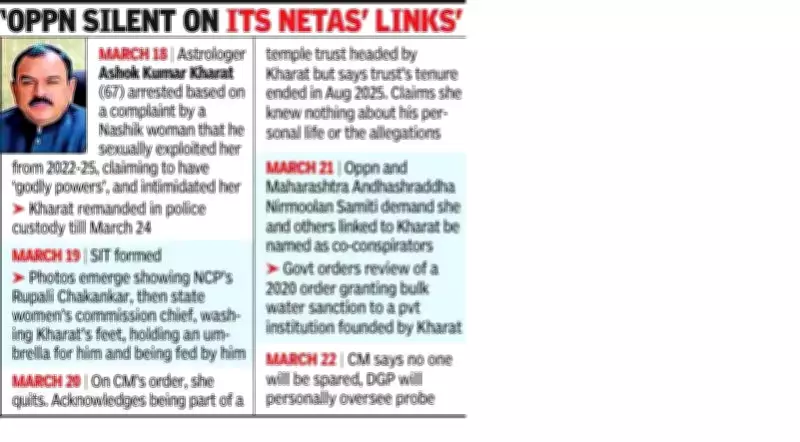
In a firm statement from Nagpur, Maharashtra Chief Minister Devendra Fadnavis declared on Sunday that the Special Investigation Team (SIT) probing the rape allegations against astrologer Ashok Kharat is being closely monitored at the highest levels of the state administration. He emphatically dismissed opposition attempts to inject political color into the case, asserting that no individual will be spared, irrespective of their political affiliations or connections.
Highest-Level Monitoring and Police Oversight
Fadnavis revealed that he has personally directed the Director General of Police (DGP) to oversee the investigation, emphasizing the gravity of the matter as one directly impacting women's dignity. "This is a matter of women's dignity. No one will be spared under any circumstances," the Chief Minister stated, underscoring the administration's zero-tolerance stance.
He further explained that the case was initially exposed by his own government based on specific intelligence inputs, highlighting the proactive role of state authorities. "The Kharat matter is extremely serious. We are the ones who blew the lid off it based on our intelligence," Fadnavis added, noting that the Nashik Commissioner of Police and the SIT are collaborating closely under senior-level supervision.

Encouraging Victims to Come Forward
The Chief Minister acknowledged the societal challenges that often prevent victims from reporting such crimes promptly. "We are aware that women do not come forward immediately due to shame or social pressure. That is why efforts are being made to give courage to victims and their families to come forward," he said.
Fadnavis reported that more women are now stepping forward with complaints, a trend he attributes to the reassuring efforts of investigators who are actively working to build trust and support for the victims and their families.
Political Accountability and Opposition Criticism
Responding to opposition demands for action against those linked to the accused, Fadnavis turned the tables by questioning the silence over previous administrations' actions. He pointedly asked, "If those who merely met him (Kharat) should face action, then those who gave him the 40-km water line through a special Cabinet meeting — what punishment should they get? Why are you silent about that?" This was a clear reference to the erstwhile Maha Vikas Aghadi (MVA) government.
While acknowledging that he possesses evidence of opposition leaders visiting the accused, Fadnavis clarified that it is the police's responsibility to act on such information. "If someone's involvement is established, action will be taken. But we are not interested in politics — we are interested in women's dignity," he reiterated, distancing the investigation from political motives.
Resignation and Political Marches
On the resignation of Maharashtra Women's Commission chairperson Rupali Chakankar, Fadnavis confirmed that she stepped down after recognizing that her close association with the accused made her position untenable. This move underscores the case's sensitivity and the administration's commitment to integrity in the probe.
Regarding the announced march by Congress and Vanchit Bahujan Aghadi (VBA) to the RSS headquarters in Nagpur, Fadnavis stated that the police will make appropriate decisions. "Everyone has the right to march in a democracy, but they should at least know why they are marching," he remarked, hinting at the need for clarity in political protests.
Broader Political Commentary
In a related development, Fadnavis reacted to West Bengal Chief Minister Mamata Banerjee being projected as a Prime Ministerial candidate by her party members. He advised against giving such statements undue importance, attributing them to electoral pressure. "Pressure has built up on her mind as she can foresee electoral loss. And under that pressure, a person sometimes loses judgement," he said.

He took strong exception to Banerjee labeling Prime Minister Narendra Modi as the "biggest infiltrator," suggesting that such remarks stem from a loss of rational thinking. "When someone loses rational thinking and says such things, it should not be given much importance. People know who the infiltrators are and who saves the country," Fadnavis concluded, reinforcing his support for the central leadership.