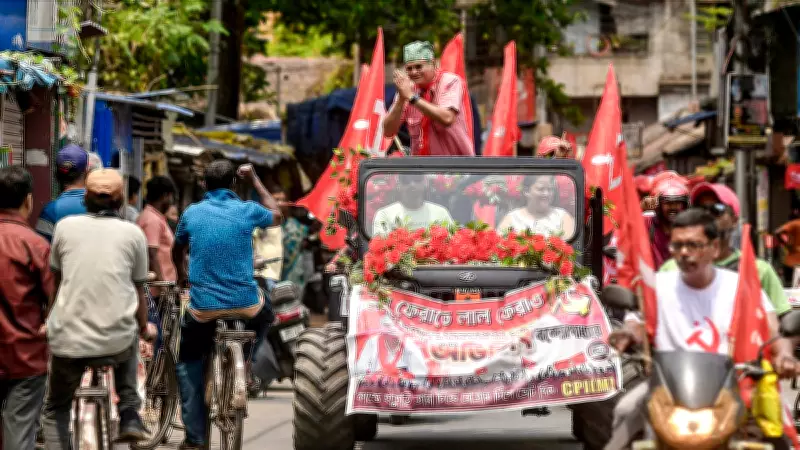
The Communist Party of India (Marxist) in West Bengal finds itself at a crossroads, navigating between welfare politics and the rising tide of majoritarianism. As the state gears up for the 2026 Assembly elections, the left party is striving to reclaim political space in a deeply fractured landscape. However, enduring challenges threaten to undermine its efforts at renewal.
The Current Political Landscape
West Bengal's political scene has been dominated by the Trinamool Congress and the Bharatiya Janata Party, leaving the CPI-M struggling to remain relevant. The party's historical stronghold has eroded, and it now seeks to position itself as a viable alternative. Yet, questions linger about whether its strategies reflect genuine renewal or a repetition of past mistakes.
Welfare Politics vs. Majoritarianism
The CPI-M is attempting to counter the BJP's majoritarian agenda and the TMC's welfare populism by emphasizing secularism and class-based politics. It has focused on issues like unemployment, agrarian distress, and industrial decline. However, critics argue that the party has failed to evolve its message beyond traditional leftist rhetoric.

Old Challenges Persist
Internal factionalism, a shrinking voter base, and the legacy of the 2010s political violence continue to haunt the CPI-M. The party's inability to form alliances with other opposition forces has further isolated it. Without a clear strategy to attract younger voters and urban middle classes, its revival remains uncertain.
Conclusion
The CPI-M's journey in West Bengal is a tale of resilience amid adversity. Whether it can transform into a renewed political force or remains trapped in repetitive cycles will depend on its ability to adapt without losing its core ideology. The 2026 elections will be a crucial test.