RSS Unveils Major Administrative Restructuring Plan
The Rashtriya Swayamsevak Sangh (RSS) has announced a significant restructuring initiative that will transform its administrative framework across India. The organization plans to expand from its current 46 'prants' (provinces) to approximately 86 'sambhags' (divisions), marking a substantial organizational shift aimed at decentralizing operations and enhancing grassroots engagement.
Decentralization and Grassroots Focus
This transition, scheduled for completion by March 2027, represents one of the most comprehensive administrative overhauls in the RSS's history. The move is designed to create smaller, more manageable administrative units that can improve local coordination and expedite decision-making processes.
"The move aims to improve local coordination and expedite decision-making," said Vidarbha prant karyavah Atul Moghe during the announcement in Nagpur. "By creating smaller administrative units, we can better address local needs and strengthen our presence at the grassroots level."

State-Level Expansion Details
The restructuring will significantly alter the organizational landscape across several key states:
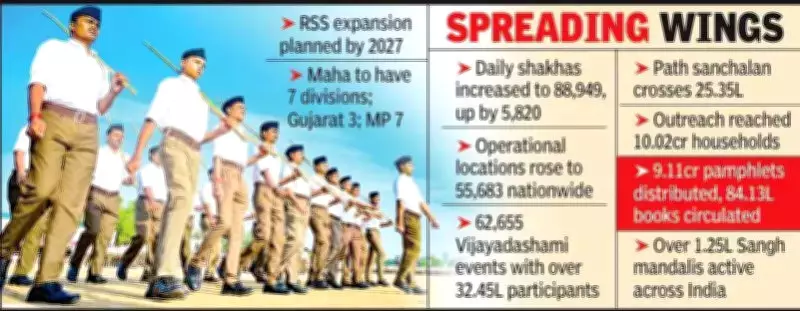
- Maharashtra's administrative structure will expand from four to seven 'sambhags'
- Gujarat will increase from two to three divisions
- Madhya Pradesh will see substantial growth from three to seven administrative units
Speaking alongside Vidarbha prant sanghchalak Deepak Tamshettiwar, Nagpur mahanagar secretary Ravindra Bokare, and publicity in-charge Brajesh Manas, Moghe provided detailed insights into the planned changes.
Organizational Growth and Participation
The restructuring follows a comprehensive review conducted during the recent Akhil Bharatiya Pratinidhi Sabha at Samalkha, Haryana. According to data presented by Moghe, the RSS has demonstrated significant growth in recent activities:
- Daily 'shakhas' increased by 5,820, rising from 83,129 to 88,949
- Operational locations grew from 51,740 to 55,683 across India
- The three-day meeting from March 13-15 recorded 1,438 attendees, reflecting a participation rate of approximately 96%
The annual report presented by general secretary Dattatreya Hosabale reviewed nationwide activities and assessed the current national and global context, providing the foundation for the restructuring decision.
Leadership Vision and Future Plans
RSS leadership, including Mohan Bhagwat, has emphasized extensive nationwide engagements and highlighted plans to expand activities in remote regions over the next five years. The focus remains on improving the quality of organizational work while maintaining large-scale public engagement.
Recent public engagement initiatives have shown impressive participation numbers:
- Vijayadashami programs numbered 62,655 nationwide
- These events drew participation of over 27 lakh youth and 5.26 lakh children
- Total attendance exceeded 32.45 lakh participants
- Path sanchalan events recorded participation exceeding 25.35 lakh
Next Steps and Implementation
The next Akhil Bharatiya Pratinidhi Sabha is expected to be held in Nagpur, where the new administrative framework may be finalized along with further organizational changes. This meeting will serve as a crucial milestone in implementing the restructuring plan as the RSS approaches its centenary year.
The comprehensive restructuring represents a strategic response to organizational growth and changing operational requirements. By creating smaller administrative divisions, the RSS aims to enhance responsiveness, improve coordination at local levels, and strengthen its presence across diverse regions of India.