President Droupadi Murmu Unveils Bust of Chakravarti Rajagopalachari at Rashtrapati Bhavan
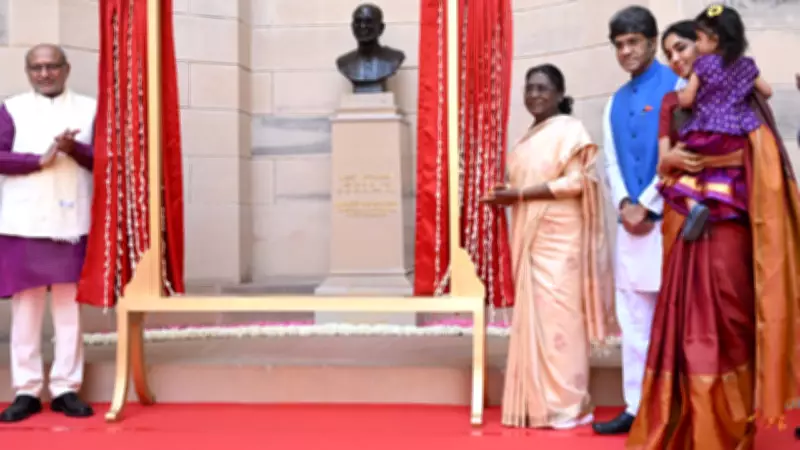
In a significant ceremony on Monday, President Droupadi Murmu unveiled a bust of Chakravarti Rajagopalachari, the first and only Indian Governor General of independent India, at Rashtrapati Bhavan. The installation marks a historic shift, as the bust replaces that of British architect Edwin Lutyens, which had long occupied the Grand Open Staircase near Ashok Mandap.
Prime Minister Modi's Vision of 'Mental Decolonisation'
Prime Minister Narendra Modi, in a message read out by Culture and Tourism Minister Gajendra Singh Shekhawat, described the replacement as an act of 'mental decolonisation'. Earlier, during his monthly Mann Ki Baat broadcast, PM Modi had announced this change, emphasizing Rajagopalachari's enduring legacy. 'His conduct, self-restraint, and independent thinking in public life inspire us even today,' the Prime Minister stated. He lamented that 'unfortunately, even after independence, statues of British administrators were allowed to remain in Rashtrapati Bhavan, but those of the nation's greatest sons were denied space.'
Ceremony Highlights and Distinguished Attendees
The event was graced by a musical rendition of all six stanzas of Vande Mataram, adding a patriotic fervor to the occasion. Among the notable attendees were Vice President CP Radhakrishnan, Union Health and Family Welfare Minister JP Nadda, External Affairs Minister S Jaishankar, Education Minister Dharmendra Pradhan, Minister of State for Information and Broadcasting L Murugan, and members of Rajagopalachari's family. President Murmu, in her address, recalled Rajagopalachari's contributions, including his initiative to begin crop cultivation on a portion of the Rashtrapati Bhavan campus, showcasing his practical and forward-thinking approach.

Life and Legacy of Chakravarti Rajagopalachari
Chakravarti Rajagopalachari, born on December 10, 1878, in the Madras Presidency, was a multifaceted leader. Initially a lawyer, he left his legal practice to join the Indian National Congress, becoming an early associate of Mahatma Gandhi. He actively participated in key movements against British rule, such as the Rowlatt Act agitation, the Non-Cooperation Movement, and the Civil Disobedience Movement. Post-independence, he was elected to the Constituent Assembly from Madras on a Congress ticket and served on the sub-committee on minorities. In recognition of his immense contributions, he was awarded the Bharat Ratna in 1954.
This unveiling not only honors a pivotal figure in Indian history but also symbolizes a broader effort to reclaim and celebrate indigenous narratives in national spaces.