

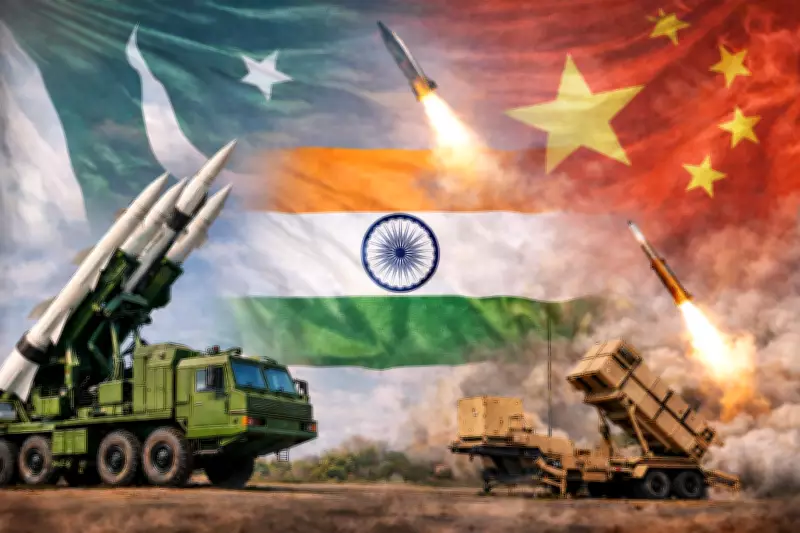
India's Project Kusha: Indigenous Air Defence Shield to Rival Global Systems
India is making significant strides in developing a domestically produced long-range air defence shield under Project Kusha. This ambitious initiative is designed to match the capabilities of renowned systems like Russia's S-400 Triumf and the United States' MIM-104 Patriot. Spearheaded by the Defence Research and Development Organisation (DRDO), the extended-range surface-to-air missile (ER-SAM) system aims to establish a robust three-tier defensive architecture capable of neutralizing aerial threats at distances up to 400 kilometers.
Recent Progress and Strategic Importance
Recent comments from Defence Secretary Rajesh Kumar Singh indicate that initial trials have achieved "some success," signaling that Project Kusha has progressed beyond conceptual stages into an advanced development phase. Although full operational timelines are not yet public, the project is increasingly viewed as a cornerstone of India's drive for strategic autonomy in air and missile defence. In September 2023, the Defence Acquisition Council granted the Acceptance of Necessity (AoN) for procuring five squadrons of the system for the Indian Air Force (IAF), marking a critical step toward eventual induction.
What is Project Kusha?
Project Kusha represents an indigenous long-range surface-to-air missile system engineered to safeguard strategic military assets and vital civilian infrastructure from a diverse array of aerial threats. It is integral to a broader strategy to create a multi-layered air and missile defence network that integrates sensors, command systems, and interceptor missiles across various ranges and domains. The system is being developed by DRDO in collaboration with Bharat Electronics Limited (BEL), which is responsible for radar systems and overall integration. A key feature is its expected integration with the IAF's Integrated Air Command and Control System (IACCS), enabling real-time data fusion from military and civilian radar networks for seamless tracking, threat assessment, and coordinated engagements.

Three-Tier Architecture: M1, M2, and M3 Interceptors
Project Kusha is structured as a layered defence system comprising at least three interceptor variants, each tailored for specific threat envelopes:
- M1 interceptor: With an engagement range of approximately 150 kilometers.
- M2 interceptor: Offering around 250 kilometers of engagement range.
- M3 interceptor: Designed for roughly 350 to 400 kilometers of engagement range.
This layered approach ensures flexibility in response, allowing subsequent layers to engage targets if one is saturated or breached, thereby increasing overall kill probability. The interceptors are capable of countering various threats, including fighter aircraft (including stealth platforms), unmanned aerial vehicles (UAVs) and drones, cruise missiles, precision-guided munitions, and certain classes of ballistic missiles. Defence expos have highlighted interceptor speeds of about Mach 5.5, along with advanced seekers and kill-vehicle technologies to enhance terminal guidance and accuracy.
Radars, Sensors, and Network-Centric Warfare
Modern air defence relies heavily on sensors and integration, and Project Kusha incorporates long-range surveillance radars and fire-control radars capable of tracking multiple targets simultaneously across extensive battlespaces. The system will deploy multiple radar variants and dedicated command-and-control nodes, synthesizing data from ground-based radars, airborne early warning platforms, and potentially space-based assets to generate a comprehensive air picture. This network-centric architecture ensures simultaneous tracking of numerous targets, automated threat prioritization, coordinated engagements across units, and reduced reaction times in high-intensity scenarios.

Reducing Dependence on Imports
Currently, India's most advanced long-range air defence asset is the S-400 Triumf system, procured from Russia under a $5.43 billion deal signed in 2018, with deliveries ongoing. However, reliance on foreign suppliers poses logistical, geopolitical, and financial constraints. Project Kusha aims to mitigate this dependence by offering indigenous manufacturing and lifecycle control, greater deployment flexibility, potential export opportunities to friendly nations, and freedom from sanctions-related vulnerabilities. By developing a domestic alternative, India seeks to secure long-term autonomy in a critical national security domain.
Part of Mission Sudarshan Chakra
Project Kusha is linked to the broader "Mission Sudarshan Chakra" (MSC), an ambitious plan to establish a comprehensive multi-layered air and missile defence shield across India by 2035. MSC envisions protection for both strategic military assets and major civilian centers, drawing conceptual parallels to initiatives like the US "Golden Dome" and Israel's layered air defence architecture. Under this framework, Project Kusha will serve as the long-range backbone, complemented by Quick Reaction Surface-to-Air Missiles (QRSAM), Very Short-Range Air Defence Systems (VSHORADS), laser-based Directed Energy Weapons, and indigenous ballistic missile defence (BMD) systems.
Integration Challenges and Cost Considerations
While many technological components are under development, the primary challenge lies in large-scale integration across India's vast geographical expanse. The defence shield must combine multi-domain intelligence, surveillance, and reconnaissance (ISR), overlapping early-warning and tracking systems, reliable command-and-control infrastructure, hardened communication networks, and interceptor batteries across varying ranges. This expansive architecture will require sustained financial commitment, but proponents argue that long-term cost savings from indigenous production and strategic independence justify the investment.
How Does Kusha Compare with S-400 and Patriot?
Project Kusha is India's endeavor to build a long-range, indigenous air defence system comparable to the Russian S-400 Triumf and the American MIM-104 Patriot. While all three systems are designed to protect critical assets from aircraft and missile threats, they differ in origins, operational philosophies, and maturity levels. The S-400 offers engagement ranges up to 400 kilometers, with Project Kusha's M3 interceptor aiming for a similar 350-400 kilometer envelope. The Patriot focuses more on ballistic missile defence with shorter ranges but high accuracy. A key distinction is that Kusha, being developed domestically, provides greater control over software, integration, and future upgrades, free from geopolitical constraints.
Road Ahead
Initial trial successes indicate that Project Kusha is entering a decisive phase, with phased testing of the M1, M2, and M3 interceptors planned over the coming years. The goal is to complete development before the end of the decade and begin induction around 2030. If timelines are met, Kusha could become the backbone of India's long-range air defence architecture in the 2030s, marking a milestone in self-reliance for high-end strategic defence systems. As aerial threats evolve, including stealth aircraft and hypersonic weapons, the effectiveness of Project Kusha will depend on both missile performance and the robustness of the integrated shield it supports.





