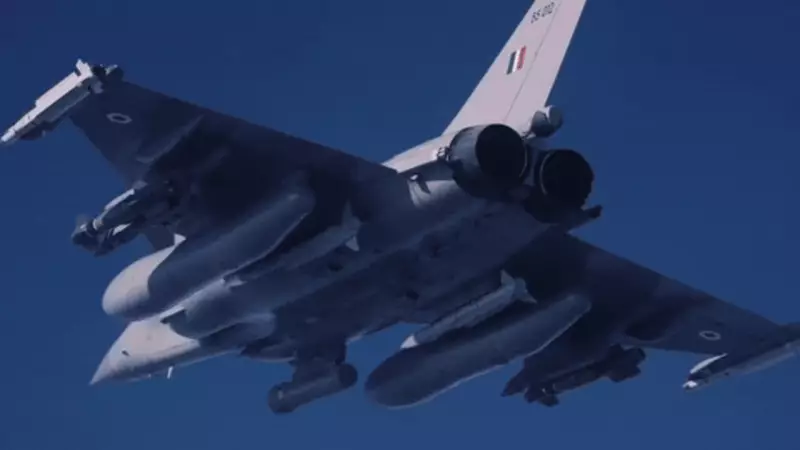
The Indian Air Force strategically unveiled compelling official footage on Republic Day, featuring its frontline fighter jets fully armed with cutting-edge missile systems. This visual confirmation directly addresses persistent questions from Pakistani and Western analysts regarding India's deployment of sophisticated weaponry during critical operations like the 2019 Balakot air strikes and the more recent Operation Sindoor.
Visual Proof of Advanced Arsenal
The powerful video, shared across official social media platforms, prominently displayed Rafale, Sukhoi-30MKI, and indigenously manufactured Tejas fighter aircraft with their hardpoints loaded with both Meteor beyond-visual-range air-to-air missiles and BrahMos supersonic cruise missiles. This footage conclusively demonstrates that these advanced systems were operationally deployed during Operation Sindoor, effectively silencing months of speculation about whether India possessed and utilized the Meteor missile in cross-border engagements.
The Meteor Missile: Air Dominance Redefined
The Meteor represents a quantum leap in aerial combat technology. Developed by European manufacturer MBDA, this next-generation beyond visual range air-to-air missile provides fighter aircraft with decisive superiority in modern warfare scenarios. Engineered to engage enemy targets well beyond pilot visibility, the Meteor can effectively counter highly maneuverable fighter jets, unmanned aerial vehicles, and cruise missiles even in electronically contested environments.

Key capabilities of the Meteor missile include:
- A range exceeding 200 kilometers powered by a solid-fuelled ramjet engine
- Sustained thrust throughout flight maintaining speeds above Mach 4
- An exceptionally large no-escape zone that significantly reduces evasion possibilities
- Sophisticated guidance combining inertial navigation with mid-course updates and active radar seeking
- A fragmentation warhead designed for maximum lethality against aerial targets
BrahMos: India's Supersonic Strike Power
The BrahMos missile, jointly developed by India and Russia, stands as one of the world's fastest operational cruise missiles. This precision strike weapon forms a cornerstone of India's conventional deterrence strategy across land, sea, and air domains. Named after the Brahmaputra and Moskva rivers, BrahMos has been successfully integrated across all three branches of the Indian armed forces.
Distinctive features of the BrahMos system include:
- Supersonic speeds ranging between Mach 2.8 and Mach 3, drastically reducing enemy reaction time
- Multiple launch platforms including mobile land systems, warships, submarines, and fighter aircraft
- Extended operational range exceeding 400 kilometers in latest variants
- High-explosive warhead weighing 200-300 kilograms with precision guidance systems
- Low flight profile and terminal maneuverability making interception extremely challenging
Operational Deployment Confirmed
The Republic Day footage provided irrefutable evidence that India has fully operationalized these advanced systems. The video showed Meteor missiles not only mounted on Rafale jets but also being fired from the indigenous Tejas light combat aircraft. Additionally, Mirage 2000 aircraft were displayed carrying the same class of missiles utilized during the 2019 Balakot strikes, reinforcing the continuity and depth of India's air strike capabilities.
Beyond the Meteor and BrahMos systems, the footage also revealed Sukhoi-30MKI aircraft equipped with Rampage air-to-surface missiles during Operation Sindoor, expanding the spectrum of standoff weapons employed in the operation. This comprehensive display underscores the Indian Air Force's evolving capabilities in conducting precise, time-sensitive air operations with advanced technological systems.
The visual confirmation comes as part of India's 7.87 billion euro defense agreement with France, which included Meteor and Scalp missiles along with India-specific modifications for the Rafale fighter jets. The Republic Day presentation effectively addressed lingering doubts about missile delivery and operational integration, showcasing India's growing self-reliance and technological sophistication in defense systems.