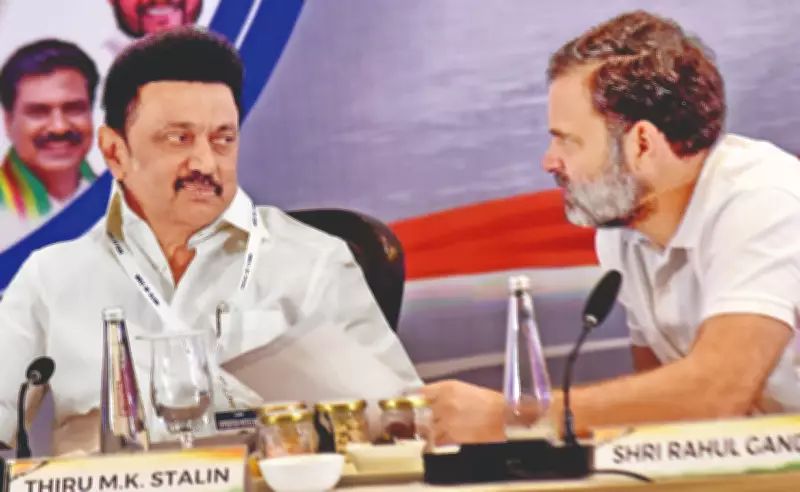
DMK and Congress Finalize Seat-Sharing Agreement in Chennai
At 6:30 PM on Wednesday, applause filled Anna Arivalayam, the DMK headquarters in Chennai, as the DMK and Congress officially signed a crucial seat-sharing deal. The agreement grants Congress 28 Lok Sabha seats and one Rajya Sabha seat, marking a significant milestone in their alliance for the upcoming elections.
Negotiation Dynamics and Strategic Moves
Initially, on Tuesday, the DMK had offered Congress 27 seats plus one Rajya Sabha seat. However, by Wednesday afternoon, following a conversation between Congress president Mallikarjun Kharge and Chief Minister M K Stalin, the offer was increased to 28 + 1. Emerging from Arivalayam at 8:15 PM, Stalin gestured with his right hand and declared, “Over,” signaling the conclusion of intense negotiations.
Seat-sharing is an art that demands shrewdness, deep knowledge of ground realities, negotiation skills, and adept handling of pressure. DMK patriarch M Karunanidhi was renowned for mastering this art, and Stalin appears to be following in his footsteps. However, Stalin faces more complex challenges today, including more demanding allies and a volatile political landscape, especially with new entrants like actor Vijay’s TVK threatening to poach partners.

From Initial Offers to Final Settlement
The DMK’s initial offer to Congress was 25 seats, mirroring the 2021 arrangement, but it was raised by three to 28. Congress, which internally discussed around 41 seats, initially demanded 38 from the DMK but eventually settled for 10 fewer. Congress also had to relinquish its power-sharing demand—at least for now—and quickly address internal threats from factions considering an alliance with TVK.
A senior DMK functionary involved in the negotiations stated, “It is a victory for Stalin – and the alliance.” Stalin succeeded by backing his talks with data, focusing on deliverables and ground realities, which helped convince Congress of the seat numbers.
Legacy and Evolution in Bargaining Tactics
Former TNCC president K S Alagiri notes that when it comes to shrewd bargaining with allies, there is little difference between father and son. “Having been with his father through many negotiations, Stalin functions in a similar manner,” he says. Alagiri recalls that Karunanidhi would lighten the mood with joviality during intense bargaining, while Stalin is sincere and aims to assist alliance partners, offering more seats this time.
Alagiri, who served as TNCC chief during the 2019 Lok Sabha polls and 2021 assembly election, adds, “Stalin manages all allies with cordiality. Both Karunanidhi and Stalin were neither hard nor harsh like J Jayalalithaa.”
Historical Context and Past Challenges
Karunanidhi faced his own challenges, such as during the 2011 seat-bargaining with Congress. Initially offering 60 seats, Congress insisted on three more. The DMK started with an offer of 51 seats, gradually increasing it to 53, 55, and 58, before Congress secured the 63 it demanded. That year, the DMK contested only 119 seats, and the alliance lost to the Jayalalithaa-led AIADMK.
DMK spokesman T K S Elangovan, who worked closely with Karunanidhi, explains that the late leader meticulously studied the political scenario. “Having studied his father's strategy for so many years, now Stalin does the same,” says Elangovan. He highlights that this time, divisions within Congress over power sharing and potential alliances with TVK became public, with Rahul Gandhi not interfering and Sonia Gandhi eventually stepping in.
Elangovan notes, “It was a much bigger problem this time. Stalin said a firm ‘no’ to power sharing. They had never asked for it before. There was never such a situation in the past under Kalaignar. It was always only about numbers.”
Stalin’s Maturation and Criteria for Alliances
Former Congress MP S Thirunavukkarasar observes that Stalin has matured as a politician and is keen to have more allies. He recalls an instance ahead of the 1991 assembly election when Karunanidhi wanted him in the DMK alliance. Thirunavukkarasar, who had quit AIADMK and launched MGR ADMK, asked for 10 seats but Karunanidhi insisted on only nine, with specific conditions regarding candidates.

Stalin employs his father’s criteria to assess ally strength, including factors like stronghold constituencies, past election performances, cadre strength, vote transfer potential, and campaign capabilities. As this reasoning intensified and alternative options appeared less viable, Congress ultimately yielded to Stalin’s persuasive approach, solidifying the alliance for the upcoming electoral battle.