Environment Minister Bhupender Yadav Addresses Key Issues at Idea Exchange Session
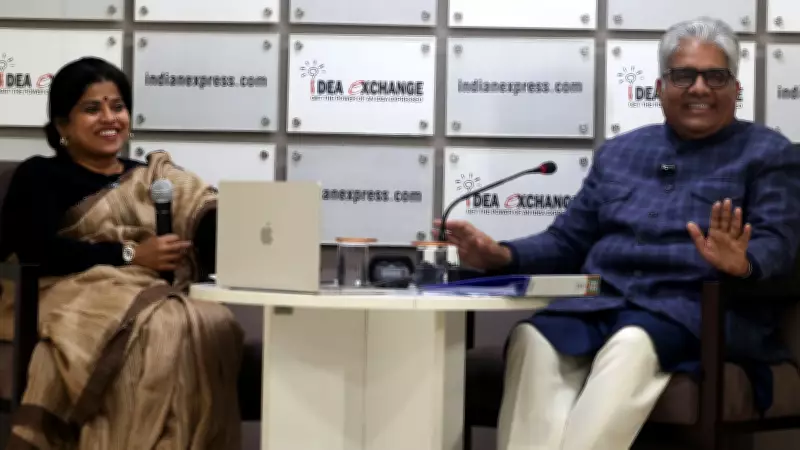
Union Minister for Environment, Forest and Climate Change Bhupender Yadav participated in an extensive conversation at The Indian Express Idea Exchange, moderated by Deputy Editor Liz Mathew. The discussion covered a wide range of critical topics including the upcoming West Bengal elections, environmental conservation efforts in the Aravalli region, the Great Nicobar Island Project, and the persistent challenge of air pollution in Delhi NCR.
West Bengal Elections: BJP's Vision and Challenges
When questioned about the BJP's prospects in the forthcoming West Bengal elections, Minister Yadav expressed strong confidence in his party's chances. "This time, the BJP government is going to be formed in West Bengal," he asserted. He highlighted several areas where he believes the current Trinamool Congress administration has failed the people of Bengal.
"Bengal, at this time, wants to come out of political violence completely," Yadav stated, referencing recent incidents of political violence. He elaborated on multiple governance failures including economic stagnation, women's safety concerns, industrial decline, and educational shortcomings.

The minister pointed to specific statistics to support his claims: "During Mamata Banerjee's tenure, 6,500 industries have officially closed down. Unemployment and migration are very high." He also referenced the recent teacher recruitment scandal that affected over 25,000 positions.
When reminded that similar predictions had been made previously without materializing, Yadav responded that conditions have deteriorated further. "Things have worsened. Governance has become worse, cases of lack of security of women have increased," he maintained, expressing confidence that anti-incumbency sentiment would work in BJP's favor.
Aravalli Conservation and Definition Debate
The conversation turned to environmental matters, beginning with the ongoing debate about the definition of the Aravalli hills. Yadav addressed questions about the Supreme Court's involvement and the recommendations of court-appointed committees.
"If any doubts have arisen regarding the definition of Aravallis, I welcome the formation of a committee," the minister stated clearly. He explained the complex history of the issue, noting that different states have applied varying definitions and criteria for mining permissions in the region.
Yadav emphasized his ministry's conservation efforts: "We launched the Aravalli Green Wall project, under which greening work has been carried out over approximately 2.45 lakh hectares of land in the Aravalli region." He reiterated strict policies against mining in protected areas and near water resources.
The minister defended the government's position by highlighting recent conservation achievements: "For the first time, recently, 100 sq km of revenue land was converted into forest land. For the first time, 10,000 hectares of land was given to NCR for compensatory afforestation."
Great Nicobar Island Project: Balancing Development and Tribal Rights
Regarding the controversial Great Nicobar Island Project, Yadav provided detailed clarifications about the project's scope and its impact on local tribal communities. He addressed concerns about displacement and ecological disturbance directly.
"Regarding Nicobar, for the two local communities there, the Nicobari and the Shompen, their habitation is not being disturbed anywhere because of this project," he asserted. The minister presented specific area calculations to support his position, noting that only about 2% of the total Andaman and Nicobar Islands area would be affected.
Yadav explained the compensation mechanism for tribal reserves: "To compensate for this, an area measuring 76.98 sq km is being re-notified as a tribal reserve. Effectively, there will be a net addition of 3.912 sq km to the tribal reserve area."
When questioned about the strategic defense aspects of the project, the minister connected national security with economic security but declined to provide specific percentages, suggesting that details would emerge at the appropriate time.

Tackling Delhi's Air Pollution Crisis
The discussion moved to the persistent problem of air pollution in Delhi NCR, with Minister Yadav acknowledging the severity of the issue. "I am acknowledging the issue of air pollution emergency with sensitivity," he stated, while outlining both short-term and long-term measures being implemented.
Yadav presented data showing marginal improvements: "In 2022, the number of days with AQI in the severe category was 209. In 2023, this was reduced to 204. In 2024, it again went up to 209. This time, it has come down to 201." While acknowledging that progress has been unsatisfactory, he detailed specific action plans.
The minister identified three major pollution sources and corresponding solutions:
- Vehicular emissions: Phasing out older vehicles and improving public transport infrastructure
- Industrial pollution: Transitioning industrial parks to cleaner fuels and implementing monitoring systems
- Solid waste management: Implementing new rules and addressing legacy waste issues
Yadav revealed his personal involvement in the issue, mentioning recent visits to multiple NCR cities and ongoing coordination with state governments. "Ten days ago, a detailed meeting happened with the Delhi Chief Minister," he noted, emphasizing collaborative efforts.
Broader Environmental and Social Perspectives
The conversation concluded with broader questions about environmental responsibility and social harmony. When asked about minority rights and religious freedom, Yadav emphasized India's pluralistic traditions: "All faiths should have the right to religious freedom. Pluralism is a part of our culture."
Regarding climate change challenges in light of international treaty withdrawals, the minister maintained a global perspective: "The subject of climate change is not created by a single country. It is a global problem and everyone should solve it together." He highlighted India's commitment to being part of the solution while acknowledging the complexities of international negotiations.
Throughout the extensive conversation, Minister Yadav presented his ministry's approach as balanced between developmental needs and environmental conservation, while articulating his party's political vision for West Bengal with characteristic directness.