

The Bhojshala Complex: A Century of Unresolved Religious Conflict in Madhya Pradesh
At the geographical heart of Dhar, an ancient walled city in western Madhya Pradesh that once served as the capital of the medieval Parmar kingdom, stands a structure that no government, court, or community has been able to fully claim—or fully surrender—for over a century. Known simultaneously as Bhojshala, the Maa Vagdevi Mandir, and the Kamal Maula Mosque, this 11th-century complex represents one of India's most persistent and politically charged communal disputes.
A Monument of Contested Identities
On paper, the Bhojshala complex is an Archaeological Survey of India-protected monument, first declared as such in 1909 and designated a Monument of National Importance in 1951. In practice, it serves as a flashpoint where Hindus perform puja every Tuesday and Muslims offer namaz every Friday. The convergence of Basant Panchami with Friday has, on multiple occasions, provoked curfews, police firing, and Supreme Court hearings. A comprehensive 2,189-page scientific survey submitted in July 2024 has intensified rather than settled the debate.
The structure dates to the Parmar period, with most scholars agreeing it was built or substantially modified in the 10th or 11th century CE. For Hindus, it is unequivocally the Saraswati temple founded by Raja Bhoj (c. 1000–1055 AD), the polymath-king whose court at Dhar was a celebrated seat of Sanskrit scholarship. They believe the goddess Vagdevi was enshrined there, the complex served as a great college (the Bhojshala, or Hall of Bhoj), and that successive Muslim rulers from Alauddin Khilji in 1305 to Mahmud Shah Khilji in the 15th century progressively destroyed and converted the temple into what became the Kamal Maula Mosque.

For Muslims, the complex is inseparable from the dargah of the Sufi saint Kamaluddin Chishti, who is believed to have died in Dhar in the 13th century. The mosque that grew up around his tomb has been a place of continuous Friday worship for centuries, forming the bedrock of their historical claim.
The ASI's Administrative Arrangement
The Archaeological Survey of India has attempted to manage both claims through administrative measures. The most consequential intervention came on April 7, 2003, when an ASI order established the arrangement that has governed the site ever since: Hindus may perform puja every Tuesday from sunrise to sunset, while Muslims may offer namaz every Friday between 1 pm and 3 pm. This arrangement pleased neither side when announced and has been contested in the Delhi High Court, the Madhya Pradesh High Court, and the Supreme Court of India. It remains in force today as a fresh legal battle over the site's identity approaches a decisive moment in the Indore bench of the MP High Court.
On March 11, 2024, the Indore Bench of the Madhya Pradesh High Court, comprising Justice SA Dharmadhikari and Devnarayan Mishra, ruled: "The detailed arguments at the Bar by all the contesting parties fortify the court's belief and assumption that the nature and character of the whole monument admittedly maintained by the Central government needs to be demystified and freed from the shackles of confusion."
What Makes Bhojshala Unique Among India's Disputes
Several factors distinguish Bhojshala from other temple-mosque disputes in India:

- Absence of decisive documentation: No medieval or British-era document establishes exclusive religious ownership.
- ASI jurisdictional control: The site falls outside the Places of Worship (Special Provisions) Act, 1991, which froze the character of other disputed sites as of August 15, 1947.
- Electoral flashpoint: The site regularly becomes a political issue in Madhya Pradesh elections.
- Longevity of contest: The modern dispute stretches back to at least 1902, with political dimensions intensifying after the Babri Masjid demolition in 1992.
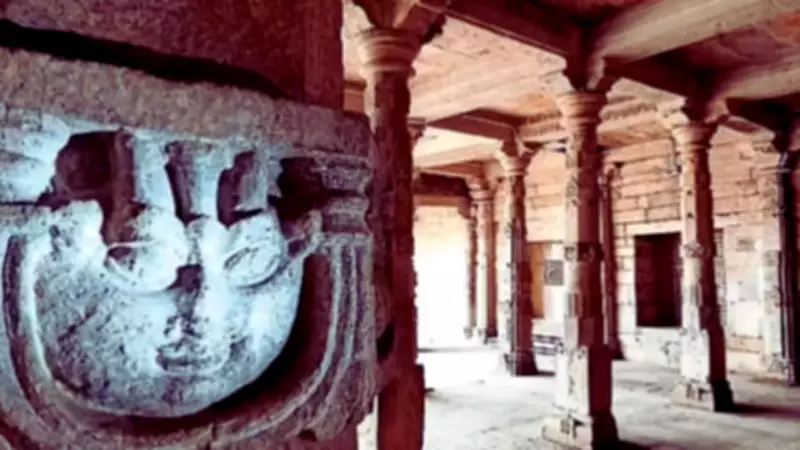
Physically, Bhojshala is a hypostyle mosque—a large prayer hall supported by rows of columns—built primarily from reused temple materials. Carved pillars with images of Hindu deities (many deliberately defaced), Sanskrit inscriptions praising Goddess Saraswati, Parmar-era basalt slabs, and a Havan Kund (fire-pit) are visible alongside the mosque's westward-facing mihrab, Persian inscriptions, and the adjacent dargah of Kamal Maulana. The building does not hide its composite history; it is literally constructed from it.
The Name 'Bhojshala' and Scholarly Disputes
The name 'Bhojshala' itself is a modern coinage, first appearing in a 1902–03 paper by KK Lele, the superintendent of education and head of archaeology for the princely state of Dhar, who was preparing the site for a visit by Viceroy Lord Curzon. German epigraphist Eugen Hultzsch published Lele's findings in Epigraphia Indica (1905–06), and the term gradually entered popular use, even though the colonial Gazetteer of 1908 flagged 'Raja Bhoj's school' as a 'misnomer.'
Notably, both John Malcolm in 1822 and William Kincaid in 1888—prolific recorders of Malwa's ruins—made no mention of any Bhojshala or Hindu tradition attached to the structure. Kincaid referred only to the 'Well of Wisdom' near the tomb of Kamal al-Din. Scholar Michael Willis, writing in the Journal of the Royal Asiatic Society in 2012, interpreted this silence as evidence that no living Hindu tradition around the name existed in the mid-19th century.
The famous Saraswati idol—which Hindu petitioners have long described as the consecrated image installed by Raja Bhoj, now held in the British Museum—is itself the subject of scholarly dispute. KK Lele's own 1943 records indicated the sculpture was found in debris at the old city palace in 1875, not at Bhojshala. Willis wrote that it is not even located in the British Museum, and its "current location remains an interesting mystery."
Two Claims, One Complex: The Competing Positions
The Hindu Position: Advanced by organizations including the Hindu Front for Justice, the Hindu Jagran Manch, the Vishwa Hindu Parishad, and the Hindu Mahasabha, this position rests on three pillars: the archaeological evidence of a prior temple (Sanskrit inscriptions, sculpted pillars, the Havan Kund); the textual record of Raja Bhoj's scholarship and his patronage of a Saraswati shrine at Dhar; and the 2024 ASI survey's finding that "the existing structure was made from the parts of earlier temples." Their demand is full Hindu control and the end of Friday namaz at the site.
Ashish Goyal, State Vice President of the Hindu Front for Justice and petitioner in the Bhojshala case, maintains: "Where in the world have you seen a mandir where people are allowed to offer namaz or a mosque where Hindus are allowed to do puja?"
The Muslim Position: Advanced by the Maulana Kamaluddin Welfare Society, this position rests on the continuous practice of Friday namaz at the site for several centuries; the 1935 ruling by the Diwan of Dhar State formally declaring the complex a mosque; the 1985 notification of the site as Waqf property; and the argument that the 2024 ASI survey was compromised—that objects were "placed through the backdoor after 2003" and that the survey team ignored Muslim objections. The Welfare Society has challenged the survey in the Supreme Court and announced it will file detailed objections before the Indore Bench.
Abdul Samad of the Maulana Kamaluddin Welfare Society told TOI: "We will submit to the high court our objections to the ASI report. The ASI ignored our earlier objections and considered objects placed through the backdoor."
A Century of Contest: Key Historical Milestones
The Bhojshala dispute has evolved through several distinct phases:
- Medieval Origins (10th–15th centuries): The Parmar period saw the construction of what Hindus claim as the Saraswati temple. Muslim associations began with Kamaluddin Chishti's arrival in the 13th century, followed by conversions and constructions under Alauddin Khilji (1305) and Mahmud Shah Khilji (1456–57).
- Colonial Documentation (1822–1909): British administrators like John Malcolm and William Kincaid made no mention of Bhojshala, while KK Lele's 1902–03 discoveries launched the modern controversy. The princely state of Dhar declared it a protected monument in 1909.
- Princely State Rulings (1924–1944): The 1935 proclamation by the Diwan of Dhar State declared the complex a mosque, while the first formal Urs at the dargah occurred in 1944.
- Post-Independence Period (1947–1991): The ASI took over in 1951, declaring it a Monument of National Importance. Tensions emerged over worship rights, with the site notified as Waqf property in 1985.
- Post-Babri Mobilization (1992–2003): Following the Babri Masjid demolition, demands for Hindu control intensified. The 2003 Basant Panchami clash resulted in police firing, deaths, and the landmark ASI order establishing the Tuesday–Friday arrangement.
- BJP Governments and Recurring Standoffs (2003–2022): Despite campaigning on Bhojshala liberation, successive BJP governments maintained the ASI arrangement, using force against Hindu protesters during Basant Panchami–Friday coincidences in 2006, 2013, and 2016.
- Recent Legal Battle and ASI Survey (2022–2024): The Hindu Front for Justice filed PILs in 2022–23, leading to the High Court ordering a scientific survey in March 2024. The ASI submitted a 2,189-page report in July 2024, finding the structure was built from temple parts.
The Politics Behind the Dispute
Bhojshala has functioned as a reliable barometer of Madhya Pradesh's communal temperature since the early 1990s. The BJP under Uma Bharti made the "liberation of Bhojshala" a plank in its 2003 campaign, which ended the Congress's ten-year rule. Yet once in power, successive BJP governments maintained the same ASI arrangement they had condemned from the opposition and used similar force against Hindu protesters.
Congress leader and Rajya Sabha MP Digvijaya Singh told reporters in January: "It is the responsibility of the government and the administration to ensure full compliance with the orders passed by the ASI—and to make every effort to maintain peace and harmony in Dhar."
Unlike the Ayodhya Ram Mandir site or the Gyanvapi mosque in Varanasi, which are governed by the Places of Worship (Special Provisions) Act 1991, the Bhojshala complex was declared a Monument of National Importance in 1951—after the Act's reference date. This places it in a legal grey zone that the Indore Bench's 2024 survey order has actively exploited.
Where the Controversy Stands Today
The Bhojshala dispute now turns on how the Indore Bench of the Madhya Pradesh High Court interprets the 2,189-page ASI report filed in July 2024—and what, if anything, it directs be done about a monument that is officially a protected archaeological site, simultaneously claimed as a temple and a mosque. The ASI's finding—that the existing structure was built from the parts of earlier temples—is broadly accepted by scholars as corroborating the use of Parmar-era temple material. However, it does not resolve the legal question of what kind of worship may occur there and under whose authority.
Former ASI official KK Muhammad, while affirming the site's origins as a Saraswati temple, emphasized that both communities must work within the law and resist actions that could "create problems for all."
For the people of Dhar—the Hindu devotees who queue at the gate every Tuesday, the Muslim families who have served the dargah for generations—the Bhojshala remains above all a neighborhood, a place of worship, and a wound that has never been allowed to heal. The next hearing on March 16, 2026, will reveal how much longer they must wait for resolution.
As Ashish Goyal of the Hindu Front for Justice stated: "Our main plea is for determining the religious nature of the complex. The ASI report supports our contention that Bhojshala is a Parmar-period monument and a new structure was built after damaging it."
Meanwhile, Abdul Samad of the Maulana Kamaluddin Welfare Society reiterated: "We will submit to the high court our objections to the ASI report. The ASI ignored our earlier objections and considered objects placed through the backdoor."
The Indore Bench's upcoming decision will determine whether this century-old conflict moves toward closure or enters yet another chapter of legal and political contention.





